Sunday, June 07, 2020

Cathy Park Hong - Minor Feelings

... 'minor feelings' being, as glossed by Hong in this remarkable collection of linked essays:
the racialized range of emotions that are negative, dysphoric, and therefore untelegenic, built from the sediments of everyday racial experience and the irritant of having one's perception of reality constantly questioned or dismissed. ... minor feelings of paranoia, shame, irritation, and melancholy.
... these emotions do not conform to the archetypal narrative that highlights survival and self-determination. Unlike the organizing principles of a blidungsroman, minor feelings are not generated from major change but from lack of change, in particular, structural racial and economic change. ... the literature of minor feelings explores the trauma of a racist capitalist system that keeps the individual in place. It's playing tennis "while black" and dining out "while black". It's hearing the same verdict when testimony after testimony has been given.
... minor feelings are "non-cathartic states of emotion" with "a remarkable capacity for duration."  ... Minor feelings occur when American optimism is enforced upon you, which contradicts your own racialized reality, thereby creating a static of cognitive dissonance. ...
Minor feelings are also the emotions we are accused of having when we decide to be difficult - in other words, when we decide to be honest. When minor feelings are finally externalized, they are interpreted as hostile, ungrateful, jealous, depressing, and belligerent, affects ascribed to racialized behavior that whites consider out of line. Our feelings are overreactions because our lived experiences of structural inequity are not commensurate with their deluded reality. 
There's so much to Minor Feelings, dealt with so deftly and with such focused anger and insight. For me, it's most impressive at four inter-related levels: 
  1. In the way it brings together the underlying issues surrounding race (political, economic, social, historical, cultural), what it is to 'be' Asian American, and the specificity of Hong's own experience; 
  2. Relatedly, in its interrogation of the idea of 'we' that underpins any writing about race - "I feared the weight of my experiences - as East Asian [Korean], professional class, cis female, atheist, contrarian - tipped the scales of a racial group that remains so nonspecific that I wondered if there was any shared language between us";
  3. In the incisiveness and clarity of its analysis - particularly the impossibility of separating any of what she writes about from the operations of capitalism and imperialism - and its mode of presentation, which has the force and directness of the best polemic and a nuance and acknowledgement of complexity that the form often sacrifices in pursuit of its advocacy aims; and
  4. In its structure - multi-faceted in a way that feels like not only the most ethically sound way to approach such a multi-faceted topic and the challenges of writing with and about the experiences of others, but also the most effective at the level of both craft and argumentation.
In a way, Hong's method is hermeneutic, taking a series of historical and personal events as texts to be interpreted and illuminated - so we get the 1992 LA riots, Richard Pryor, seminal writer and artist Theresa Hak Kyung Cha (and her rape and murder in 1982), Yuri Kochiyama and her life in activism before and after the photo of her cradling Malcolm X's head after he was shot dead in 1965, and more, each elaborated in its wider significance and entwined with Hong's own life experiences.

(from a piece of Cha's, but the image is of her sister not herself - something that Hong unspools in her own portrait of the artist)


But actually my favourite individual section - the essays themselves are so well-connected thematically that it makes more sense to think in terms of sections than in terms of the nominal essay delineations - is the extended one about Hong's college friendships with two other Asian American women, both artists.

I heard about this book through Jia Tolentino's typically spot-on review of it.

Friday, June 05, 2020

Killing Eve seasons 2 & 3

Season 1 passed me by, but seasons 2 and 3 are delightful - funny, unconventional, sharp on gender, strongly characterised, and poised nicely on the verge of complete psychological implausibility without quite tipping over. The thing with Villanelle is that while she's not a sympathetic character, often the show brings the viewer to something like empathy by situating us within her perspective, abetted by the performative - theatrical - way she often telegraphs her responses to situations.

Ben H Winters - The Last Policeman

Diligent detective investigates what he suspects isn't the straightforward suicide that it looks, in the looming shadow of a giant asteroid that will collide with Earth in mere months - in an existential pre-apocalyptic semi-hardboiled procedural. Quite good, but in a way that sent me to wikipedia to read the plot summaries of the following two books in the trilogy rather than sending off for the books themselves.

Wednesday, June 03, 2020

The Lockdown Monologues: Part One (Malthouse)

A great initiative - three live-streamed mini monologues of about 7 or 8 minutes each, performed by the actors in their own homes, all on the theme of the current lockdown. 'The Clown' by Tom Holloway and performed by Daniel Schlusser, 'Ping' by Jean Tong and performed by Sophie Ross (my favourite, maybe because it was the most relatable, albeit fairly distantly at this point), 'Cocooning' by Jane Harrison and performed by Harry Tseng.

Monday, June 01, 2020

Kiki's Delivery Service

I tend to like the grander Miyazakis more - in terms of breadth of imagination and visual spectacle - but Kiki's Delivery Service, while very much down the more modest end of things, is pretty impossible to fault in its all round loveliness and twining of narrative and theme. So winning.

Jack River - Sugar Mountain

This is a strong album, with some particularly good moments ("Fool's Gold" and "Constellation Ball" are the best for mine), but it's a hard genre - broadly, dramatic alternativeish but essentially mainstream pop - to really stand out in; I often feel while listening to Sugar Mountain that Sia already did this, and overall a bit better. But maybe that's unfair - there's much to like here on its own merits.

Saturday, May 30, 2020

Jason Isbell and the 400 Unit - Reunions

By any normal standards, Reunions is outstanding; in the context of Isbell's recent discography it's merely very good, a sustaining of the high standard he's set in that run since Southeastern. Whether on crisply written, richly layered and thrumming singer-songwriter fare like first three songs "What've I Done to Help", "Dreamsicle" and "Only Children", guitar-to-the-forefront rock songs like "Overseas" and "Be Afraid" (which bring to mind both the War on Drugs and Isbell's old band the Drive-By Truckers) or mellower moments like "River" and "Letting You Go", it all resonates; for modern Americana it doesn't get much better than this.

Friday, May 29, 2020

Stephen King - 'Salem's Lot

I've had a fondness for Stephen King going way back - a testament to the power of story-telling, I think, as horror has never particularly appealed to me as a genre (although I don't mind occasionally dipping into it). 'Salem's Lot was his second novel, vampires in small town Maine. While I got through it quickly, some of the elements that make King great weren't as fully developed at this stage of his career as they would be later - in particular, the way things would go is very telegraphed, taking some of the tension and sting out of the story, and the sense of creeping dread that he'd later master is also a bit nascent (although apparent). On the other hand, his ability to draw a large cast of engaging characters is already apparent to a large extent, as are the story-telling instincts.

Sunday, May 24, 2020

Georgia O'Keeffe (ed. Tanya Barson, Tate Publishing)

This book was pitched pretty much exactly at the level I would've wanted for an exploration of Georgia O'Keeffe, one of my very favourite artists: many large colour reproductions spanning all important parts of her body of work, six mid-length essays going into aspects of her work (including its reception and the context in which it was made) in just the right amount of depth, and some shorter interpolated pieces and extracts mostly from contemporary reviews of O'Keeffe's work. Most of the works I've encountered before, and a lot of them in person, but all are always welcome, and some were new as well.

Black, White and Blue, 1930

The two strongest through-lines are her relationship to abstraction - as traced, for example, through the development of her 'black place' series, a striking stretch of hills some distance northwest of Ghost Ranch - and the role of gender in how her work has been received and interpreted over time, including the role that Alfred Stieglitz played in creating and disseminating a heavily feminised reading and how that fit with Modernist art currents in America at the time.

Black Place III, 1944

There are some illuminating perspectives on abstraction in particular, and how this relates to the sense of infinity in O'Keeffe's work. In relation to the 'patio' series (the door of her patio in Abiquiu that she painted over and over), for example, and Barnett Newman: "Newman developed a heightened sense of the 'sublime' or - more applicable to O'Keeffe - the 'infinite'. This he achieved not by perpetuating traditional 'sublime' subjects, but by making the moment of aesthetic perception of his expansive, 'present' canvases an overwhelming emotional sensation ... O'Keeffe transformed the patio wall motif into an intangible, metaphysical vision".

White Patio with Red Door, 1960

I also found the discussion about how O'Keeffe was influenced by photography interesting and persuasive - the pathways it opened to abstraction, including the techniques of close ups and unusual perspectives, and the emphasis on negative space. (And again, in that case, in interplay with Stieglitz.)

Deer's Skull with Pedernal, 1936

"It is the abstracting - as with the flowers, the bones, the simplicity - that should be the example, the abstract continuity of unseen patterns and clues, culled in perhaps unrecognizable form at first, but revealing when examined, a simple clarity, wholeness" - Christine Taylor Patten

Pelvis Series, Red with Yellow, 1945

Maria Gainza - Optic Nerve

With many books I've liked, there's a moment, often early on, that makes me certain I'm going to like it a lot - a passage, scene or image that arrives with a sense of opening up, both in its own right and as an indication of the kind of depths the book contains. (That's true of tv series too - e.g. - which suggests an interesting parallel given that's the only other form to which this applies.)

Alfred de Dreux - "Deer Hunt" (unknown date; 19th century)

Optic Nerve I enjoyed from the get-go, and I could tell that its layered, oblique disclosures and inter-connections had plenty going on, but that moment arrived just shy of halfway through, in the chapterlette (neither 'chapter' nor 'story' feels quite right for the shortish sections in which the book's organised) about Gustave Courbet, his "The Stormy Sea", the narrator's periodic visits to an old stone house in the coastal city of Mar Del Plata, and the narrator's older cousin who walks the house's hallways at night. It's a section that could have come from A Field Guide to Getting Lost, even before its last paragraph: "My cousin was also called Maria. And only recently has it come to me that our name has the sea in it - mar - embedded like a lure, like a foretelling."

(1869)

The way those four main elements are woven together through just 13 widely spaced pages reflects the approach of Optic Nerve as a whole - the life of an artist and a particular work (often one held in the Museo Nacional de Bellas Artes in Buenos Aires) in conversation with an aspect of the narrator's own life and her experience of the world, which is 'in character' given how important a role art plays in her life. The book is full of moments of recognition in the face of art, only once (I think) made fully explicit, when her eye is caught by a painting that recalls her own 11 year old self. As she says early on, you write one thing in order to talk about something else.

Augusto Schiavoni, "The girl sitting" (1929)

There's some great writing about art here - about individual pieces, and about the powerful subjective experience of encountering art. How's this, for example: "But when Rothko felt anxious, he became talkative - overly so. And this in turn led him to overlook the fact that often the most powerful aspect of any work of art is its silence, and that - as they say - style is a medium in itself, its own means of emphasis. Perhaps there is something spiritual in the experience of looking at a Rothko, but it's the kind of spiritual that resists description: like seeing a glacier, or crossing a desert. Rarely do the inadequacies of language become so patently obvious." In the Rothko 'chapter' (or what have you), the narrator visits a doctor's surgery after "several days' of a constant vibration in my right eye", sees a Rothko poster, and slips abruptly in its final section via "My husband fell ill twice" into a densely reverberant passage wrapping in life, death, eros, class, humanity (via her encounter with a prostitute who walks the wards at night), the spiritual, red, and black.

(1955-57)

Also great is the closing bit on El Greco, a painter who's come into my life in a couple of ways lately. As she says, his "View of Toledo" is "easily expressionistic enough to belong to the twentieth century". Looking at it now, it's genuinely amazing to think it was painted somewhere at the end of sixteenth century instead. And her description of his "Christ in the Olive Grove" is even more descriptively intriguing, as well as revealing a great deal about the narrator herself, in the context in which it appears (at its most surface level - in a museum during a visit to her estranged brother who has chosen to remain outside): "A piece I have a weakness for. Not its theme - in fact I have little idea what the scene is supposed to signify - but rather the way in which everything in it seems suspended in the air. In it, gravity functions in reverse: something draw the figures skywards, sucking them in the direction of the clouds, like the lava lamps of my adolescence. The correct way to look at it, I thought, would be while doing a handstand; forget about the figuration and simply appreciate the scandalous sensuality of the brushstrokes strewing the oils this way and that across the canvas. Aldous Huxley must have been thinking similarly when he claimed that El Greco was such a visceral painter that, had he lived to see ninety, he would have ended up producing abstracts. Such were my thoughts as I looked up at the sky in the painting. A portentous sky, the kind beneath which only terrible or solemn events may occur, like a family member leaving home, or the erection of a cross."

(1596-1600)

(1600-1607)

The writing about art is pleasurable in itself, but much more so is the effect of its interweaving with character and theme. When I started Optic Nerve, the first reference point that came to mind was Rachel Cusk, in the way much of the external action occurs through the narrators' interactions with others and what we learn about those others, combined by razor sharp observations of those same other people. But we learn far more about the narrator here - Maria - than we ever do about the Outline trilogy's Faye, and while the reader needs to work to put the pieces together, the picture of a character and a life, situated in her particular familial, social and historical context, emerges clearly, both through the mediation of (her thoughts on) art and otherwise. And the rewards from the light it sheds on what it is to live - today, and earlier - are greater still.

(Discovered via its deep run in this year's Tournament of Books)

Three playlists

Just like last year, Rob, David and Julian all shared playlists in earlyish 2020. Mainly because I don't really listen to spotify, it's taken me this long to listen to them.

On Rob's - my favourites are Slotface's "Telepathetic" (I see they are 'punks' from Norway), K.Flay's "This Baby Don't Cry", the Jack River songs, and Alex the Astronaut's "I Like To Dance" (even though / including because that last one sounds super First Aid Kit).

On David's - Phantom Planet's "BALISONG" (good to hear they can still knock out a rousing rock anthem, and that someone can) and "Mercy Mercy Me" (Eddie Vedder, the Strokes and Josh Homme) plus of course "Seventeen" (SVE) and "The Barrel" (Aldous Harding; I've eventually been won over by it after repeated exposure).

On Julian's - amidst a predictably more esoteric mix moving across prog, jazz, folk, electro-industrial and power pop, particularly beguiling are Prefab Sprout's 22 minute "I Trawl The Megahertz" and Cechomor's "Bosilecky zvony" (according to the internet, they're a Czech band who play traditional songs in rock formats).

Saturday, May 23, 2020

The Strokes - The New Abnormal

Well, this is easy to listen to although not very remarkable. I don't think I've listened to the Strokes really since First Impressions of Earth came out, except maybe the occasional revisit of a song or few from that memorable first album, and I was never ultra excited about them in the first place, but, yeah, fond memories.

Friday, May 22, 2020

Moneyball

Yale, economics, baseball. Also Brad Pitt and the bonuses of Chris Pratt and Philip Seymour Hoffman.

(previously)

Wednesday, May 20, 2020

Phoebe Bridgers - Stranger in the Alps

Previously known to me as the least interesting - or so I thought - member of boygenius and the female half of Better Oblivion Community Center, Bridgers finally came on to my radar proper when Penelope recommended "Scott Street", which is an epic slow-build of the melancholy kind, in the best way.

That one's the highlight of Stranger in the Alps but there are a lot of other good songs here, Bridger's reedy voice and the at times gossamer instrumentation and production belying the songs' frequent forcefulness and the ground they cover under the cloak of that overall wistful-sounding air; "Smoke Signals", "Motion Sickness", "Funeral" and "Georgia" are the most distinct.

Sunday, May 17, 2020

Bob Dylan - Love and Theft

From 2001; best songs "Mississippi", "Po' Boy" and "Cry a While" (all very relaxed); good all round.

Hayley Williams - Petals for Armor

Crisp, heartfelt pop that sounds equal parts of the now and the nineties (those two currently being blurred to begin with) from the former Paramore singer. 

300: Rise of an Empire

Absurd, gratuitous, entertaining - especially thanks to Eva Green.

Saturday, May 09, 2020

William Eggleston: Portraits (Phillip Prodger)

Normally I like photographers whose work is highly composed, often to the point of evident artifice upon closer inspection - Crewdson, Gursky, some Jeff Wall, Cindy Sherman. William Eggleston is an exception, his photos presenting as slices of everyday life, but - as the introductory essay and closing interview with Eggleston in this book more clear - that doesn't mean he was about seeking to represent the world in a straightforward or documentary way. Rather than seeking to capture some defined or self-contained sense of his subjects or the world they inhabit -
It has often been said that Eggleston is at war with the obvious. But the obvious is one area in which the camera excels. Duchamp demonstrated how a thing can be thought of as something other than what it appears to be. Eggleston took this a step further, by showing that the camera, with its unparalleled capacity to record information in exacting detail, does not have to be used for representational purposes, nor do photographs have to be taken at face value. Some early critics expressed frustration that Eggleston's photography reveals little of consequence about Memphis and its environs. But this was precisely the point. Eggleston has never aspired to create social documents or conduct visual surveys. Like Duchamp, his pictures present the banal and the everyday; but unlike Duchamp, they are usually transitory and frequently unsettled, like momentary realisations, or flashes of memory.
This book accompanies the British National Portrait Gallery exhibition which came to the NGV in 2017, and I remember many of the photos clearly, especially their vivid colours, as well as the tension between their focus on people - many of them family members and other intimates of the photographer's - and Eggleston's insistence that his photos of people did not express any particular psychological or formal relationship (such as of empathy or expression of worldview) between their human subjects and himself.


Wednesday, May 06, 2020

Frankenstein (National Theatre live)

With Benedict Cumberbatch as the creature and Jonny Lee Miller as Frankenstein. This was good but I wasn't fully immersed; I think maybe the nature of the play/production didn't lend itself to being filmed as much as some of the others I've seen. 

The Little Drummer Girl

Quite good spy series but maybe less than the sum of its parts given that those parts included Park Chan-Wook, Florence Pugh (relatively new to me but clearly excellent) and Michael Shannon.

Friday, May 01, 2020

Mama Kin Spender - Golden Magnetic

Good natured blues-roots.

Laura Marling - Song for Our Daughter

Another great record from Marling. This one's more acoustic than 2017's exceptional Semper Femina - after the assertive start of "Alexandra", "Held Down" and "Strong Girl' (the first two of those are among her best ever), it turns and stays quiet, requiring attentive listening to find its many rewards.

The Traveling Wilburys - Traveling Wilburys Vol 1

A low key good time. The best bits are (a) "Handle With Care" (of course) and (b) all the bits with Roy Orbison.

Hans Rosling - Factfulness

The subtitle tells you what this book is about: 'Ten Reasons We're Wrong About the World - and Why Things Are Better Than You Think'.

Its initial quiz makes its point effectively - most people are systematically and significantly wrong in their understanding of the overall state of the world as measured by facts like the percentage of girls finishing primary school in low-income countries, the trend in numbers of people living in extreme poverty, global life expectancy, and infant vaccination rates. I got 5 out of the 12 questions right - excluding the global warming one. Each question had three options, meaning I barely beat what Rosling calls the chimpanzees, ie what would be expected if someone randomly guessed the answers; Rosling's point is that most people, including (and maybe especially) those who are highly educated actually do worse than the chimpanzees due to those systematic biases.

There's plenty in Factfulness that I agree with - for clear and critical thinking, the list of 'dramatic' instincts which organise the book (the gap instinct, the fear instinct, the destiny instinct, the blame instinct, etc) are useful, in many cases combining cognitive biases of the kind laid out by Kahneman, Ariely et al with reminders about the way statistics can mislead if not used properly. And there's no arguing with Rosling's central call for us to know and understand the facts about our world, including being aware of the ways in which we're making progress.

I have one disagreement with the book's premises, and it's a big one. I think the book assumes that facts about things like educational attainment, immunisation rates, etc are an accurate indicator of global wellbeing, ie if those data points are going in the right direction, then the world is getting better. And of course these kinds of statistics are an important part of the story here.

But his argument doesn't reckon with two important and related things: the fact (of a different kind) that the price of these improvements has been immense consumption of natural resources since industrialisation and, at the same time, catastrophic climate change, and the (more contestable but I think true) point that the post-industrial scientific and technological boom has probably made the world a net more unequal place, with the gains from scientific progress unequally shared and especially once you factor in the disproportionate costs of climate change being borne by basically the whole world that doesn't fall within Rosling’s very wealthy 'level 4' group of countries.

Put those things together, and especially the point about environmental resource consumption and degradation, and it starts to look like Rosling might - ironically - have fallen victim to his own 'straight line' instinct in assuming that past progress on material needs will be sustainable without a different (and more equitable) way of doing things.

This also made me think of the Pinker/Ridley/de Botton/Gladwell debate about whether humankind's best days lie ahead.

Fiona Apple - Fetch the Bolt Cutters

Fetch the Bolt Cutters is one of those unusual albums that feels genuinely a bit sui generis. But one comparison does come to mind - it reminds me of nothing so much as Boys for Pele, in retrospect maybe Tori Amos's best album (although from the choirgirl hotel and to venus and back will always have my loyalty as my favourites). The similarity's there in some of the atmospherics (vocals sometimes, sprinklings of piano, and occasionally in its percussiveness) and the way little melodic and rhythmic elements and flourishes emerge at intervals from its overall texture, like small fragments of candy scattered and stuck to a carpet's heavy weave - but even more so in its uncompromising quality and air of individual seeking for a mode of expression through music.

It's also unusual in how excellent it is. It's impressive how sustained a record it is, considering its refusal to stick to normal pop song forms. If you squint, you can just about discern familiar outlines at the beginning - "I Want You To Love Me" kind of slides you in, "Shameika" is a cascade of surging verses, choruses and bridges, "Fetch the Bolt Cutters" has almost the build of an anthem - but it's all a bit off-kilter. Apple turns left where you expect her to turn right multiple times in each song, without ever losing the thread. The sequencing helps - in the context of the record's density as a whole, moments like "Rack of His", "Ladies" (which I think might be my favourite along with "Shameika") and "For Her", with their loping, intricate melodies, up-and-down hooks and jazzy touches, arrive as welcome song-length grace notes.

Saturday, April 25, 2020

Prospect

Good indie sci-fi with strong Western elements, tapping the twinned senses of venturing through an alien world and exploring new frontiers - in a convincingly dangerous and beaten-down setting, where to prospect is to seek treasure in a more or less lawless environment and there's little choice but to rely on others who you can't trust, with all the risks that entails.

Sunday, April 19, 2020

Sally Rooney - Normal People

I have a lot of feelings about Normal People, so it's not surprising that they don't all line up neatly with each other.

I flew through it, found much of it very recognisable (ok, relatable), admired Rooney's prose and all-round thought it was very good, yet at the same time I had a bit of a sense of 'is that all?' when it ended. It has a sense of verisimilitude which is impressive and emotionally engaging - Marianne and Connell both persuade, as does their relationship - and which is only possible through considerable insight and craft, including to render it all so apparently transparently.

My reservation is maybe that, as finely does as it is on its own terms, Normal People is too actually transparent - too simple - in its project (I mostly agree with this take); it shows us, precisely and sympathetically, two people acting and living in a mode that feels real, layered and entirely contemporary, and induces us to care about them. Maybe that's more than enough for fiction to achieve - yet still I found myself wondering, 'what of it?'.

In many respects I'd expect to be biased towards Normal People but my response - especially set against the general critical acclaim - does make me wonder whether other (unconscious) biases are kicking in in the opposite direction. Am I not taking it as seriously as literature because its main subject is youthful love? Is there a gendered element to my response? (As to the latter, it's got to be possible - but if so not in a straightforward way given that probably 90% of the contemporary fiction that I read and most like is written by women.) It's hard to say.

My overall reaction to it was very positive; maybe my expectations are playing a part too - an inevitable disappointment following how talked-about it, and Rooney, have been. Maybe I need a bit more distance to discover what its real quality is, what it really means to me.

Saturday, April 18, 2020

Alison Bechdel - Fun Home

The question is always 'what does the form bring to the story being told?'. Reading Fun Home, I found myself noticing that, while the written narration was doing a lot of telling - describing in broad strokes Bechdel's family life growing up in small town Pennsylvania, and especially her father's influence and personality - the illustrations were doing plenty of showing, not just in the literal sense of depicting in pictures what was being described, but also in adding texture, subtext, tone and mood.


Cumulatively, it's unshowy but very effective, with the graphic memoir's several strands coming together neatly but without feeling forced - Bechdel's relationship with her father, her own sexuality as well as his (my one substantial quibble is the way it doesn't directly reckon with the possibility - likelihood maybe - that his closeted homosexuality extended to affairs with teenage boys ... although to have expected that of a memoir of this kind might be unfair), her parents' relationship, the interplay between inner and outer lives, the shapes of families and family relationships, the outsize role of fiction and literature in all of that in her own case. It's at the same time modest and deep.

Wednesday, April 15, 2020

Marlon James - Black Leopard, Red Wolf

Black Leopard, Red Wolf was an interesting reading experience for me. I had to slog through the first 60 pages or so; even though they were quite intriguing, the allusive language and stop-start nature of the narrative were a barrier - the latter created deliberately through the cascade of stories and story frames that wash through, overlapping and moving back and forth through time. Then it really took off and I was pulled through the next several hundred pages of mysteries, monsters, shape-shifters and general medieval-mystical African mayhem, before beginning to stall out towards the end.

In its rich texture, teeming imagination, unstable moral reference point and ready turns to darkness, it reminded me more of Perdido Street Station than anything else, even though its setting is very different. Maybe its strongest feature, along with the extent to which that imagination is fully realised, is its central character, Tracker, including his queerness and how that meaningfully infuses his personality and actions. I also liked his smart-assness and the threads of humour which surface from time to time amidst all the grim journeying, threatening, running and fighting.

Sunday, April 12, 2020

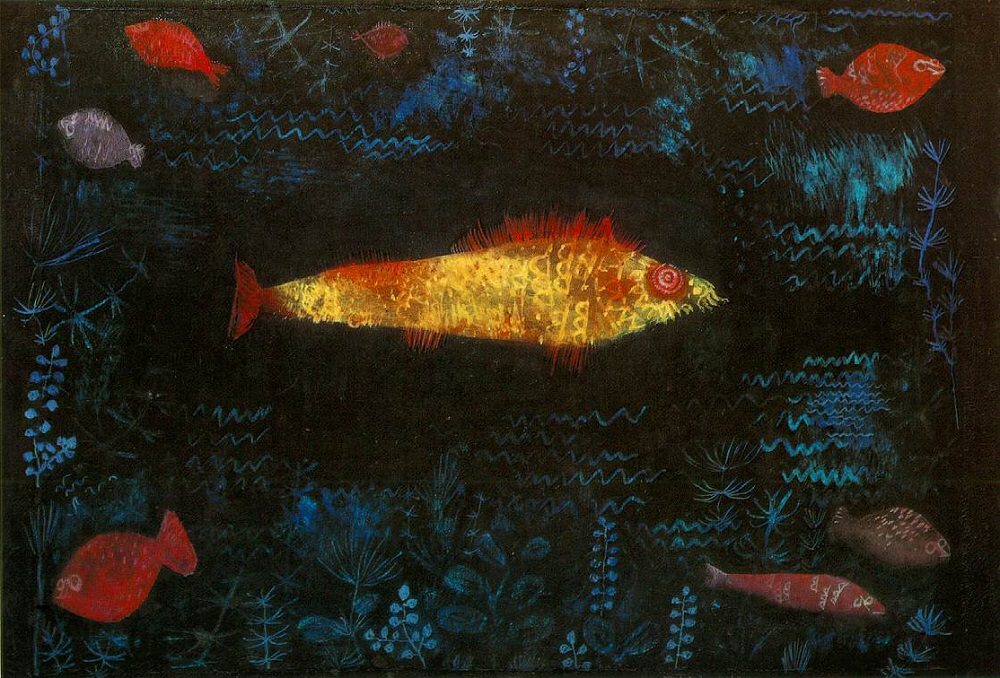
Susanna Partsch - Paul Klee

One of Taschen's 'basics' series - if the current isolation continues, I suspect I'll be reading more art monographs over the next few months.


The context of Klee's life was interesting - the way his 1914 trip to Tunisia opened up his understanding of colour and abstraction, the period teaching at the Bauhaus, the impact of the Second World War in forcing him from Germany to his birth country of Switzerland and how his art was received in both countries (despite not himself being Jewish). But I got more out of the sections on his theories of art, which illuminated not only why he painted and drew as he did, but also - at least in some measure - why his art has the effect that it does on me (eg on this encounter in Lucerne). Not exactly in the same vein, but still, I was moved by "Separation in the Evening" (1922), above, after reading Partsch's description: "The title of this completely abstract watercolour conjures up the evening dusk. The horizon can still be seen, the sky has already turned lilac, there is only a thin strip of light shining upon the earth before it finally disappears."

"The Goldfish" (1925)

"Now we make the reality of visible things apparent and in doing so express the belief that, in relation to the world as a whole, the visible is only an isolated example and that other truths are latently in the majority. Things appear in their extended and manifold sense, often seemingly contradicting yesterday's experiences. The aim is to reveal the fundamental idea behind the coincidental." - Klee, 1920

"Ad Parnassum" (1932) - the seat of Apollo and the Muses

"Art does not reproduce what is visible, but what makes things visible. The nature of graphic art easily makes abstraction tempting, and rightly so. The imaginary character is both blurred and has a fairy-tale quality about it and at the same time expresses itself very precisely. The purer the graphic work, ie the greater the importance attached to the formal elements used in the graphic representation, the more inadequate the preparation for the realistic representation of visible things." - Klee, 1920

"Individualized Altimetry of Layers" (1930)

"Insula dulcamara" (1938) - incorporating the Latin words 'dulcis' (sweet) and 'amarus' (bitter), hence 'bittersweet island'

Shut Up and Sing

Fun documentary following the Dixie Chicks from 2003 to 2006, ie from public comment about being ashamed about then President George W Bush followed by banning from country radio and general pillorying through to release of "Not Ready to Make Nice" and Taking the Long Way. For me their music has been always there, one way or another, for the past decade or so and Shut Up and Sing - watch was inspired by seeing they have a new album coming out - made me like them even more (they come across as very likeable not to mention tough).

Saturday, April 11, 2020

Grimes - Miss Anthropocene

Artist / art. On the one hand, relationship with Elon Musk. On the other, Visions and Art Angels were both so excellent!

And so is Miss Anthropocene, whatever the everything surrounding it. It's a tight record, with something textural - aesthetic maybe - binding its individual songs despite their range of styles.

I especially like "4Æm", as pulsingly urgent and viscerally exciting as anything she's done before, "New Gods" and, of course, spinning, glittery closer "Idoru".

Saturday, April 04, 2020

Phish - The Story of the Ghost

I heard "Wading in the Velvet Sea" in a store a few weeks ago and glommed on to its spacey, anthemic vibe and I'm still liking it, but the rest of the album's all over the place and not particularly good.

Better Oblivion Community Center - Better Oblivion Community Center

Conor Oberst + Phoebe Bridgers. Mid-tempo rockish folk/pop with some excellent electric guitars and a bunch of good melodies.

Sunday, March 29, 2020

Ben Lerner - The Topeka School

The Topeka School takes on, at a minimum, three very important and interesting topics, but none of which I would have started off assuming would draw me into a novel - language's loss of meaning in the face of its recent debasement in its public form, socio-economically privileged white masculinity (dealt with in a nuanced and often sympathetic way), and the challenges of raising children (especially boys) well amidst that.

In fact, it's remarkably successful in how it brings them all together, also weaving in a meaningful account of the operation of history at both a personal (familial) and social level, with its multiple generations of damaged individuals, all themselves shaped by macro forces of war, economics and the unconscious, and events and perspectives knitted together out of order.

I haven't landed on how I feel about the Darren Eberheart thread; I guess it illustrates the violence enacted by those same systems on those at the margins, while also rendering them especially susceptible to magical thinking and likely to become enmeshed in a cycle of violence themselves. It also develops real tension by its end, so that the closing pages which follow Adam and his family - with Natalia, after all - have genuine stakes. A very impressive novel.

Previously: Leaving the Atocha Station, which has stayed with me - including literally, in surviving the severe culling I've done over the last few years - and not just for its memorable first scene in the art gallery.

Shadow

Zhang Yimou's latest is practically gothic in its chiaroscuro palette and general moodiness. It's slow going for its first half - I read a review which describes that first half as basically a series of people walking into rooms and explaining how they're related to each other - and while the action, once it starts, is exciting enough, it didn't add up to a satisfying whole for me ... even with the philosophical aspects taken into account.

Saturday, March 21, 2020

The National - I Am Easy To Find

A slow build even by the National's standards; I've noticed before that their albums often take me quite a while to really fall into. I'm not yet there with I Am Easy To Find but I'm sure, still, that it's a good one, and the introduction of female vocals and other more subtle mixings-up of their formula is welcome.

Soccer Mommy - Color Theory

Very enjoyable 90s-throwback sulky-sounding singer-songwriter alternative rock-pop record. I read her saying she was inspired by songs like "Torn", "If It Makes You Happy" (or maybe another Sheryl Crow song in similar vein) and "Complicated" and it shows, in a good way. Early faves: "Circle the Drain", "Yellow is the Color of Her Eyes".

John Wick: Chapter 3 - Parabellum

'Si vis pacem, para bellum' - it's a faux-epic reference but, like everything surrounding it, is sold by the film's all-round tightness, like this 'third chapter''s predecessors. Kind of obvious to say this but Keanu is essential to the film working, which it does.

Wednesday, March 18, 2020

Susan Choi - Trust Exercise

I finished Trust Exercise a few days ago, and with that distance from its tricky, sinuous structure and its unexpected ending, my appreciation of it continues to increase. A novel that engages in the kinds of perspective shifts, reversals and ambiguities that this one does needs to earn those elements, and I think Trust Exercise does, through how well they're executed and how well they serve the book's concerns - about power, abuse, trauma and story-telling.

Each of the three sections is interesting - in its own right and as part of the whole - not only for how they contribute to the suspense of what will happen, or has happened, and the answers they provide to those questions, but also equally (if not more so) for what they reveal about the ways in which victims continue to be affected by abuse long after in their lives, and how this works through in the public or private narratives they construct to make sense of their experiences.

I think we're meant to take Claire's account as what 'really' happened; I also think it deliberately leaves unclear the details of that reality, which has the effect of highlighting that in some important ways it doesn't matter exactly what happened, because the outlines are enough that the enduring damage of the abuse at the stories' heart is showed to be inescapable regardless. It's a slippery interplay between specificity and overall theme, and doesn't leave much space for many of the conventional elements of characterisation and the ways they bring readers to recognise characters, let alone sympathise with them. Rather, Sarah, Karen and Claire (and, in a different way, David) are defined by the harm they've suffered and how they've tried to reckon with it - which itself is part of the point that Trust Exercise so sharply and (in its structure) originally makes.

Alice Munro - Runaway

A passing reference - Michelle de Kretser comparing Josephine Rowe's Here Until August to Munro's stories - created a little niggle which grew into a firm wish to re-read Runaway. It's one of those books that had grown in stature in my mind since I first read it, and it didn't disappoint on a revisit.

It's difficult to put into words why the stories in it are so good, but I think it's something to do with their plain-spokenness and directness, and how unforcedly taut they are, so that the characters and their motivations emerge with just the right (lifelike) combination of availability and oblique mystery, and the more dramatic elements of the plots work in service of the stories and what they're about, rather than dominating those stories. In their quiet way, they leave me feeling stirred-up.

She keeps on hoping for a word from Penelope, but not in any strenuous way. She hopes as people who know better hope for undeserved blessings, spontaneous remissions, things of that sort.

Monday, March 09, 2020

Bendigo Art Gallery

Collection exhibitions: "Talismans for uncertain times" & "The Becoming"

Benjamin Armstrong - "Conjurer III" (2012)

Ilona Nelson - "In-Sanitarium" (2015)

Josh Muir: What's on your mind?

Short multimedia pieces reflecting on (Indigenous) identity.


From the collection

Belinda Fox - "Tilt I" (2018)

Saturday, March 07, 2020

Miss Americana

I've liked Taylor Swift's music from quite a way back (though I haven't kept up with it lately) but this documentary made me like her, too. 

Sunday, March 01, 2020

The Professor and the Madman

Two main problems for me:
  1. I couldn't get past the associations I was bringing to watching Mel Gibson and Sean Penn (especially Gibson), who seem like two of the less agreeable men of Hollywood.
  2. Much of the film's critical action wasn't anywhere near sufficiently showed or explained - most glaringly, why Natalie Dormer's character would fall in love with her husband's murderer (and I did not like the him teaching her how to read).
(w/ Kevin)

Saturday, February 29, 2020

Black Ties (ILBIJERRI Theatre Company and Te Rēhia Theatre)

Entertaining cross-cultural romantic comedy-musical with the young lovers coming from cultures on opposite sides of the Tasman Sea, a Maori woman and an Aboriginal man, and the clashes coming when their families meet. Uncle Jack Charles, wedding style seating (at the Arts Centre's Pavilion), some audience participation amidst the controlled chaos of the second half.

(w/ R and Hayley)

The King

Handsomely put together and I do like Timothée Chalamet but it didn't really have anything particular to say - about power, royalty, family, war, Shakespeare or otherwise.

Friday, February 28, 2020

Weyes Blood @ Melbourne Recital Centre, Wednesday 26 February

This was good. I missed the layers of orchestration - and production - which dress up the songs on record, but Natalie Mering proved to be a strong singer, with the ability to open her throat more on the big moments and convey the shifts and dynamics in her undulating, long-lined songs.

She got through most of Titanic Rising and Front Row Seat to Earth, along with a (live debut) version of "Forever Young" and one older one. It didn't shed any particular new light on the songs for me - though I liked the way she used "Movies" as an epic main set closer - but I enjoyed it.

(w/ R)

Tuesday, February 25, 2020

Marriage Story

Great like everyone says it is and felt very real including in the aspects which were deliberately verging-on-satirical (the depiction of divorce lawyering and the family law system) and the scenes that were directed in ways that highlighted its own fictional - theatrical? dare I say it Brechtian? - nature. Characterisation and performance of both main adults an obvious highlight, but so too the supporting cast.

Saturday, February 22, 2020

The New Pornographers @ Melbourne Recital Centre, Friday 21 February

Enjoyable if not in any way revelatory. The songs from their latest album - which I haven't listened to - were front-loaded and after the first half hour or so it was one 'greatest hit' after another. I had memories of them doing many of these in one or both of the previous shows of theirs I've been to (2006 and 2010), and I was happy that all of my biggest main-album favourites got a run: "Testament to Youth in Verse", "Champions of Red Wine", "The Bleeding Heart Show". Not sure whether there was something going on with Newman's voice, or if it was something to do with the sound, which led to him being even more in the shadow of Case's than was possibly always inevitable.

(w/ R)

Sunday, February 09, 2020

Josephine Rowe - Here Until August

I already knew that Josephine Rowe writes sentences like a dream; for evidence I needn't go further than the first paragraph of the first story in this collection, "Glisk", which also happens to be the story of hers which prompted me to pick up Here Until August in the first place (because it's extremely good):

We are wading out, the five of us. I remember this. The sun an hour or two from melting into the ocean, the slick trail of its gold showing the way we will take.

What I now know is that her craft also extends to putting stories together, with all ten of those collected here satisfying not just on the level of language, but also in how narrative and action fold into theme, concern and mood - structurally as well as in terms of story-ness.

Most - maybe all - of the stories are structured around absences and losses, and frequently there's a sense of characters in that state of both drifting and stasis; given that Rowe is a writer who was born in the early 80s and grew up in Australia (although her settings range broader), it's not surprising that there are little grace notes of cultural reference points sprinkled throughout, a passing reference to Kieslowski here, another to Blacklisted and The Greatest there.

Strikingly, though, the situations and characterisations are also strong - especially the driftless couple of "Real Life", becalmed in Montreal amidst multiple deaths, the newlyweds arguing about which of them will bear their hypothetical child in "Anything Remarkable" (also, the sneakily ambiguous, ambivalent way that one begins: "Certain days: it is easy to imagine this small, once-prosperous river town (barely distinct from many other small, once-prosperous river towns) as if you are only passing through it, shunpiking the thruways in favour of the scenic rural two-lanes on a road trip in your better, your best life."), and the taxi driver and her passenger in "The Once-Drowned Man".

For me, Rowe's commitment to the shapes and elements of her stories - and her great ability to interleave them - is one of the things that makes them stand out. There were perhaps two or three points, across the ten stories, where I felt a particular gesture or moment was too 'story-ish', but even they land with a certain panache, and they're exceptions amidst what's a fairly marvellous set, which I got a lot out of and some of which I suspect I'll return to.

Saturday, February 08, 2020

"Assembled: The Art of Robert Klippel" & "Valhalla" (TarraWarra Museum of Art)

Klippel - I didn't engage deeply, but I most liked some of the drawings and collages, and the small steel and wire sculptures, rather than the more obviously monumental larger assemblages.

"Valhalla" was keen, like most of Callum Morton's art. On the outside, it's a three-quarter scale replica of his childhood house in ruins; on the inside, it's an unsettling generically modern lobby area - also three-quarter scale - with three closed lifts and associated lights which flicker on and off and sounds which include mysterious thuds, menacing laughter and a scream or two.


(w/ R and L)

Saturday, February 01, 2020

"Collecting Comme" & "Lucy McRae: Body Architect" (NGV)

The Comme des Garcons dresses and other garments on display were fun to look at, with some surprisingly imaginable as actual street wear.


There was a bit to like about Lucy McRae but my favourites were the videos she did on commission for Miss Chu and Aesop, which both - like all her work in this exhibition - explore how technology may shape the human body and experience in the future (in the case of the one for Miss Chu, involving cloning one's own body and then eating the result) in a way that's not unchallenging while at the same time aesthetically pleasant.


(involving trips to both the NGV International and NGV Australia, with R but in each gallery viewing different things)

Your Name

By coincidence, I was in Japan when this film came out - late 2016 - and I remember seeing its poster absolutely everywhere. Later (quite a bit later) I learned what a huge hit it had been: highest grossing film in Japan that year and fourth highest of all time, and highest grossing Japanese film worldwide of all time. And now that I've seen it, I understand why - it's a wistful, romantic, gorgeously animated movie whose premise satisfyingly accounts for the common (especially among the young) feeling of being in search of something that can't be named, and whose ending I wasn't sure it was going to reach, causing it to land all the more effectively.


The Good Place season 4

If this culminating season doesn't have the same zip - energy, inventiveness and barrelling momentum - as its predecessors, it comes close to making up for it with its dedication to shedding new light on what it means to be good, and to lead a good life, and continuing to excavate from the soil of its fantastic (ie un-real) premise. And, as always when you get this far into a tv show, there's plenty of built-up goodwill to draw on, for the characters and for the show itself. It ends well.

(1 & 2; 3)

Wednesday, January 29, 2020

Bombshell

Stylish and surprisingly tense (surprising because we know how the story ends, with Roger Ailes' deserved downfall), and - importantly for multiple reasons - convincing in its depiction of sexual harassment. Also very strong performances. But I struggled to get past both the intensely privileged 'white feminism' nature of it and, despite the film's downplaying of these aspects and emphasis on their humanising features, the harm that the central figures have done through their day jobs on Fox News. So even though it was very watchable, I didn't like it near as much as I otherwise might have.

(w/ R)

Sunday, January 26, 2020

Joy Williams - The Quick and the Dead

The clearest through-line's that of the three teenagers - Alice, Annabel and Corvus - ranging motherless and wild in and around what I'm fairly sure is a smallish city, or perhaps other urban development, in desert-laden Arizona, and they're also the most intriguing for a range of reasons, well, especially Alice.

But the many others who intersect with them and each other in various direct and indirect ways - Annabel's father Carter, who is very literally haunted by his dead wife Ginger; the only slightly older Ray, whose encounter with them in the desert leaves him tied up and abandoned for the supposed crime of killing a ram; Sherwin, the dissolute piano player with whom Alice somewhat takes up; late-appearing eight year old Emily Jane Pickless; and more - are just as integral to the design of The Quick and the Dead, as the novel circuitously roams through its many oblique perspectives on life and death, which Williams evidently considers as both a dyad and a many-dimensioned spectrum.

The Quick and the Dead is sharp, funny, stormy and elusive, in a way which sometimes reminded me of those first few Pynchon novels. There are characters and they have arcs, and there's a strong sense of a morality working its way through the events, but not in the sense that individuals seem to meet their just deserts based on anything like conventional ideas of responsibility for their actions or character (in the other sense) - and indeed several come to what could be considered untimely ends along the story's twisting path, while others (Ray's parents, say) really seem only to have walk-on parts. As a whole, the novel feels like it can't be grasped through any conventional approach - it's too sideways-of-conventional and slippery for that.

There's something of the jagged lightning-flash nature of Williams' short stories - in The Visiting Privilege and Ninety-Nine Stories of God - without quite the same sustained effect. But that's an extremely high bar and The Quick and the Dead is its own beast - including a permeating air of the grotesque and even gothic - and quite something marvellous at that.

Come on Up to the House: Women Sing Waits

None of these are revelations: Tom Waits is a great songwriter, his songs come to us in a distinctive package when performed by Waits himself (which can be a barrier to, as well as an integral part of, enjoying those songs), and covers by other artists - often female - can work well. 

Also not revelations: Aimee Mann, Patty Griffin and Rosanne Cash (to name just my personal biggest three) are each magnificent singers, and the pool is deep in that broad genre - more of a style and a sensibility really - spanning roots, folk, Americana and 'classic' singer-songwriter pop, especially when it comes to women.

One thing I hadn't realised: there've been big covers of Waits's songs before other than Rod Stewart's "Downtown Train", notably the Eagles' "Ol' 55" and Bruce Springsteen's "Jersey Girl".

So this collection isn't revelatory but it has many nice songs of which the best are probably the versions involving the exact singers and songs I've already mentioned, especially Mann's "Hold On", Allison Moorer and Shelby Lynne's "Ol' 55" and Corinne Bailey Rae's "Jersey Girl"; Rosanne Cash singing "Time" has an unsurprising depth too.

Jane Harper - The Dry

Page turner with bonus Australian-ness very much including our culture's dark side.

Tuesday, January 21, 2020

Little Women

Wonderful movie, so finely put together in every sense, much of the artistry especially apparent on the second viewing. I found it very moving. Lady Bird was a marvel (I also saw it twice); Little Women might be just as good.

(w/ R then a second time by myself)

[29/1/20: The scene that's stuck with me is the one where Jo tells her mother about her frustration that women are seen as only fit for love, before adding quaveringly that she's so lonely, and the way her mother doesn't go to her but instead - lovingly - stays where she is so that Jo is left to work through what she's feeling herself, drawing on her own strength, just as her mother has done all her life, that latter bit being all subtext rather than explicit and even more powerful for it. 

And that pivotal scene is connected to the film's ending. My interpretation had been that, in this 'Little Women', Jo didn't end up marrying Friedrich, but instead stayed true to the aspect of herself that led to dedication to writing rather than to marrying or love, and the intercut final scene at the educational institution with the whole family celebrating Mrs March's birthday the way her novel ended, with the conventional ending in marriage (in this case, as opposed to the other option of death) being that insisted upon by her publisher. But everyone I've talked to since had read that final scene as being the literal ending, happening as well as the publication of Jo's book, or at least thought it was ambiguous - which led me to think of it as actually indeterminate, as in left not 'ambiguous' in the sense that it's up to the viewer to decide, but rather in an either/both state which is deliberately unresolved ... which is an even more elegant solution on Gerwig's part to the problems of adapting Alcott's novel.]

[1/2/20: This morning I've been thinking about the scene with Beth and Jo on the beach, fine sand blowing out to water, Beth saying you can't stop the tide, Jo saying she will hold it back. It's affecting in its own right - one of Gerwig's clearest directorial flourishes, and it comes off, having the air of the iconic even on first viewing in its rendition of impending loss and its characters' competing emotions and responses, resistance and quiet acceptance - and heightened by its placement in a sequence of intercutting and juxtaposition between past and present; it's one of the film's several such sequences to great effect, in addition to the underlying effects its structure creates, throughout and at its climax.] 

Amal El-Mohtar and Max Gladstone - This Is How You Lose the Time War

There's a bit of fizz to this novella-length fiction, constructed by its two authors in a series of short episodes and inventively dispatched letters between the two time travelling protagonists, Red and Blue, agents of opposing sides in an endless war through time and multiverse who develop a romance. It's a tricky conceit to pull off, though, and it veers a bit naff at times, and its somewhat thin science fiction premise would have benefited from more depth and concrete detail given the amount of action that it's asked to bear.

GLOW seasons 1-3

Surprisingly fun, substantial and charming; Alison Brie very appealing (see previously, when she was younger: Community). I don't romanticise the 80s but the show makes maximal - without caricatured - use of the period setting and does a good job with its themes while periodically offering writing that's just a half-step more clever than might be expected. 

Monday, January 13, 2020

"Japan supernatural" (AGNSW)

An enjoyable tracing of threads from art of the Edo period of isolation (1600-1868) to the contemporary. The through-lines were convincing and interesting, particularly the way certain types of ghosts, goblins and demons recur over time and across media, and the continuities of style across the same (eg the idea that modern animated Japanese movies are the successor to traditional scroll paintings).

Miwa Yanagi - "Rapunzel" (2004), the second time I've encountered this creepy fairytale series

Tabaimo - "The Obscuring Moon" still (2016) - I recognised her style from a distance, this one taking imagery from an 1857 Utagawa Hiroshige painting

There were a few large and splashy Takashi Murakami pieces; this was the funniest (actually it's better paired with its companion red oni demon guardian) - "Embodiment of 'Um'" (2014)

Not pictured but enjoyed: many ukiyo-e pictures, which I think (?) often had a real sense of humour about their grotesque depictions, although maybe that's just something in the conventions around exaggeration and so on; Mizuki Shigeru's insertion of yokai (types of spirit/demon/monsters) into Utagawa Hiroshige's 'Fifty-three stations of the Tokaido' series; Chiho Aoshima's whimsical, slightly troubling watercolours and pencil drawings.

Tuesday, January 07, 2020

2019: "If you find what you're looking for"

Annual soundtrack to the year just gone by.

1. River - Patty Griffin
Patty Griffin (PGM, 2019)

2. No One's Easy To Love - Sharon Van Etten
Remind Me Tomorrow (Jagjaguwar, 2019)

3. Stay Down - boygenius
boygenius EP (Matador, 2018)

4. Nonbeliever - Lucy Dacus
Historian (Matador, 2018)

5. Twist - Thom Yorke
Anima (XL, 2019)

6. Wild Time - Weyes Blood
Titanic Rising (Sub Pop, 2019)

7. All Mirrors - Angel Olsen
All Mirrors (Jagjaguwar, 2019)

8. Fire Escape - Miranda Lambert
Wildcard (RCA, 2019)

9. Seventeen - Sharon Van Etten
Remind Me Tomorrow (Jagjaguwar, 2019)

Sharon Van Etten and Lucy Dacus were the really big ones in 2019, and to a lesser extent boygenius and Weyes Blood. Female singer-songwriters ruling the roost, and not as country/Americana-heavy as some recent past years'.

On spotify.

Jojo Rabbit

Nice, entertaining, and its heart is in the right place, and I liked it more than I didn't, but this one didn't 100% hit the mark for me; the sentimentality and tweeness sit uneasily alongside the enormity of the subject matter in a way the film is aware of but - for me - doesn't fully reconcile.

(w/ Erandathie)

Jia Tolentino - Trick Mirror

Excellent collection of essays about contemporary life, with identity probably the single strongest theme. 

The Witcher season 1

A bit all over the place, but really, lots of fun. 

Tuesday, December 31, 2019

Peter Sutton - The Politics of Suffering

Sim lent me The Politics of Suffering after a conversation about how to think about western ideas of improved health and other life outcomes not being an unquestionable objective of white engagement with Aboriginal and Torres Strait Islander people and communities, and it's been a very worthwhile read, especially given my current work.

Its two major challenges to conventional (white) progressive thinking - and my own - are its arguments that:
  1. The relative importance of colonisation, genocide and intergenerational trauma to the terrible conditions - in terms of violence, abuse, poor health, overcrowded housing, poverty and suffering (to name just a few) - in many/most contemporary Indigenous communities is typically overstated, and the effects of the interaction between traditional cultural practices and norms (including those which involve sanctioned violence, internal inequality and anti-scientific practices), and the forced imposition of modern technologies, social institutions and conditions (eg fixed housing, with its associated communal and hygiene-related challenges), understated; and
  2. Too much weight is given to the 'rights' agenda, including campaigning for land rights, constitutional recognition, 'reconciliation' via treaty and other formal mechanisms, and self-determination, at the expense of action - intervention - much more directly targeted at the ill health, violence and other factors causing direct harm to individuals, including a particular focus on child socialisation as a means of breaking the intergenerational cycle.
Both of those obviously have large implications for how to try to close the gap between Indigenous and non-Indigenous Australians, and indeed for how even to understand the nature of 'Indigenous disadvantage' and what addressing it and 'closing the gap' might mean.

The way it's written, as well as the depth of experience, knowledge and empathy that Sutton brings, makes it clear that The Politics of Suffering isn't meant as an apologia or Trojan Horse for simplistic conservative attitudes to the topic, and having read it more or less twice all the way through, I'm inclined to be at least open to that first argument (although it makes me very uncomfortable, and what its nuanced acceptance means for the messy, contested realm of public debate and policy-making, with all its ignorance, bad faith and vested interests amongst its competing participants, is another question), while less convinced about the second.

One obvious response is that neither question is an either/or - but that doesn't answer either the in-principle question about how to then balance efforts between the two poles of each question, or the practical one of how to contribute to moving the balance of government's and others' focus towards where they best should lie. Also obvious is that there are no easy answers, and at the same time that the recognition of such lack shouldn't be an excuse for diminishing the forcefulness with which any individual/collective/organisation (including, in whatever small way, me) pushes towards what is right, and at the same time again that a constant humility and awareness of the complexity of the terrain is the only ethically responsible course. I think I'll return to this book, because it presents a real and needed basis of tension to force me to examine my own beliefs and assumptions about how 'we' should engage with Aboriginal and Torres Strait Islander people.

Twyla Tharp - The Creative Habit

This one was a loan from Sara, and I've worked my way through it a couple of times over the past however long it's been - something like a year I think, probably longer. In a genre - broadly, books about creativity and how to practice or acquire it yourself - that I suspect is crowded and full of woolly platitudes, and which I've mostly avoided for that reason, it's refreshing in its combination of practicality and richness. The narrative sections are full of useful ideas and concepts - such as the concept of finding a work's 'spine' - and the exercises are illuminating, and the act of translating them from choreography and dance to other forms of creativity, such as writing, is itself helpful.

The Rise of Skywalker

I was planning to skip this but it came up that Rob was planning to see it by himself, and since he can always get free tickets and I had a free night, I was well pleased to go along to such an event of a film. And I guess it was fine, just a bit weightless; it also gave me a renewed appreciation for The Last Jedi.

(w/ Rob)

Knives Out

I went into Knives Out with no strong feelings or knowledge about its advertised genre - murder mystery / 'whodunit' - but a large amount of faith in Rian Johnson on the strength of everything he's done before (especially, still, The Brothers Bloom), and I think it was equal parts that personal starting point and the way the film itself knowingly both draws attention to and plays out any number of iconic components of its genre which made it impossible for me to disentangle the extent to which Knives Out is traditionalist, as opposed to deconstructionist, in what it does.

In any case, it turns out not to matter because the result is a very entertaining, clue-filled story full of enjoyably performed characters and more-or-less unexpected turns, with a depth that comes from the integrity of its plotting and construction as much as from its thematic treatment of class and race.

(w/ Hayley)

Monday, December 16, 2019

Parasite

Very ferocious, very metaphorical, very good - including in the way it evades neatness in its constituent parts (especially characterisation) and is thereby sharper in its diagnosis of capitalism / neo-liberalism as the root cause of all the suffering and hardship it depicts. Also made me think of "The Ones Who Walk Away from Omelas".

(w/ Kim)

Saturday, December 14, 2019

Angel Olsen - All Mirrors

Enormous, and at the same time delicate. All Mirrors is outstanding, probably her best yet, and both of the last two - My Woman (2016) and Burn Your Fire For No Witness (2014) - had been pretty great already. There's heavy orchestration on many of the songs, sparseness at other times. There are icy, churning moments which veer almost goth - the standout title track reminds me of Pornography - while elsewhere the mood traverses 'fraught Disney', contemporary torch, and all kinds of distinct singer-songwriter, with something both tender and fierce underneath every song. 

Shirin Neshat - Dreamers (NGV)

Three videos, each following a different woman through a series of encounters with aspects of the unconscious, black and white and around 15 minutes each.

"Illusions & Mirrors" (2013) is the most straightforward in its symbolism - a cyclical sequence in which Natalie Portman follows a figure along a beach into a house filled with troubling, blurry reflections of herself and others (including one moment which is something like a jump scare in what I took as a return of the repressed) and ends with a doubled gaze back out to the crashing waves. "Roja" and "Sarah" (both 2016) are equally striking in their imagery but more cryptic and I think deeper, operating with a less-determined (less linear), and so more apt, logic in accessing the unconscious, more glancing association than one to one representation.

Saturday, December 07, 2019

Zombieland

I'm late to this one (I've seen bits on tv before); it's good. The writing takes it a fair way but the four main actors are crucial. Plus Bill Murray.