Despite the truly awful title (the S stands for 'single'), a quality short-run - eight episode - show which quickly broadens beyond single mother experience to take on inter-connected issues of class and parental impact while staying satisfyingly funny, crude, good-hearted and on-point.
Thursday, December 06, 2018
Rachel Cusk - Outline
There's something nagging about the narration in Outline, a sense of something constantly withheld, where the withholding is happening in a way that's structural to how the almost-unnamed narrator - her name appears only right near the end - experiences her world. Its mode sometimes reminded me of Deborah Levy's brilliant Hot Milk, but Hot Milk is all undertows and the heat of fierce, flickering emotion and dangerous ambiguity, while Outline generates a stifling sense of blockage, as if between surface and interior lies a layer so heavy and still as to be virtually impenetrable.
Then a young woman, whose name, according to my diagram, was Sylvia, began to speak, having glanced around the room apparently to ascertain that no one else was going to take the initiative. Her small, resigned smile made it clear that she often found herself in this position.
The narrator is sharply, forensically observant; facets of surfaces accumulate, and there are times when language and world merge, as below, the 'surprisingly' itself appearing surprisingly in an otherwise typically plain sentence.
I could imagine her in the monasticism of a practice room, her fingers flying surprisingly across the black and white keys.
Themes of identity, stories and other types of meaning-making recur, and the barest details of the narrator's life emerge: a divorce, a connection to Athens (where the book's two days take place), hints of an unsatisfying relationship with her sons. You spend a whole book in her head, privy to her highly nuanced, specific responses to the people and places around her, yet by book's end I felt I hardly knew her at all.
He paid the bill, waving away my offers of money after a brief but observable hesitation, and we stood to leave.
Even after two consecutive reads, I can't say why Outline is so intriguing, so seemingly lingering. It's not the mystery as such, and it's certainly not the plot (which is basically non-existent). Some of it, I think, lies in the human drama associated with the many slices of people's lives that make up the book's scenes, each with different levels of closeness to an actual narrative of the person's life; and, maybe, the contrast to the narrator's own opacity, a blankness that seems incongruous with the intimacy that her proximity ought to bring. I like phenomenological fiction, after all, and here there's a phenomenology at once baffling and curiously familiar.
I closed my eyes and tried to summon up my feelings for my neighbour. When I opened them again Elena was still looking at me, waiting. I said that I had become so unused to thinking about things in terms of whether I liked them or whether I didn't that I couldn't answer her question. My neighbour was merely a perfectly good example of something about which I could only feel absolute ambivalence.

Monday, December 03, 2018
Ladies in Black
Slathers on the period (1959) details and Australianisms ("strewth", "hooroo", and much more), soft pedals the racism and sexism which are in no small part its subject, and steers directly into fantasies of harmony and easily-swallowed 'progress' by its ending after limply indicating the possibility that they might not be realised - yet it's also quite charming, and sly in its depiction of Australian masculinity in particular, while its positive depiction of immigration can only be welcomed.
(w/ Erandathie and Ru)
(w/ Erandathie and Ru)
BlacKkKlansman
Both entertaining and righteously direct, providing and using the pleasures of story to sharply deliver its message about historical and present-day racism.
Friday, November 30, 2018
Pistol Annies - Interstate Gospel
Pistol Annies are a country supergroup comprising Miranda Lambert, Ashley Monroe and Angaleena Presley, and great fun with it. Favourites: "Best Years of My Life", "5 Acres of Turnips", "Leavers Lullaby", "This Too Shall Pass". There are times when the music sounds somehow familiar, but here, that isn't a bad thing.
Night Is Short, Walk On Girl
Zany, colourful, surrealist romp. The sophists' dance was a highlight, so too the big musical numbers forming part of the guerilla theatre staging. Seemingly in pursuit of fun over most anything else, and creative in story structure and animation - overall quite excellent.
(w/ Kevin, part of Japanese Film Festival)
(w/ Kevin, part of Japanese Film Festival)
Monday, November 26, 2018
Will Gompertz - What Are You Looking At?
Fun whisk through the history of modern art, organised chronologically by 'isms'.
Tuesday, November 20, 2018
Sharp Objects
Amy Adams, Patricia Clarkson, southern atmosphere ('Wind Gap, Missouri'), a present-day murder investigation against a backdrop of unresolved past death and damage. Sinks its claws in from the start and doesn't let go, all the way through to the end of the closing credits of the finale.
George Saunders - Lincoln in the Bardo
What an astonishing work of fiction. I bounced off Lincoln the first time I tried to read it, a few months back (even after discovering how amazing Tenth of December is), bogging down in the first 20 pages in the description of the Lincolns' party, but if I'd pressed on just a few more pages to reach the scene in which Hans Vollman and Roger Bevins III meet the newly arrived Willie Lincoln, with its mixture of comedy, feeling and interesting exposition, I wouldn't have looked back. From then on, the novel - if that's the right word for it - races forward, its chamber of voices entwining in increasingly powerful and moving ways, maintaining both a simplicity of vision and construction (including in how it deals with the voices of the African American slaves) and a rewarding complexity across its many threads. Emotionally forceful, intellectually questing, morally rigorous; marvellous and humane.
Sunday, November 18, 2018
Rhiannon Giddens - 'Sisters Present' @ Symphony Space, NYC, Sunday 18 November
Final show in a four-gig residency; the 'sisters' being Allison Russell (vocals, banjo), Amythyst Kiah (vocals, guitar, banjo), Toshi Reagon (guitar, electric guitar) and Lalenja Harrington (vocals and spoken word - also, Giddens's actual sister), all women of colour (notably: a large majority of the audience, however, was white) and all very proficient. A lot of the set was drawn from songs that Giddens, Russell and Kiah have written for a forthcoming Smithsonian Folkways record, and it sounds a barnstormer. The songs ranged across folk, soul, blues, gospel and rock and roll; live, Giddens is an electrifying singer and an endearingly intent-seeming musician.
Whitney Museum, NYC
The big attraction that's just opened at the Whitney - in a cool new(ish) building no less - is "Andy Warhol: From A to B and Back Again", so, not so exciting for me; I've dutifully seen plenty of Warhol over the years, not least the big exhibition at the NGV a couple of years ago (indeed, twice). Still, I took a quick turn through. (Also on were a Mary Corse survey and an exhibition exploring the relationship between programming and art; neither made an impression.)


But the main event for me was the smallish selection (maybe 80 or 90 pieces) from the permanent collection, organised under the theme "Where We Are" (1900 to 1960). My previous visit to the Whitney, in early '09, I called the part of its collection then on display "smallish but exquisitely selected" and it was the same again this time - a very high standard, several times punching through even the tidal wave of great art in which I've been immersed lately.
The star of the show was Edward Hopper's "A Woman in the Sun" (1961), a painting that for me has always been mostly about the light, and which I think of often. It was mesmerising. There were a bunch of other Hoppers on view too, most notably "Early Sunday Morning" (1930).


Also on offer, an outstanding O'Keeffe ("Music, Pink and Blue No. 2", 1918) and an equally outstanding Rothko ("Four Darks in Red", 1958), both of which were sharp reminders of why I love those artists in the first place.


Other highlights:
Thomas Hart Benson - "Poker Night (From A Streetcar Named Desire)" (1948)

Archibald Motley Jr - "Gettin' Religion" (1948)

Jasper Johns - "Three Flags" (1958)

Henry Koerner - "Mirror of Life" (1946)
Saturday, November 17, 2018
My Fair Lady on Broadway (Lincoln Center Theater)
It was fun to see a big bright Broadway musical, and I've always been a bit intrigued by My Fair Lady because of the Pygmalion connection, but what put it over the top for me was the prospect of seeing a grown-up Lauren Ambrose as Eliza Doolittle. So it was disappointing to learn, a couple of days before, that she's recently been replaced by someone else. It was enjoyable anyway, but in the end, nothing all that memorable.
Friday, November 16, 2018
The Ferryman on Broadway (Bernard B Jacobs Theatre)
Now this is main stage theatre done well. It's a lavish production - a cast of more than 20, half of them children, not to mention an actual baby, a live rabbit, and, particularly plot-relevant, a live goose into the bargain. Written by Jez Butterworth, directed by Sam Mendes, a uniformly strong cast (including Paddy Considine and Justin Edwards, who reminded me of someone and who I've just learned was Ben on The Thick of It), a more or less single but versatile set which at times holds virtually the entirely cast (maybe even the whole cast by the climax) - the Carney family's kitchen and the staircase upstairs.
It's set in 1981, in the heart of the Troubles, and the drama and the weft of it come equally from the political and the familial tensions - tensions which are drawn out and overlaid over the play's three hours, before resolving satisfyingly explosively and quickly at its end. The 'meat' of the play would already have been enough to make it extremely good - Quinn's relationships with his wife Mary and widowed sister-in-law Caitlin, the reverberations when his brother Seamus's body is found in the bog ten years after he disappeared, the multiple layers of the IRA's influence, the subplot and counterpoint of Tom Kettle (his proposal scene was one of the most moving). But it's the mythic resonances, most obviously through the passage from Virgil's Aeneid which gives the play its name, not to mention via the role played by Aunt Maggie Far Away (and especially the monologue when she, oracle-like, tells Aunt Patricia's backstory), which make it really a bit special.
It's set in 1981, in the heart of the Troubles, and the drama and the weft of it come equally from the political and the familial tensions - tensions which are drawn out and overlaid over the play's three hours, before resolving satisfyingly explosively and quickly at its end. The 'meat' of the play would already have been enough to make it extremely good - Quinn's relationships with his wife Mary and widowed sister-in-law Caitlin, the reverberations when his brother Seamus's body is found in the bog ten years after he disappeared, the multiple layers of the IRA's influence, the subplot and counterpoint of Tom Kettle (his proposal scene was one of the most moving). But it's the mythic resonances, most obviously through the passage from Virgil's Aeneid which gives the play its name, not to mention via the role played by Aunt Maggie Far Away (and especially the monologue when she, oracle-like, tells Aunt Patricia's backstory), which make it really a bit special.
The Met, NYC
Turn of the 19th/20th century stained glass, Hudson School landscapes, John Steuart Curry's "John Brown" (1939), a scattering of Klees, "Reimagining Modernism" (1900 - 1950), a bit of contemporary, 19th century European painting, some Old Masters.




Martin Johnson Heade - "Newburyport Meadows" (1876-81)

Georgia O'Keeffe - "Corn, Dark, No. 1" (1924) ... struck anew by how great she is, which is quite something given how much of her work I've seen over the last few weeks

Edward Hopper - "Tables for Ladies" (1930) ... the composition of this one is remarkable - the diagonal lines, the whites and blacks

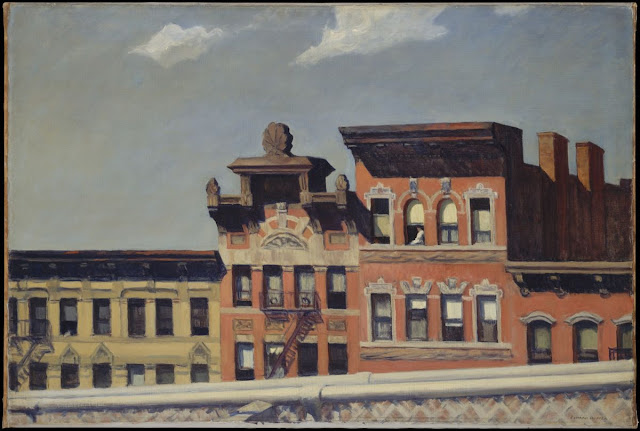
Edward Hopper - "From Williamsburg Bridge" (1928) ... as I now know, the view today from this spot isn't so different

Kay Sage - "Tomorrow is Never" (1955)

Anselm Kiefer - "Bohemia Lies by the Sea" (1996) ... this image completely doesn't do justice to the monumentality of the work - size, texture, colour

Vincent Van Gogh - "Wheat Field with Cypresses" (1889)

Giuliano di Piero di Simone Bugiardini - "Madonna and Child Enthroned with Saints Mary Magdalen and John the Baptist" (ca 1523)

Fra Filippo Lippi - "Portrait of a Woman with a Man at a Casement" (ca 1440)
Thursday, November 15, 2018
"This Alien Nation" @ Joe's Pub, NYC
A monthly event in which Sofija Stefanovic hosts a range of people, each speaking or otherwise performing in celebration of immigration (as does Stefanovic herself). This one: Casey Legler (writer, model, and former Olympic swimmer), Xochitl Gonzalez (writer and retired wedding planner), Masha Dakic (writer and actor), Maysoon Zayid (comedian, actress, disability advocate, and tap dancer), Patricia Okoumou (activist, Statue of Liberty climber), and DJ Tikka Masala and friend. Terrific concept, strong execution - funny and real.
(w/ Nenad)
Usual Girls (Roundabout @ Black Box Theatre)
A colourful splash of vignettes from third grade through to early-mid adulthood (time: 1980s - 2018), interwoven with darkness all the way through - which turns out to be because, as it sets up in its opening scene, the play's major concern turns out to be toxic masculinity, which it builds upon and elaborates as it jumps through time and builds to its gut-punch final scenes. An extra layer is that the protagonist, Kyeoung, is a woman of colour - as is the older woman / version of her who is a character in her own right. Director: Ming Peiffer. It was very good.
Wednesday, November 14, 2018
Courtney Barnett - Tell Me How You Really Feel
Another excellent, crunchy, unforcedly meaningful record from Courtney Barnett. I like Sometimes I Sit and Think more though - that one just keeps on being great.
Thom Pain (based on nothing) (Signature Theater)
A 70 minute monologue, full of digression, bathos and other types of anti-climax; Thom Pain attempts to tell a story, with jokes and other entertainments, but can't. Its spirit reminded me of Beckett, including in its insistence on the human-ness of the entire encounter, but its existentialism is contemporary. I picked it (apart from the good reviews) because Will Eno - of Middletown and The Realistic Jones - wrote it (it was his debut), and it didn't hurt that the performer was Michael C Hall, famous because of Dexter but famous to me because of Six Feet Under.
"Hilma af Klint: Paintings for the Future" @ Guggenheim Museum, NYC
I was thinking while walking to the Guggenheim that my tastes in art have become very defined - movements, styles, individual artists, even types of colours, motifs and so on. Having experienced a concentrated dose of af Klint's work, I wouldn't say she's exactly a category-breaker, but I did enjoy it a lot, and she does exist somewhat outside of my familiar frames.

I think I first encountered her fairly recently, at the 'Museum of Everything' exhibition at MONA, but it turns out she was a successful part of the art establishment in the early part of her year, before following a path into spiritualism which coincided with her beginning to produce a range of striking and sometimes remarkable paintings in the terrain of abstraction separately from and before the recognised canonical figures began blazing their own trails.

Part of her method was to paint in series, seemingly often around a dozen or twenty works, the pieces leading to each other in powerful ways. The Swan (1915), in particular, is amazing, and cumulatively quite intensely moving. From the exhibition notes: "the swan symbolizes the union of opposites necessary for the creation of the philosopher's stone ... after the forces embodied by the swans come into conflict and begin to combine - a process signaled by the shift from representational to abstract imagery - they ascend into higher realms, until they are ultimately unified."

Joy Williams - Ninety-Nine Stories of God
"The letter, in time, though only rumored to be, caused her children, though grown, much worry."
That's the only sentence like it across the 99 stories and I'm sure it's deliberately placed at the end of the first story. Yet I couldn't say where that conviction comes from; that's how this entirely puzzling and brilliant collection works. They're remarkably compressed and at the same time wide open, often offering up suggestive connections between their component elements without going to far as to explain. For example:
(first read)
That's the only sentence like it across the 99 stories and I'm sure it's deliberately placed at the end of the first story. Yet I couldn't say where that conviction comes from; that's how this entirely puzzling and brilliant collection works. They're remarkably compressed and at the same time wide open, often offering up suggestive connections between their component elements without going to far as to explain. For example:
21
If there is a crash at an American airport, the wreckage is removed immediately so as not to alarm the passengers on the flights that will come after.
This is not true at Russian airports.
While at some airports in the major cities, such as Moscow or Saint Petersburg, the wreckage might be taken away quite as if nothing had occurred, small runways in Siberia are littered with failed flights, their rusting hulks simply pushed to one side.
On a recent flight from Nome to Chukotka, the woman in the seat opposite us became quite agitated as we dropped rather peremptorily through the dark skies. She began loudly praying to God for deliverance. My companion remarked that her fervent request was useless, as God had long ago turned His great back on Russia. She might just as well have prayed to the luxurious black sable coat that enveloped her from chin to ankle. We had earlier been half-hypnotized by its beauty, what my companion had dared to describe as the glimmering, endless depths in the fur of so many little animals.
COATThis was my second read - and first since falling deep into Williams' universe with The Visiting Privilege - and this, whatever this is, it's more and more under my skin.
(first read)
Subscribe to:
Posts (Atom)