Friday, August 01, 2014

East coast art hop (Hobart, Sydney, Brisbane)

Down to Hobart on Friday night, and then Mona (Red Queen) the next day - with Trang. Both city and museum felt familiar from my previous visit, the familiarity at times diffuse and at others specific - particularly on re-encountering individual works from last time. I think I enjoyed this return visit to Mona more than the first and got more out of it, probably due to both being more open in the particular moment and more readily able to grasp it on a second pass - although I hesitate over the second of those, as its cluttered and non-linear space and arrangement are very much part of the impact. 

A few slices:

Two pieces partaking of the ancient (I also saw both last time, I think). A small, oval-shaped piece of stone (steatite) - Commemorative Scarab of Amenhotep III (Egypt 1379 BCE) - inscribed on its flat face with tiny hieroglyphics which somehow I found very affecting. And Brigita Ozolins pyramid dream Kryptos (2008-10), an eerily darkened installation in concrete, steel, aluminium, gold and lead, encircling catacomb walls embossed with raised sequences of binary digits interspersed with the occasional word (HIDDEN, FOUNDATION, SECRET, DARKNESS, SUN, RAYS, DEAD, LIGHT, HEARS, SEES, FACE, VOICE, DEATH death was the first that I noticed, in the square central chamber, having just given myself a shock after looking up to unexpectedly see my own reflection in the mirror overhead).

 
David Claerbouts video installation - actually an extended series of black and white stills - The Algiers Sections of a Happy Moment (2008) had something special to it. A rooftop soccer game, some birds, and not much more, yet luminously perhaps infraordinary, like some lost naturalistic piece of French new wave.

E: I cant go on like this.
V: Thats what you think.

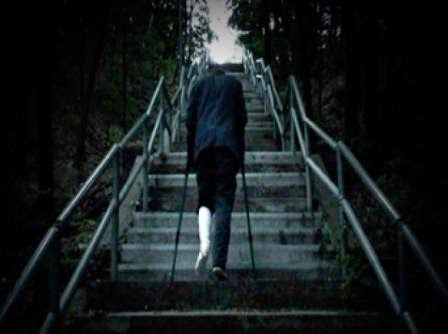
(Todd McMillan - Go On, 2007 - Sydney staircase, man on crutches)


Others: Tracey Moffatts Something More series of nine; some Henry Darger (disquieting); various Roger Ballen (very disquieting); Zhang Huans Berlin Buddha; Balint Zsakos colourful untitled (it had also jumped out at me last time); Nolans two Leda and Swans; Sandra Seligs Universes (spider silk sprayed with coloured enamel paint against black backgrounds); Julius Popps bit.fall at the entrance displaying contemporary words including Ukraine and MH17.

* * *

Sydney, NSW Art Gallery, currently on: the 2014 Archibald Prize, along with the Wynne (landscape painting or figurative sculpture) and Sulman (subject, genre or mural).

Ive never taken particularly to portrait, which makes me particularly susceptible to responding to and forming judgements about examples of the form to a very large extent based on my well established aesthetic sensibilities - and, indeed, on their surface elements rather than the deeper factors that established those sensibilities in the first place. And so I wonder about my liking of, say, Sophia Hewsons Artist kisses subject (the subject is Missy Higgins, the kiss rendered in glowing pastels and light that Id be even more suspicious of if the artist were a straight man) and Heidi Yardleys Julia DeVille (moodily on the verge of romanticisation - though I think actually very good).


One of the pleasures of portraiture is the chance to see some familiar faces, but they dont predominate in this years selection, though both Dan Sultan and Cate Blanchett were readily recognisable; also, there was James Powditchs faux-movie poster Citizen Kave (as its clearly intended to, making me think what a great film it wouldve been, whether made in 1983, today, or, in fact, never). And one of the more striking - and stronger - pieces was Paul Ryans Rox, an expressionistic view of Richard Roxburgh (face only).

More of the finalists for the Wynne particularly caught my eye. I liked a couple of the semi-abstracts near the beginning (Steve Burleys Hillside landscape and John R Walkers The Darling at Kalyanka); also, the breadth - at once geometric and natural - of Michael Johnsons Oceania high low (the winner of the prize; the title plaque aptly characterises it as exploring convex space rather than horizontal perspective), Philip Wolfhagens small, dreamy Landscape reinvention no 17 (pink-red scrub, a small strip of blue sky) and Max Berrys Goat farm, overlooking Norfolk Bay, whose lilacs, mauves, light aquamarines and browns add up to a poetic, not overly engineered whole. Plus Alexander McKenzies Japanese-inspired Man moves mountain - pleasing.


Perhaps unsurprisingly given its scope, the Sulman pieces drew more heavily on pop culture and pop art. A handful especially appealed, for various reasons: Andrew Sullivans T-rex (tyrant lizard king) with its nice sense of humour and touch of pathos, Cameron Hayes teeming, panoplic Martina Navratilova versus Chris Evert Lloyd (children, castle towers, things upside down, detailed, large-scale), the straightforward but well rendered Memory Drift (Richard Baxter - a wooden house blown off the ground by the wind, with all the archetypal associations summoned by that image; a hare looking up at it, a white cat on the roof, a kite tangled on a telephone wire). And the one I most liked, Jason Moads What death leaves behind, very Magritte-ean with its view of the reflected image of a succulent seemingly growing directly from an otherwise empty bed in a large circular mirror mounted on a nightstand.

 
Elsewhere, a Sol LeWitt exhibition (Your Mind is Exactly at that Line), including several pieces that Id seen in past visits as part of the rotating collection; Ive always thought I should find him more interesting than I actually do, though the large wall drawing of the five floating cubes against grey backdrop, all with different coloured sides, was at least striking.

Then MCA - exhibitions good as always. One, a collection from a Japanese artist called Tabaimo (Mekurumeku), comprising a set of video, projection and animation (hand-drawn then computer animated) works appearing one by one through a series of dark rooms and corridors, in some cases using the corridors themselves for the works. There were six, I think (plus some drawings), all on the short side at around 5 to 10 minutes and all worth the time, playful and whimsical, the imagery at times fantastic and even surrealistic but also seeming to invite and open up rather than hold the viewer at a distance.

To take the first, living up to its title - Japanese Commuter Train - by locating the viewer in a corridor on the interior of a distended hexagonally-shaped room, with train carriages extending in either direction: intercut with titles that are both literal and elusive (in Chicken and egg question, chickens lay eggs which then roll through the carriages, from which various things emerge; in Everybody can be so good material, people wrapped as sushi rolls are laid on the train floor as giant hands from outside reach in and stuff them into similarly huge mouths), it offers all manner of oddity amidst the normal without any reaction from the trains other passengers. The others explore different terrain, although a recurring theme is an interest in water and in blurring the lines between the human body and other forms of biology (limbs morphing into aquatic vegetation).


The other was Annette Messenger (Motion/emotion), a French artist working with drawing, photography, needlework, sculpture and installation forms; I think Ive come across her before. Only a couple stood out, but the two that did, I really liked. There was Histoire des robes (1990) (Story of dresses), comprising 17 dresses each in long individual wooden boxes mounted landscape-orientation on a single wall, visible through glass fronts, with the boxes also containing other framed images and words, invoking or gesturing towards possible meanings bound up with the dresses themselves (one, for example, stark: jalousie).

And also the installation Casino (2005), a darkened room into which billowing red silk blows across the floor from an adjoining chamber; underneath, the illuminated outlines of buildings and less identifiable objects, some gelatinous and vaguely oceanic; the whole evokes the red desert spaces of the imagination, capped by the mysterious black objects, suggestive and alien, that descend to the surface at the end.

* * *

And next Brisbane - first time in more or less a decade - to find a few things going on at GOMA.

Harvest: Art, Film and Food: Objects in circulation (looking at the movement of food around the globe - including Jonathan Froeses elegant b&w photos of figs, fish, pawpaw segments), Pop and the vernacular, A portrait of labour (Tracey Moffatt appearing again, with another series of kitschily striking photos, and also a playful 10 minute video, Lip, montaging a number of short movie clips of black women serving white) and Imagining another future, themed around visions of alternatives to the cultural and environmental status quo in food production and distribution.

My two favourites were in that last section - both large-scale. There was Tomas Saracenos set of Biosphere sculptures (2008-09) - large plastic bubbles attached to ground and walls by webbed rope, about five or six of them across the large, light-filled central space on the ground floor. And Emily Floyds Permaculture crossed with feminist science fiction (2008) - varnished pieces of timber (circular cross-sections, blocks, longer planks and one burnt egg-like structure at the centre)  laid out on the floor, inscribed with passages from Bill Mollisons books on permaculture and Ursula Le Guins and Doris Lessings novels.


Seen and Heard: Works and Multiples from the Collection, multiples being (I learned) works conceived and produced as multiple units. The exhibition is around crossovers between popular culture, music, sound and visual art, and includes a bunch of record covers (including some that are iconic for me - Velvet Underground, Joy Division, the Smiths etc), a bunch of Nam June Paik (I liked his TV Cello, 2000) and various Fluxus/Cage, Robert Rauschenbergs screen print poster and limited edition vinyl for Speaking in Tongues, and Bill Violas visual score to Edgard Vareses Deserts”…made me think about the significance that music has held for me in the past and wonder to what extent its still current, and may be in the future.

Separately, a nice Hiraki Sawa installation, O (2009). Single darkened room, three large screens projecting scenes from central Australia, an abandoned house (along with animated white birds and miniature fairground wheel) and, apparently, the surface of the moon; on the surrounding walls, smaller tv screens each showing a single rotating object (light bulb etc) with sounds projected from similarly spinning speakers mounted on wooden plinths.

QAG I only intended to browse through, and it turned out there wasnt that much to see. A good de Kooning landscape, a general survey of Australian art 1840-1970 with an emphasis on modernism (Nolan stood out again; also the clustering of Roy de Maistre (one of his also caught my eye at the AGNSW), Roland Wakelin and Grace Cossington-Smith); and my introduction to the glorious colours of Sam Fullbrook (best of all Pikes farm at Haden, 1982-7). 

Thursday, July 24, 2014

"From the sky we look so organised and brave": Jason Isbell - Southeastern

Generally speaking, sensitive singer-songwriter guys aren't really my thing these days, but Jason Isbell's Southeastern has cracked that surface and taken hold of me a bit, its mix of alt-country balladeering, laments and rockier moments nicely hitting the spot.

Isbell sings in a voice that's rich and warm while also carrying a pleasing scratchiness that complements his carefully observed vignettes, and there's a nice sense of 'just-enoughness' to the arrangements; I particularly like the fiddle wherever it appears. I wouldn't say I have a favourite, but I do like "Cover Me Up" and "Travelling Alone" (the fiddle's particularly effective on this one, providing mournful folky accents), the anthemic (and electric-guitars-out) "Flying Over Water" and slow-burn mid-tempo piece "Songs That She Sang In The Shower" (actually maybe that one's my favourite ... and the songs that she sang in the shower all ring in my ear / Like Wish You Were Here / How I wish you were here ... ).

Tuesday, July 22, 2014

R A W Rhodes and Anne Tiernan - The Gatekeepers: Lessons from Prime Ministers' Chiefs of Staff

An interesting read, drawing and quoting heavily from roundtable discussions held by the authors with eleven chiefs of staff going back to Fraser's administration. Struck me as quite valuable in shedding light on an important position about which probably relatively little is publicly known, primarily in the way that it organises and sets out the various roles and functions of the office; if various media commentary is anything to go by, one suspects that matters of political management, and particularly in relation to the ministry and party, may be more prominent in practice than their fairly brief treatment in this account would suggest (unsurprising if so, as those are the elements that former chiefs of staff are probably least likely to highlight and speak candidly about), and of course the book tends to emphasise the similarities (and certain historical trends) more than the significant differences that would surely exist for each individual PM-CoS relationship.

(also)

Community season 4

Another time round with season 4. Yep, it's moderately good, certainly nowhere near the level of the first three, too beholden to the 'Community formula', and at once too sentimental and not sufficiently fleshed-out. On the upside, though, it has Sophie B Hawkins.

Wednesday, July 16, 2014

Rebecca Lee - Bobcat and other stories

Two mentions in less than a week - brought up by one of the new book club members, one Ariella, and also Believer's book award for last year - and then happening across it while browsing in a bookstore and opening to this passage -

Truthfully, I was not pleased with his book. I had just finished reading it for the first time, in galleys, and within the first forty pages, the protagonist had slept with three women, none of whom even remotely resembled me ...

-  was enough for me, and I'm glad it was because this is an exceptional collection, destabilising, insightful and human.

The titular story is a particular highlight - all it is, is a dinner party description, and yet I can't remember the last time I read anything so liberally sprinkled with exquisite little lines and images, at once direct and mysterious. And "Fialta", a poetic and deeply satisfying boy meets girl, also stood out. For all of them, though, the meanings of the stories are seemingly all there for the grasping, and yet they defy any easy explication - the apparently pellucid prose and clearly signposted narrative beats in fact cover for deeper structuring lacunae and a logic which has more in common with poetry or perhaps the unconscious than with most literature, and which turn out to be just as much what the stories are 'about' as their surface lines, and as a whole continuing to work on me in the days since I finished them. 

The Both - The Both

Ted Leo I've heard two songs from that I can think of ("Me and Mia" and "Bomb Repeat Bomb") and both are good but Aimee Mann is simply one of the very biggest objects in my musical firmament, and that inevitably shapes how I hear this collab between the two; also, the fact that I have basically a pavlovian response to Mann's voice anywhere it shows up.

So what that means is that, to me, The Both pretty much sounds like a somewhat more crisply rocky Aimee Mann record with some dude doing a fair bit of the singing and the addition of plenty of brightly crunching electric guitars (Bachelor No 2), which turns out to be no bad thing. Upbeat back-and-forth power-pop cuts like "Milwaukee" and "Volunteers of America" grab the attention, broody mid-tempo numbers like "No Sir" are welcome in their familiarity, and in "Hummingbird" there's the quiet, prettily sad tune without which no Mann record is complete - plus there are jauntier moments like "Pay For It" and "Bedtime Stories" which presumably reflect the Leo influence and carry it off well too.

Wednesday, July 09, 2014

How I Met Your Mother seasons 1-8

31/5/14

I mentioned some of the ways in which HIMYM has acquired personal meaning for me when writing about its seventh season last year:

When I started watching HIMYM ... it resonated - there was, and is, a dual, related appeal in its depiction of this certain time of life, in being able to both identify with it and enjoy what is, given its framing premise (ie the title!), the promise of a happy ending, however inevitably digressively arrived at. ... And in terms of (relevant) autobiographical note, the show actually did play some part in shaping my ideas of modern romance at the time ...

Out in the ether, it's all over now - season 9 is done, and so's the show...in the more real sense, for me, it's still on hold, suspended with the final shot reveal of the mother at the end of season 8. But I thought it would be nice to watch the whole lot through again, in anticipation of that final season and ending.

(Also from the first time through: 1-5, 6.)

So, season 1. A lot of markers for what's to come are laid down here, and those five characters - Ted, Robin, Barney, Lily, Marshall - are satisfyingly recognisable from the get-go, as are (with the benefit of still-incomplete hindsight) the elements in their personalities, relationships and back-stories that will drive a lot of what comes over the next several years.

It starts in 2005; Ted turns 28 during the season, making him I guess about five or six years older than me; at this point, while he's of course already hopelessly romantic, single-ness is his default setting. The long-running saga with Robin kicks off and undergoes plenty of turns even during this first season (I don't have a Robin in my life, but that doesn't mean I don't empathise with the pang of the situation); and then there's sentimental favourite Victoria, who deserves better than to just be collateral damage to that particular mess. And - we get Ted's list of requirements for 'the one'...including that she play bass.

3/6/14

Season 1 ended with Ted and Robin getting together and Lily leaving Marshall for San Francisco; the arc of season 2 is basically the playing out and reversal of those two strands, finishing with Ted and Robin's split, unveiled (ha ha) at Lily and Marshall's wedding. And, in between, we get more colouring in of Barney's history as well as evidence of his redeeming qualities.

10/6/14

And then in season 3 we meet Stella; indeed, the season ends on Ted's proposal. I guess, given the foreshadowing that the show's already thrown in by this point, that the writers already knew at least the outlines of how that was going to end; also during this season, if it wasn't already strongly enough implied previously, it's made explicit that Robin isn't going to be the mother - and there's more on the slow-burn lead-up to her and Barney.

Also striking over the course of season 3 are several elements that I've noticed on previous watches: the (large) extent to which its logic is fundamentally reassuring in the way that it moves inevitably - if peregrinatorily - towards happy endings for all concerned (important not only because we of course come to care for the characters, but also because we - okay, I - identify with them, so that if things end well for them, well, so should they for us! Reinforced not only by the very title of the show and its framing narratorial device but also by the occasional flash-forward showing the characters several years on and still fundamentally themselves); the close attention to, and signposting of, specific dates and times ("in the spring of 2008..." etc); and the playing with narrative, story-telling and perspective (which is, of course, inherent in the structure and conceit of the show as a whole).

16/6/14

The Stella arc that plays out over season 4 highlights many of the show's strengths. There's the wedding episode early in the season - a set piece that gets the balance right between amusing and serious (zanier and more colourful than real life, though only just - and also emotionally poignant, not least through Ted and Robin's exchanges), it also advances the overall story and our understanding of all the main characters and their relationships with each other. There's the nuanced treatment of adult relationships and feelings where the heart is involved, in all of its ambiguity and confusion. There's the unabashed romantic-ness - Stella leaves Ted at the altar because of happenstance, because their rush to marriage had been at least in part from being in love with the idea of each other and happily ever after rather than being entirely about the person themselves ... but also because Tony is 'the one'.

And there's the kindness of its worldview and fundamental optimism - given how much the show positions us to identify with Ted, Stella could easily have ended up an unsympathetic character, and the episode showing how Ted intends to confront her at her home and the choice he actually makes could have exacerbated that. But instead, to round out her story, the show has them later run into each other on the street, leading to their lovely, quiet conversation, side by side in the car - "she's getting here as fast as she can, Ted" ... and the narration reassures us that this, too, is a link in the chain that will finally lead to Ted meeting the one for him.

Meanwhile, Barney and Robin, Marshall and Lily - the different parts of their lives (and of Ted's, beyond his romantic quest - architect career taking more of a centre stage) all continue to be filled in...with a decent quota of laughs scattered throughout too.

25/6/14

Season 5: Barney and Robin get together and then break up; Lily and Marshall keep moving forward; Ted continues his romantic and professional journey (feelings for Robin still simmering); the Maggie episode ('The Window') feels like a small gift, giving us a sweetly romantic capsule 'girl and boy next door' that intersects with the main story and serves as a reminder of the many beyond it.

29/6/14

Maybe part of the reason why it feels like things don't move forward that much during season 6 is the way that it's bookended - in its first episode we learn that Ted will meet the mother at a wedding, and in its last we see that the wedding is Barney's.

In between, Zoey and the Captain enter Ted's life and while both Zoey and her storyline veer ever so slightly towards the cartoonish, that tendency is offset by the real feeling and emotion that the show's able to elicit from the episode where she and Ted get together, as well as (to a lesser extent) their later breakup - the former sequenced to arrive very close to Marshall's father's death, which also packs an emotional punch. (One of the less obvious, but important, elements of the show is that it's a solid ensemble cast, all of whom can hold their own when required to deliver important and believable moments.)

There's also Barney and his father, and his first attempt at Nora - both important parts of his growing up. And then, in that same final episode, he runs into her again, ending on a hopeful note...on which two things: first, the show does rely quite a bit on coincidental crossings of paths to bring or re-bring characters together (another example in this season is Cindy's reappearance - her roommate will later prove to be the mother), which I don't have any difficulty in assimilating into the imagined city of NYC that I carry around even independently of HIMYM; and second, it's a real old finale of a closing episode, from Barney and Nora (and Robin's expression in the background), to Lily's pregnancy, the closing of the Zoey arc and the (related) metaphor as the Arcadian comes down so that Ted can create something new.

3/7/14

Music isn't generally particularly a feature of this show - a well placed burst of Regina Spektor's "Better" and another of Radiohead's "(Nice Dream)" in earlier seasons notwithstanding - but there is one standout use in season 7 and, appropriately, it's via foreshadowing, in the episode early in the season where the key riff appears and recurs throughout before the Kinks' "Victoria" finally bursts into full voice late in the ep as the character herself reappears.

What follows is another season continuing the developments of the sixth - including Barney's growing maturity and his and Robin's deeper feelings for each other (both evidenced in the way things end with Nora as well as how Robin supports him in getting together with Quinn) and the birth of Lily and Marshall's child - and as I noticed on first watch through, closing off several of what would otherwise be loose ends in Ted's story.

There's also a bit of playing with the format, most notably Robin talking to her future 'children' - a good example of the pathos that the show is able to extract from its recurring device of showing events before revealing that they're only being imagined by a character...which also aligns with the show's focus on the importance of the perspective from which stories are told.

... and then a flurry at the end, with Barney and Quinn getting engaged, and then Victoria's re-reappearance, and the further reveal that the bride at Barney's wedding, signalled in season 6, is Robin.

9/7/14

It's also worth mentioning how very relatable these characters are. A large part of the show's appeal - and this is obviously implicit in what I've been thinking and saying about the extent to which it's resonated and to which I've identified with its situations and characters - is in how recognisable its characters' personalities and lifestyles are, and how referable to my own and those of people I know, yes idealised of course, but that's part of the effect.

By season 8 (as an aside, music seems to be relatively more prominently and better used throughout this season, starting with "The Funeral" crashing through the closing stages of its opening episode), much growing up has been done by all, and by and large it's seemed organic and through experience as much as reflection - ie much the way it works in real life. There's a definite sense of things being wrapped up - even Jayma Mays' coat check girl, from right back in season 1, is brought back to be taken off the table (along, more substantially, with Victoria) ... and by season's end we know what the mother looks like, and have a fair idea about where things are going to land with the other four main characters. So the question really becomes: will the final season be worth the wait, after eight years' worth of build-up? With the frankly surprising extent to which I've found myself invested in this show, it turns out to be a large question, with lots of layers.

Tuesday, July 08, 2014

Daniel Kahneman - Thinking, Fast and Slow

In Isaiah Berlin's typology, I think I've leant more towards the hedgehog for most of my life, though with  increased fox-like tendencies over the last few years - so, generally, it's been big ideas with the potential to seemingly explain everything that have tended to really capture my attention. First, there was Sartre's take on existentialism, his articulation of the underlying knot of freedom, responsibility, authenticity and angst resonating as both description and design for life. Then at uni came postmodernism and deconstruction, meanings I pursued through a series of texts, seminars etc with a zeal only sharpened by the elusive, riddling nature of the insights in play (some of my enduring memories of university involve puzzling over and over through various passages of Derrida). And finally, overlapping and circling back, the phenomenology of Husserl and Heidegger and Gadamer's philosophical hermeneutics, which - individually and collectively - underlaid all of those others.

(I've put the political to one side here, for a couple of reasons. Those views were developing along related, but in some respects fairly separate tracks, from what felt at the time like more personal and specifically moral - as opposed to intellectual - values.)

Anyway, more recently, for a while now I've been increasingly drawn to some contemporary streams that have in common an emphasis on the cognitive biases and other factors limiting human rationality, much of it wrapped up under the behavioural economics rubric. A different kind of 'big idea' from those that preoccupied me through, I guess, my late teens and then most of my twenties - indeed, maybe a set of ideas that go better with a fox-like outlook (whereas I guess that capital-letter Phenomenology, Existentialism and Postmodernism present more as hedgehog systems, subject (ha) to caveats about postmodernism, hedgehog-fox distinction, and the possibility of a metaphysics of absence) - but what behavioural economics has in common with those others is an applicability to both a wider social context and individual choices, actions and experience, an argument about how the two spheres are inherently connected, and (for me) the promise, if realised, of better ways of understanding and being, both for myself and much more widely.

One consequence of all this for my reading of Thinking, Fast and Slow - I've been through it twice now over the last few months or so - is that much of it was already familiar, and more than that, that I'd already accepted many of its premises; part of the field's appeal for me is that its picture of the ways that individuals actually make decisions, systematic and predictable biases and all, is intuitively plausible, and certainly more so than the rational actor of traditional economics (in the language of behavioural economics, its actors are Humans rather than Econs). Plus, much of the empirical basis for the book's analysis has now been in wide circulation for some time now, to the extent that much of it has now assumed the status of common sense, at least in some circles - the notion of confirmation bias comes to mind.

So for me, the real value of the book came from four elements. First, the systematic way that it lays out this familiar terrain of heuristics, biases and other departures from rational decision-making models and assumptions and shows how the framework - story - provided by Kahneman's 'two systems' account of the mind is able to provide a meta-explanation (to a certain extent) of those interesting observations and findings. Second, its treatment of prospect theory, which I hadn't previously grappled with properly, and again in a wider context that helps to make sense of familiar elements like loss aversion, diminishing sensitivity to gains and losses, and endowment and other related effects. Third, the distinction between the experiencing and the remembering selves and hints of what this might mean in seeking to design societies that maximise their members' wellbeing. And fourth, the sheer conceptual richness of the whole, in bringing together all of these ideas and coining some new ones (WYSIATI). A book, I imagine, that I'll return to in future, for particular sections or in full - and with interest to see what else it leads to.

"The Good Person of Szechuan" (Malthouse)

Brecht makes a natural subject for contemporary treatment, and particularly in the Malthouse house style, given his emphasis on stylising and highlighting the artificial nature of his plays (the alienating principle underlying his theatrical philosophy); this production runs with that but doesn't quite land it despite some committed performances, most enjoyably from the three gods who set events in motion with their gift to Shen Te, the so-called 'good person' who offers them a bed to stay (one of whom, Emily Milledge, I saw in Frankenstein a few months back, where she also stood out).

So anyway overall, while I thought it was a bit of a hot mess, I enjoyed the play, and it had both an overall design and moments showing flashes of brilliance - and after all, getting the tonal balance right between evoking the nightmarish imagined Szechuan and human society and characters on the one hand, and deliberately throwing the audience out of its involvement to force us to think about the structural socio-political dimensions being depicted on the other, is a tricky pitch.

(w/ Erandathie and Jon, and also Cass arriving late and stuck up back)

Community season 4

Here's a small but indicative example of how Community, seasons 1 to 3, has made my life better: at an after-work drinks a few months ago, when in passing I used the phrase 'the darkest timeline', a colleague picked up the reference - which made me both feel that small warm glow of a shared connection with her and, later as I was walking home, came back into my mind and reminded me of the odd (and, in the particular case of Community, apt) way that tv show characters can, in some respects, come to feel like friends.

Season 4 isn't as good - it doesn't have the freewheeling inventiveness of the three that came before it, feeling more like it's re-treading familiar ground (in terms of situation, characters and devices) or its deftness in at once subverting and using our expectations of the form, which may have something to do with the inevitable difficulties of sustaining such a flow and perhaps more to do with show creator Dan Harmon's absence from the season. Still, even as an approximation of the magic of the first three seasons, it ain't too bad either.

Gladiator

Gladiator and Braveheart have long been the two against which I've benchmarked all other epic films (plus, nowadays, the three Lord of the Rings films) - the experience that they provided on first and subsequent viewings being exactly the kind that I look for in the genre. (I don't know whether it's coincidence or dramatic necessity that both end with the deaths of the main protagonist - no doubt along with plenty of other common story beats and structural elements.) I don't know how many times I've watched it; it remains good.

Vampire Weekend - Modern Vampires of the City

Tail end of 2013, I noticed this album topping both popmatters' and pitchfork's lists of the best albums of the year - intriguing, after a pair of nice but not, for mine, outstanding predecessors in Vampire Weekend and Contra. But this is one that I'm out of step with the critics on - to my ears, Modern Vampires is perfectly pleasant listening (the stand out is "Steps") but not a lot more.

Thursday, July 03, 2014

First Aid Kit - Stay Gold

These days I'm pretty bad about listening to albums all the way through - it's all too tempting to skip through after a first couple of listens, just listening to the songs that've caught my ear rather than absorbing records as a whole. So what that means, though, is that I have to particularly like a new album for it to induce me to repeatedly listen to it in toto - which is just what Stay Gold has done.

It's not really a surprise, I guess, seeing as The Big Black & The Blue and The Lion's Roar were both excellent; if it lacks any individual moments as immediately utterly swoon-worthy as "Emmylou" or "To A Poet", it's maybe a touch overall more consistent. Thoughts and things I especially like:
  • Three strong songs straight out of the blocks: "My Silver Lining", "Master Pretender", "Stay Gold", all of which you like straight away and only realise on repeated listens how actually interesting they are.
  • "Cedar Lane" is as good as any country ballad recorded this side of the year 2000.
  • The way the "we" is drawn out on "Shattered & Hollow" makes me think of Taylor Swift's "We Are Never Ever Getting Back Together", and once that got in my head, the whole thing reminded me, in a vague, shadowy way of that other.
  • I've drawn comparisons between First Aid Kit and Neko Case before; the surging "The Bell" again evokes the Canadian redhead.
  • There's got to be a reason why the figure (trope) of the small town waitress - generally with some combination of a Past, a rich inner life or both - is such a popular one...I guess it's an archetype, or metaphor, that people can identify with. Anyhow, rarely can it have been set to such a triumphant musical backdrop as here ("Waitress Song").
  • And just generally, the way that the underlying 'folk-ness' of their sound so clearly comes through, even if all embroidered and prettied up with electric instruments, country urges, little twinkling details and everything else.

* * *

As an aside, albums that I've listened to all the way through at least 10 times since I got itunes, according to itunes (number of times in brackets):

The xx - xx (23)
The National - Boxer (20)
The National - High Violet (20)
Amaya Laucirica - Early Summer (16)
Jen Cloher & the Endless Sea - Hidden Hands (15)
Laura Cantrell - No Way There From Here (15)
Beach House - Bloom (14) 
Sally Seltmann - Heart That's Pounding (14)
Wild Nothing - Gemini (14)
Holly Miranda - The Magician's Private Library (13)
First Aid Kit - Stay Gold (12)
Robert Plant - Band of Joy (12)
Girls - Album (11)
Patty Griffin - American Kid (11)
The War on Drugs - Lost in the Dream (11)
Aimee Mann - Bachelor No 2 (10)
First Aid Kit - The Lion's Roar (10)
Fleet Foxes - Fleet Foxes (10)
Grimes - Visions (10)
Lykke Li - Wounded Rhymes (10)
Patty Griffin - Impossible Dream (10)
The xx - Coexist (10)

Wednesday, July 02, 2014

The Fifth Element

Haven't watched this one for a while!

Things it reminded me of:
1. Luc Besson sure knows his way around a visual.
2. Bruce Willis' pleasingly surly charisma.
3. How enjoyable Gary Oldman was during that spate of hammily evil villains that he was playing during through the 90s (see also: Air Force One ... by contrast Besson's The Professional, which had the villainy without the hamminess).

Things it made me wonder:
1. Was Milla Jovovich's Leeloo my first MPDG? Does she even count?

Sunday, June 29, 2014

Terry Pratchett - Unseen Academicals

As familiar as his novels always seem to me - even, these days, when I haven't read the particular one before - I haven't come across another writer who seems particularly similar or even comparable to Terry Pratchett...his style and setting are immediately recognisable and Ankh-Morpork in particular is these days thoroughly a familiar place. Unseen Academicals doesn't add anything substantial to the reader's knowledge of the city, its denizens or the wider Discworld, but it's more layers nonetheless, and as always enjoyable.

(last time)

Camera Obscura - Desire Lines

A really very nice album - yet another one. Also, this review is close to spot on.

Thursday, June 26, 2014

Jolie Holland - Wine Dark Sea

Have I mentioned that 'Jolie' is the name I've given to one of my potted succulents, sitting prettily outside on the balcony? I've definitely mentioned my infatuation with the music of songstress Jolie Holland, in whose honour said plant was named. And what do you know? This latest record of hers, Wine Dark Sea, is probably her best yet.

It's not an album that can be absorbed inattentively, for its charms become apparent only on careful listening - which is not to say that it's inaccessible, but rather an indication of its depths. There are immediately winning moments, like second track "First Sign Of Spring" (something of a throwback to her earlier work) and the back-half trio of "All The Love", "Saint Dymphna" and "Palm Wine Drunkard", while elsewhere a Velvet Underground-esque rumble, buzz and racket permeates (opener "On and On" and "Dark Days" cases in point) through Holland's thornily honeyed folk-country-blues-soul weave, that voice as beguilingly slurred throughout as always. Pretty much all of my favourite music has always stirred something nameless in me, evoking both the familiar and the ungraspable - and so here we are again.

Escondida; Springtime Can Kill You; The Living and the Dead; Pint of Blood.

Kate Atkinson - Life After Life

Kate Atkinson's were the first novels that I can recall causing me to feel intensely at once sad and happy - or, at least, that prompted me to consciously articulate my responses in those terms. This would've been Behind the Scenes at the Museum and Human Croquet, both of which I blew through either late high school or some time very early in uni; I have a memory of standing in a bookstore with Kim, her excitedly handing one of the other of them to me (I can't remember which) to read its first pages. And there was also Emotionally Weird, which I'd clean forgotten till looking at old extemporanea entries was partly responsible for my decision to drop psychology after one semester and take up literature instead (good choice, 17/18 year old me) - I think maybe one of its more charismatic characters was a lit/philosophy major? And, a bit later, I read a couple of the Jackson Brodie ones and liked them too (1, 2)...

It's been a while since I read anything of hers, though, so discovering that Life after Life was a lovely, fluent, novel of ideas, characters, story and society was like discovering her anew, as well as being a wonderful reading experience in its own right. The concept - Ursula Dodds is born, lives and dies over and over, each time learning from the last - could easily have been distancing, gratuitous, naff, but instead it and Ursula feel real ... I felt the fragility and value of life, the enveloping presence of death, the inchoate and inarticulable terror that Ursula experiences when approaching pivotal moments in her multiple lives, as learned and dimly retained from past go-arounds.

The writing and the craft are important, and there's an easy allusiveness in Atkinson's wielding of her motifs (the snow amidst which Ursula's born in England 1910, the animals and especially foxes and dogs who appear everywhere in substance and in names) and rendition of settings and events (notably the London Blitz, in which Ursula dies over and over). And, as always, her writing affects me - the focus on death and its many forms is far from a structural or technical gimmick but rather integral to the profound thematic concerns of the book. And the ending is just right: Sylvie's practice makes perfect and the wider implications that it suddenly throws open; the re-take on what comprises a happy ending and the kinds of choices that an individual might make to reach one; and finally, Mrs Haddock, ever stranded in her pub, not going anywhere tonight.

Monday, June 23, 2014

Paul Grabowsky and Katie Noonan - Before Time Could Change Us

Dorothy Porter poems, set to music - specifically, jazz. A bit distanced and chilly for mine, but then what do I know?

Saturday, June 21, 2014

Amelie

I want to say that I saw Amelie for the first time on Boxing Day 2001 at the Kino, with Laura - would that be right, or just an imagined recollection created after the fact? Maybe I actually watched it by myself, with someone else, a different place, a different time? Last night, after rewatching it for the first time in ages, I took the hazardous step of flicking through my old handwritten diary from around that time to look for clues, but to no avail.

That would've been opening day, which figures - as both possible actual fact and imagined one - seeing as Jeunet was one of my favourites at the time, probably actually my favourite director, mostly thanks to The City of Lost Children (a whole other story in itself) and of course Delicatessen was pretty great too. I'd been excited about it beforehand, having first learned about it through a postcard marketing campaign - those ones that were (and still are) to be found in various likely locations, wire card-stands and piles in music and book stores and the like.

Of course, it was, indeed, fabuleux - it caught me, I think, just at a time when my own sensibilities were transitioning and balanced in the way that the film's are, taking in both the darker elements of Jeunet's earlier work and a far more vividly colourful, whimsically optimistic tone. And so anyway I took it to heart.

I probably watched it two or three more times in the two or three years after that; I cut out one of those little postage stamp-sized reproductions of the poster from an Astor calendar and carried it around with me in my wallet - its reminder of the brightly lit possibilities of life were a comfort when I began doing the rounds of work-related cocktail parties, interviews, seasonal clerkships during those later years of university. And so on - it was a totem, a touchstone, the idea of it treasured even if, over the years, less and less acutely. From extemporanea it seems like I haven't watched it since before 2005, meaning that it's been more or less literally a decade since last viewing - a sobering thought in itself - but my affection for it has endured.

* * *

Anyway, last night - Friday night, end of a long week, and coming back to Amelie was like spending time with an old friend, one who reminds you of times past in a way that's good but kind of bittersweet. It seemed a touch more poignant and sadder in the margins than I recalled - but then I wonder whether actually I always found those things in the film. Of course, I'm older now, so some of the situations resonated with more of an empathetic charge, at times from personal experience; also, even having spent just a week or so in Paris since last watch has reinforced the impact of the film's (luminous, fantastic, romanticised) depiction of the city of lights. The underlying sweetness still comes through just as strongly, along with the sharp little acerbic bits that make it even better - and so basically it's still wonderful and for reasons that aren't all that different from why I thought so on that first go round...whatever else may have changed, Amelie is still a film to keep close to the heart.

Sunday, June 15, 2014

Elysium

Pretty good, pacy piece of action sci fi, losing some of the grittiness of District 9 while adding a bit more visual spectacle.

Tuesday, June 10, 2014

Royksopp & Robyn - Do It Again

Five tracks but it feels substantial, maybe not least because the two book-ends are close to 10 minutes each. Opener "Monument" is electro-spacey, has Talk Talk-seque saxophones and is good; next track "Sayit" is too clubby for me and closer "Inside The Idle Hour Club" a bit too amorphous; in between are two neat dance-pop numbers in the Robyn vein, with the title track in particular worthy of being mentioned in the same breath as past genius moments like "With Every Heartbeat" and "Dancing on My Own" (though without quite the deep melancholy edge that really put both of those predecessors over the edge into greatness), and "Every Little Thing" coming across all Italo disco-ballady.

Rainbow Rowell - Eleanor & Park

Eleanor & Park made me wonder how much of my life has been inevitable, and since when; specifically, whatever complex of historical and personal factors it was that led up to this being a book that would strike me so personally, and how much of that must be shared with others who've had similar reactions to this one.

This is probably an exaggeration but it feels like everything would've been so different had I not sunk into that succession of bands and artists at just the right time - which has, years later, left me primed to remember and completely get it when misfit adolescents Eleanor (red hair, overweight, horrible home life, bullied at school) and Park (Korean mother, almost always in black, tries to be invisible, later starts wearing eyeliner) find each other in Omaha, 1986 and bond over - among other things - the Smiths and other post-punk, swapped mixtapes and all.

Having said that, while the music is important in its own right, it's also a stand-in for something broader and more universal - a wider type of (teenaged) experience, on which Rowell is pitch perfect in her evocation...whichever way it shakes out, anyhow, Eleanor & Park is very fine.

She could still hear that voice in her head - not his - the singer's. From the Smiths. You could hear his accent, even when he was singing. He sounded like he was crying out.

'I am the sun ...

And the air ... '

Monday, June 09, 2014

Frozen

Peppily modern and enjoyable.

The Speechmaker (MTC)

A Working Dog production with some familiar faces including Kat Stewart, Lachy Hulme and others. US political satire; some laughs but not a stand-out - overly broad and not particularly focused in its satire (perhaps more on the farce side).

(w/ Cass, Erandathie, Trang, Al, Steph N and two friends of Cass' - Andrew and Amy)

"the only way out is the only way in: Douglas Gordon" (ACCA) / NGV

Five works/rooms making up this eerily memorable exhibition. You walk in through "Between Darkness and Light (After William Blake)", a large semi-transparent screen with The Exorcist projected on one side and a film called The Song of Bernadette on the other, so that each bleeds into the other; next is a large and appealing room filled with small to medium sized framed photos and mirrors filling up all four walls as well as a central bisecting wall partition, recurring images in a range of scenes and perspectives - some purple flowers, papers being thrown from a city building, an elephant, various gruesome close ups, plenty of others.

Deeper into the darkness, around a couple of corridors, and off to one side is "Through a Looking Glass" - four looped, slightly out of sync large projections of the "are you talkin' to me" scene from Taxi Driver.

Then the highlight, an ominously dark room full of tv screens (about 150 I'd say), all clustered in the middle, facing outwards, arranged roughly on three tiers of stacked milk crates; some silent, some murmuring - images reappearing from the mirror/photo room. Hands holding scorpions, a pair of women's legs elegantly descending a spiral staircase, two flies in separate frames lying on their backs, flames, a man lying with old-fashioned headphones with ghostly Lou Reed and Velvet Underground covers echoing amidst the general low-level muttering white noise audible if you focus on it ("Perfect Day", "Candy Says", "Pale Blue Eyes"), donkeys walking slowly through a stone building, black and white movies, opera, animals' eyes in close up, the Chrysler Building in NYC at different times of day, more. A visceral theatre of mind, imagination and memory.

And, hidden in shadow off to one side (to the extent that a good dozen or so people must have come into the tv room while I was there and none of them even noticed the adjoining chamber), a final, almost pitch black room - "30 seconds text", lit at intervals by a single light bulb, words on the wall about an experiment in communicating with a condemned man's severed head following his execution by guillotine (Languille). I was in there for a few cycles; it was genuinely unnerving after a while.

* * *

Also, two things from a trip to the NGV after: Are We There and specifically "Afraid of Nothing" turns out to be perfect music for the untitled red Rothko in their collection; and the unexpected treat of what I'm pretty sure is a new (at least, I'd never seen it) Olafur Eliasson on display - "Limbo lamp" (2005), the titular lamp beam shining through a circular aperture and then refracted through a suspended set of plastic cylinders throwing a rotating series of coloured spheres and circles around the white walls.

Thursday, June 05, 2014

Sharon Van Etten - Are We There

I've only been listening to Are We There for a few days but the word that keeps floating to mind is 'masterpiece' because holy shit this is good. From start to finish, it never lets up - there's a bareness and yet also a richness to it, in the songs themselves, their arrangements and instrumentation, Van Etten's vocals (you can drown in her voice) and the all-round emotionalism of the music, apparent in each of those individual elements and even more so in the record as a whole.

It begins with "Afraid of Nothing", which has made me feel like crying every time I've listened to it - I'm already sure that it'll stay with me in months and years to come. It feels like cheating to draw even tenuous comparisons to others, but if there's one artist to whom a comparison makes sense across Are We There, it's Cat Power and "Afraid of Nothing" is like one part Moon Pix, one part You Are Free, plus a haunting flicker of U2 circa The Unforgettable Fire, and it's as great as that makes it sound.

And then, remarkably, it gets maybe even better with the next two tracks, both of them veering, soaring songs graced with telling details: the Cure-esque guitars that open proceedings over an ominously strutting bass line in "Taking Chances" and then strum ferociously back in later; the pulsating drum fills that run through and underpin the cresting vocals of "Your Love Is Killing Me". And so on and in - at times with one foot still in the atmospherically alt-countryish terrain in which her previous records largely dwelt (like on the horn-punctuated "Tarifa), while at others going well beyond really any recognisable genre (for example, on the beguiling, bruisedly delicate soul-folk-I don't know what it is of "Our Love").


There's a great sense of dynamics throughout - not just loud-soft (although certainly that) nor even just also heavy-soft (though also that) but more subtly in the shades and nuances between those poles. It's there in the rawly swooning drama of both the relatively unornamented piano-led moments like "I Love You But I'm Lost" and "I Know" and in the full-band numbers like "You Know Me Well" and the dream-pop of "Break Me" (that latter bridging into its chorus on a wave of chimes and synths that recalls the Cocteau Twins and Beach House). And, last but not least, then there's the comparatively languid "Every Time the Sun Comes Up" that closes it out, a warmly slurred slide into some metaphorical endless sunrise, the refrain morphing and iterating differently each time round until eventually it rings the whole thing out...

Well anyway, all in all, Epic had promise and Tramp was pretty excellent, but this is something else again - completely immersive, at time (and cumulatively) overwhelming, and just generaly brilliant. And, almost incidentally, easily the best new album that I've listened to so far this year. Oh, it's good to be moved by music!

Peter van Onselen and Philip Senior - Howard's End: The Unravelling of a Government

Basically a blow by blow description of the period from Rudd's ascension as leader of the ALP in December 2006 through to the '07 election; never gets beyond a superficial account of the political tactics and events of the time to any deeper analysis of the significant policy differences between the two sides or the wider politico-social context in which the campaign was fought.

Wednesday, June 04, 2014

Natalie Merchant - Natalie Merchant

Oh, Natalie Merchant. Like all of her work, this album is elegant, graceful, ruminative, melancholy; it's quiet, but it has a sustained tone and mood to it that pulls me in.

Tuesday, June 03, 2014

The Long Blondes - Someone to Drive You Home

They nail their colours to the mast with the refrain of opening song "Lust in the Movies", a sing-shouted "Edie Sedgwick, Anna Karina, Arlene Dahl - I just want to be a sweetheart" (though I must admit I had to look up Arlene Dahl), which sets the tone for this knowingly retro-modern pop record from a few years back, equal parts Franz Ferdinand, Blondie and latter-day 60s revivalists like the Pipettes and the Like. For me it's kind of a museum piece - I like it plenty but probably there've been times in my past when this one would've felt much more immediate what with its angular guitars, upwardly corkscrewing hooks, slightly punk-ish girl-singer attitude and general stylishly tossed-off Brit-ness.

(I was introduced to the band by the still kind of exciting "You Could Have Both" via an IMP mix cd back in the day.)

Saturday, May 31, 2014

Prisoners

I think it got into my head that I should watch this because of an intriguing review that I read while it was cinemas, which used the old 'don't know too much about this film before you watch it' hook. Well, it's good, but gods is it grim - tense and claustrophobic, to the extent that it feels like a horror film at times, and brutal too. Well made, strong cast in excellent form, and it did keep me watching to the end - but if I'd known what it was going to be, I probably would've avoided this one.

Amaya Laucirica - Sway

When opening song "Three Heart Delay" washes in, it's like the aural equivalent of the expanding flavour of a good red wine, or some truffles maybe - accompanied by the same enveloping pleasure and sense of wellbeing. Like truffles - although, it must be admitted, even in this year of living cleanly, not always like red wine - the song's a scene-setter (stretching the metaphor, more a small entree than a mere amuse-bouche) rather than a main course; what follows is another ten songs of much loveliness, at times all drifty and dreamy, and at others more on the upbeat side. v.g.

(This being, of course, the follow-up to the much-loved-by-me Early Summer from a few years back.)

Sunday, May 25, 2014

Ruth Ozeki - A Tale for the Time Being

I liked this one and its treatment of the mysteries of time, narrative, agency and day to day life, though for mine it was perhaps a bit too straight up in its thematising of what were admittedly some inherently complex subjects and ideas, and perhaps overly engineered in structure (although maybe that was unavoidable).

Also, book club rides again (inaugural attendees this time round were Ash, Cass, Meribah, Erandathie, Jade, Nicolette and Kelly) and voila from my post-meeting wrap: 

... impressively, everyone enjoyed the book, in some cases a bit against expectations. There were different views about how likeable some of the characters were (notably Oliver), but I'm pretty sure everyone liked Nao. For some of us, the fantastic elements not only made sense but were integral; for others, they were an obstacle to enjoyment. Either way, the events of the novel and 'what's it all about' were equally mind-bending - and also poignant, even if the impact of the harrowing experiences suffered by Nao seemed oddly filtered, at least to some of us.

We talked about how Ruth's (the character, as distinct from the author Ruth - or is she?) unreliability as a narrator conditions our understanding of what's transpiring between the pages (pages within the pages - Haruki #1's letters, Nao's diary, Ruth's annotations,
A Tale For The Time Being). There were certainly plenty of interesting parallels across the two sets of narratives - Ruth's and Nao's. And we figured that Ruth Ozeki actually being a Buddhist nun may not have been completely irrelevant to the Buddhist feel of the novel itself.

Plus, appropriately for a novel interested in how narrative can affect the external world, we ranged well beyond the confines of the book to take in bullying, religion, suicide, Japanese culture generally and, of course, clams.

Godzilla

I think what I forgot in my pre-watching enthusiasm for this one is that, actually, the monster movie isn't particularly one of my favourite genres. Nonetheless, and even though I'd call it good rather than great, this Godzilla held my attention, with a combination of satisfying creature effects and destruction and some strikingly poetic and beautiful visuals, like the sequence where a group of military types parachutes down into a smokily ruined city (that last a hallmark of director Gareth Edwards' previous, Monsters).

(w/ Julian + his friend Darcy)

Friday, May 23, 2014

The Hidden Fortress

Screening as part of ACMI's 'samurai season', this early (1958) Kurosawa is much fun. It starts with, and follows, two peasants who are almost absurdly venal and selfish, and so hapless with it that they end up even calling to mind Vladimir and Estragon, Rosencrantz and Guildenstern (Stoppard's not Shakespeare's), though without any of the tragic humanity of either of those pairs; equally enjoyable is Toshiro Mifune as the samurai general who quickly cows them - I wouldn't have minded more samurai action, but what there was, was satisfying enough - as they become entangled, together with a spunky princess in hiding, with an enemy army, a large stockpile of gold, and sundries.

(w/ David)

Sunday, May 18, 2014

"Night on Bald Mountain" (Malthouse)

A good one, if both bleak and oblique. Australian Gothic with a Beckettian edge that includes a touch of the grotesque, edged around with startling humour. Mounted on a great set, and strongly performed; incidentally, my first exposure to Patrick White.


(w/ Cass and Meribah - Anna F also there)

Wednesday, May 14, 2014

Lykke Li - I Never Learn

Somehow I always expect Lykke Li's songs - and albums (Youth Novels, Wounded Rhymes) - to be more immediate than they actually are. It's probably the way they sound, all pop and everything - when in fact, pretty often the choruses aren't actually as hooky as you expect they're going to be, so it takes a few listens (for me, at least) to realise that despite that seeming deficit, there are a lot of pleasures to be had here.

Her latest, I Never Learn, is no exception. It starts promisingly, with the deep strumming that leads into the opening, title cut and as a whole feels nicely balanced and just the right length at nine tracks altogether. Highlights are the climbing "Just Like A Dream" (in the marquee 'track 3' position), the right-in-her-sweet-spot "Gunshot", "Love Me Like I'm Not Made Of Stone"'s stripped-back plea (even the title's a little bit heartbreaking) and "Never Gonna Love Again", which, rapturous-sounding but, again, lovelorn, is basically her take on a hands-in-the-air anthem.

Tuesday, May 13, 2014

William Blake / Wang Gongxin @ NGV International

William Blake

There's something about religious imagery and, if you like, mythology that has captured my imagination for as long as I can remember, certainly going back to primary school days, and while that's waned over the years (as my tastes have moved more in an intellectual, artistic and humanistic direction), this exhibition of a large number of pieces from the NGV's collection of his - often fragile - works reminded me of that old sense of wonder. (The relief etching - 'illuminated printing' - technique that he apparently invented is impressive.)

That was particularly the case for the watercolours for the Divine Comedy, depicting Dante and Virgil's journey through the circles of Hell and then on through Purgatory and Paradise, many done in pen and watercolour over pencil, and with a strong air of the fantastic - and, of course, the very finely detailed engravings depicting the Book of Job, interwoven with Blake's own personal and seemingly rather spiritualistic mythology.

But actually my favourites were the tiny pages (leaves) from his Songs of Innocence - green ink, finished in watercolour, words and images finely matched (and, it must be said, at times reminding me of Edward Gorey).


Wang Gongxin

Three large-scale 2010 video installations. The first one that I walked into, "Relating - it's all about Ya", was my favourite - nine large panels ('channels') showing a series of projections, scored by related sounds, hung around a large room and in such a way that it's not possible to see all of them at once as the images cascade across the screens (leaves and branches in the wind, bellies wobbling, close-ups of clothing). The others were less striking - "Basic colour", give screens with close-ups of parts of the body on which coloured pigment gradually drizzles, and "The dinner table", an installed table tilted at an angle from the surface of which the crockery, food, etc gradually slides.

Sunday, May 11, 2014

Angela Meyer - Captives

A small book of short short stories, most clocking in at around 200 words. The style is crisp, contemporary, apparently transparent yet also oblique - slices of life shot through with undercurrents and haunted (text as much as subtext) by captivity in various forms, and also by death. Some are on the insubstantial side - 'overdetermined' seems an odd descriptions for pieces so brief, but in a few cases, for mine, there isn't enough there to support the weightiness that seems to be intended. But overall a very pleasing collection, filled with hooks to snag the attention, by turns vivid, cryptic, poignant - sometimes all three at once - and achieving a cumulative effect rather like that which arises while reading a collection of poetry; two that I particularly liked were the Van Gogh one near the start and the vignette between a girl and her boyfriend's brother where they talk about past lives.

Emmylou Harris - White Shoes

One of her minor 80s-period records, though "On the Radio" (a Donna Summer cover, remarkably) is nice.

Idol again; music (reprises)

I. A few weeks ago, almost home, walking into the sun, everything hazy, Dido in my ears and all around ("Here With Me", or maybe "White Flag"?) - a moment.

II. Impossible to overstate how much Radiohead's music has meant to me ever since forever, and even when - as lately - I'm not particularly listening to them nor keeping up with new releases, it's too close and too large to see. So it was something to be reminded, twice in a week or so, of the piercing immediacy that their songs can have for me, the pure emotional response - the once through "High and Dry" over the closing montage of a Newsroom episode, the other via Jena Irene on Idol knocking "Creep" out of the park.

III. Also, of course, it's exactly the kind of thing to which I'm most susceptible, but Irene's "Can't Help Falling in Love" last night was my favourite performance by anyone on the show this year.


It's a prime example of the sort of 'American Idol' performance that I was fretting about damaging my musical sensibilities through the simplicity of how it evokes a response, but those concerns seem beside the point when the music itself just goes directly into my spine. (I think the Friday night timing helps too - my critical barriers having been thoroughly eroded by the week gone by.)

IV. For me, with all music, it's always in large part been about melody, and the classics of the pop songbook have probably never loomed larger than these days; in fact, that's another of the pleasures of American Idol - hearing contemporary versions of undeniably great songs.

V. Speaking of classics, and just as an aside, Willie Nelson's "Always On My Mind" has been on high rotation lately.

VI. The new year's resolution about running has stuck, despite some significant adversity with demanding new job etc (and the cold weather will be the next challenge). An incidental benefit: a new type of experience of music, including a few times on the pick-up as I round the bend along the path at the south-east corner of the Carlton Gardens (on a recent occasion, Asobi Seksu's "Thursday" - perfect). Also while lying on the ground stretching afterwards, again in the gardens and often at night, Bill Henson-esque scapes overhead. Change, continuity.

Sunday, May 04, 2014

Buddy Miller - Your Love and Other Lies / Buddy Miller & Jim Lauderdale - Buddy and Jim

The top and most recent tail of Miller's solo/eponymous recording career - Your Love and Other Lies from 1995 and Buddy and Jim from 2012. And, as it happens, I think these two round out on my own retrospective listening tour of his records - these were the last two for me, and they attest to how consistent, and consistently good he's been throughout. Your Love and Other Lies has a quietly classic air to it, while the collaboration with Jim Lauderdale (a regular musical partner in any case) rollicks a bit more. Both growers.