Monday, October 30, 2017

Final Portrait

All in all, a bit of a nothing film, although it slightly grew on me towards the end as I realised that it was a genuine effort at depicting the creative process, its struggles and its stakes; Geoffrey Rush the main attraction, Armie Hammer always enjoyable, Sylvie Testud and Clemence Poesy providing ornamental (but well played) Frenchness.

(w/ Erandathie)

Sunday, October 29, 2017

Kader Attia (ACCA)

Quite liked this, including the thread of trauma that runs through the survey of Attia's work. I didn't get a super strong sense of voice (or vision) from the works as a whole though.


(w/ Hayley)

Saturday, October 28, 2017

Lilli Carré - Heads or Tails

'Stories by Lilli Carré,' it says on the cover, and that's what these are, ranging from very short to substantial and with an impressive diversity of illustration styles. And they're marvellous - precisely, slippingly poetic, and never more so than in the longest story in the book, "The Carnival", which is one of my favourite things I've read in a long time, in this or any other form.

Feist - Pleasure

Whatever else it is, Pleasure is strikingly personal, in the sense that it feels every inch like an expression of some part of Leslie Feist without regard to saleability or expectation. We know she can write wonderfully warm melodies (not to mention bittersweet ones) and a hell of a chorus when she wants to - never more in evidence than on last album Metals - but on this outing she sticks almost exclusively to a moody, stretched out, slow-burn rockishness that I would enjoy more if it more frequently caught really alight, but nonetheless, has a lot going on.

Friday, October 27, 2017

Arcade Fire - Everything Now

It was bound to happen eventually and now it has: the Arcade Fire have made a bad album. Funeral has stayed great, Neon Bible was a pleasant surprise of a second album, and then I went into each of The Suburbs and Reflektor expecting them to be really not good only to discover in succession that actually they were each excellent, but Everything Now, unfortunately, lands with a thud.

Lots of songs that seem like they're trying to be tight and funky but are actually just dull, only two ("Creature Comfort" and "Electric Blue") that I'd count on the positive side of the ledger (also, "Put Your Money On Me" would maybe beat break-even if it didn't go on for so long), and oh I guess "We Don't Deserve Love" is quite nice too but by the time we reach it at album's end, it's too late. And a first for this band: in "Good God Damn", a song that makes me cringe a bit in embarrassment. 

Thursday, October 26, 2017

Eilen Jewell - Down Hearted Blues

How knowing is the seeming tautology in the album's title? Fairly knowing I think, which doesn't detract from the sincerity with which Jewell tackles the titular song, nor any of the other of the twelve all somewhat lesser known blues songs included here (the only one I knew before was "Nothing in Rambling" courtesy of Lucinda Williams' version).

Anyhow, Down Hearted Blues has been creeping up on me a bit. On initial listens it seemed fine enough, but maybe a bit too unadornedly monochrome, with quite a lot of these takes quite clean vocals+electric guitar+sparing drums, without the gleeful variation and dynamism that's created many of the highlights of Jewell's previous records - but it's popped a bit more on the last couple of spins, so perhaps one of those that I need to live with some more...

(Sea of Tears, Queen of the Minor Key, Live at the Narrows, Sundown Over Ghost Town).

Tuesday, October 24, 2017

Haruki Murakami - Men Without Women

I'm not sure if it might be that I've been away from Murakami for a little while and so I've forgotten a touch what he's like, or perhaps that I've so thoroughly internalised his world that it seems normal, or maybe that there actually has been a discernible shift in his style, but overall Men Without Women, like his most recent novel Colourless Tsukuru Tazaki and His Years of Pilgrimage, seemed to me to tend considerably more realistic than has been typical for him in the past.

I'm pretty sure there's only one story, "Samsa in Love", which is out and out fantastic, and it's the weakest; having said that, the one with the strongest sense of the uncanny, "Kino", is by a fair margin the best, and it may not be a coincidence that (apart from the fable-like "Samsa") it's also the most resolved of the seven collected here, albeit with resolution being a somewhat relative term as always when it comes to Murakami.

Bill Willingham and Shawn McManus - Thessaly: Witch for Hire

Lunchtime reading today. Thessaly was always one of my favourite minor characters in Sandman, and this four-issue series takes a lighter road with her and is easy to read, though its resolution turns on an all too predictable language thing (guessable as soon as the oracle tells her that nothing and no one can stop that chaotic creature that's coming for her).

Monday, October 23, 2017

"Rene Magritte: The Revealing Image - Photos and Films" (Latrobe Regional Gallery)

A few photos of Magritte and his family, and more taken by Magritte himself spanning from around his thirties (in the 1930s) onwards, the subjects being some combinations of himself, his wife Georgette, his friends, and one or two family members including his brother Paul, as well as some short 'home video' type movie recordings that he 'scripted' and made in similar vein, including many stagings of scenarios and images that also made their way into his paintings. Nothing life-changing, but the playfulness of it all, not to mention the wholehearted willingness of those close to him to participate in the clowning, is a good reminder that, for all the seriousness and perfectionism apparent in his paintings, there is a strong playful stream of humour running through his work and ideas too.

(w/ trang - company needed for trip out to Morwell)

Anne Lamott - Bird by Bird: Some Instructions on Writing and Life

I read this on a recommendation, and it was a good one. Plenty of reinforcements and some new ways of looking at things; a good companion to the Colum McCann one. A resonant extract:
If something inside you is real, we will probably find it interesting, and it will probably be universal. So you must risk placing real emotion at the center of your work. Write straight into the emotional center of things. Write toward vulnerability. Don't worry about appearing sentimental. Worry about being unavailable; worry about being absent or fraudulent. Risk being unliked. Tell the truth as you understand it.
And a little summary laundry list of some of Lamott's 'things she knows about writing': Short assignments, shitty first drafts, one-inch picture frames, Polaroids, messes, mistakes, partners, where 'Polaroids' is shorthand for the way that a piece slowly develops as you work on it, its true subject maybe only gradually revealing itself as something very different than where you started with your attention.

Saturday, October 21, 2017

Yerma (National Theatre live - Young Vic)

This was exceptional - the first of these NT 'live' screenings that has really made me wish I was there in person. A Simon Stone re-telling - and you can really see his distinctive stamp on it - of a Federico Garcia Lorca play starring Billie Piper and Brendan Cowell, it's gripping from the get go and intensely dramatic in every sense, feeling both universal and symbolic, and contemporary and filled with real people and real actions. "Barren", and of course there's blood by the end.

(w/ Cass)

Thursday, October 19, 2017

"Tree of Codes" (Wayne McGregor, Olafur Eliasson & Jamie xx)

It was Olafur Eliasson's involvement that caught my attention and Jamie xx's on top of it that made this a must-see and both of their work comes through very clearly and spectacularly in this context. And because I'm basically ignorant when it comes to dance, contemporary or otherwise, Wayne McGregor's name didn't mean anything to me (I gather he is big), but the dancing, both as choreographed and performed by dancers from McGregor's company and the Paris Opera Ballet (whose collaboration with Alex Prager, incidentally, has brought me some pleasure at intervals over the past few months) is terrific, in part because of all the ways in which it's precisely imprecise, unfluid and out of sync, creating all kinds of interesting effects in conjunction with the mirrors in Eliasson's staging.

So I thought "Tree of Codes" was great even though somehow I struggled to stay 'in' it for the whole time - and it's relatively brief, at only a bit over an hour, at that. Maybe it was just one of those things, compounded by the somewhat limited visibility from our (very close to the stage) seats. But, notwithstanding, overall it was definitely something, with moments that were really sublime - most frequently when there were only a limited number of dancers on stage, two or three or four - and a general sense of joy.


Incidentally, made me think a little bit of that Knife opera "Tomorrow, in a year", also from the Melbourne Festival a few years back - but much more successful (and more focused on the dance aspect).

(w/ trang and Meribah)

Tuesday, October 17, 2017

Sia - We Are Born

There could be no better sign for a pop record than to have you actually smiling within its first few seconds on a first listen, but that's what the kick-off to "The Fight" did for me. And the album charges on from there, with Sia's sidelong hook prowess and range on full display across its first half, through "Clap Your Hands" (maybe the leanest and most straight ahead of them), "Stop Trying", "You've Changed" (with its repeated expectation upending pause and swoop on '... for the better'), "Be Good To Me" and "Bring Night". It drops off from there, but still.

(1000 Forms of Fear; This Is Acting)

David Bowie - Station to Station

Well, this one is excellent! And excellently enigmatic. Six long songs which defy explanation but grab hold tight.

Lorde - Melodrama

Very good. Space, rhythm and dynamics, with an array of interesting hooks and enough melody to tie it all together.

"The Lifted Brow mixtape"

Well this is fun - The Lifted Brow made a mixtape. My favourites are all basically lo-fi, could-be-bedsit indie-pop - Jade Imagine's "Esteem", Milk Teddy's "Too Old To Cry" and Waterfall Person's "I Really Like This" - plus the impressively smooth and soulful "Sex Appeal" by Pillow Pro, which reminds me of All Saints (in a good way obviously) and Jessie Ware.

Monday, October 16, 2017

Queen Victoria Museum & Art Gallery, Launceston

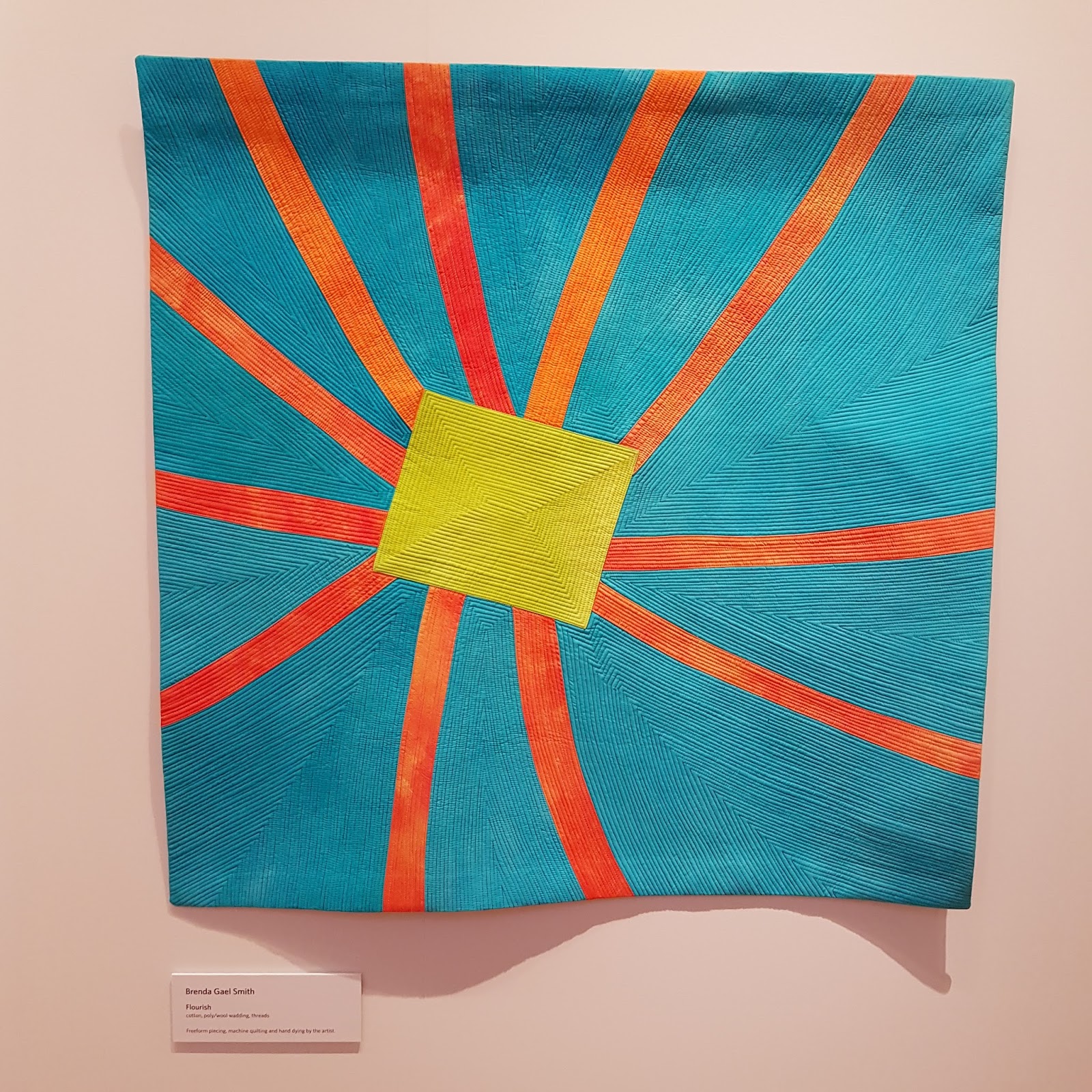
Various exhibitions when I happened to visit, including one on Frederick Strange, a colonial painter of Launceston (I liked the watercolours more, but it was the oil paintings that drew me more deeply into imagining what it would actually have been like to see and live in 19th century Tasmania), and 'Art Quilt Australia 2017', the main room of which I walked straight through on first pass, so uninterested was I, but on a more careful look, lots of them proved worth the closer examination, with the best being genuinely painterly.

Below: Alison Withers, "Cassidy's gap"; Jill Rumble, "Telling secrets III"; Louise Wells, "Dusk"; Cherry Johnston, "Circles of life"; Brenda Gael Smith, "Flourish".


Sunday, October 15, 2017

Peter Høeg - Miss Smilla's Feeling For Snow

It's quite something how many little lines, images and scenes had stayed with me from when I previously read this, nearly a decade ago - a testament to the sharpness of Høeg's writing and his ability to find unusual (and evidently memorable) angles on things.

The main reason I went back and re-read it was the first person present tense voice in which it's written, and I must say that while the voice contributes a lot to its distinctiveness, this time round I'm not sure what purpose is served by the use of the present tense in particular; also interesting is the way that the narrative jumps around in time quite a bit, and that Peter often speaks in the present tense.

Other things: extensive use of simile; often funny (Smilla Jaspersen really is a wonderful creation); frequent misdirects (e.g. Smilla internally monologues in one direction and then turns around and says that what's going on with her is its exact opposite) - the last of which are frequently the entry points into a scene, serving treble purpose as backstory-delivery, characterisation and avoiding jumping straight in with either the bluntness of action or the filler-ness of scene description. Also, it's still a great read, pacy, atmospheric, philosophical and human.

Thursday, October 12, 2017

"The Museum of Everything" & the collection (MONA)

There's something about MONA - my relationship with the museum is disproportionate to only having visited twice before (admittedly, both extended visits), in 2011 and 2014, and so this trip came with plenty of existing associations, both general and in relation to individual works.

The current exhibition, "The Museum of Everything", is a 'takeover' by the travelling museum of the same name, installing an array of work by artists who are self-taught and outside the traditional art-making system (many with some kind of disability or mental illness); a roomful of Henry Darger in the middle but much, much else too. Not a field ('style' doesn't feel quite right) that has ever much appealed to me, but it does throw up some unusual modes of expressing perspectives and personal truths, as well as some interesting through-lines to the art canon.

In the first of those categories, ones that struck me included Marcel Storr's fantastically detailed cathedrals, William Mortensen's 1920s witchcraft photos and Ionel Talpazan's 'self-powered UFOs'.


And in the second category, notable ones were Hilma af Klint's theosophical watercolours from the 1930s, and Joseph Yoakum's mountain ranges and Anna Zemankova's 'interior botanies' (both from the 1960s).


Also very pleasing: the anonymous 'devil drawings' from early in the 19th century and Louis DeMarco's 'personal aphorisms'.


The presentation of that exhibition is quite conventional in some ways, going room by room according to loose theme - an interesting but, I think, effective choice to present and make some sense of a collection of pieces that (1) don't conform to any particular stylistic patterns or movements and (2) comprise the exhibition's argument for the value or interest of works created by outsiders.

* * *

And then there was the general collection, much of which I'd seen on previous visits, meaning that some of the most striking have taken on a difference valence through familiarity and time, as well as the space itself now being considerably less overwhelming, and either I've just gotten used to it or it actually has veered just a touch more conventional over the years. Anyhow, of note:

  • "Kryptos" (Brigita Ozolins) was the one that I most wanted to revisit. It feels like the externalisation of something - some chamber - within myself. Still powerful.
  • I visited the 'death chamber' for the first time, having been put off by the queues on previous occasions. Mummy and 'mummy' in a darkened, water-filled chamber through which one moves via a series of steps, a disquieting print on one wall that turns out to be a Serrano. It didn't move me, even though I got to go in alone.
  • Took a beanbag for a few songs' worth of Candice Breitz's "Queen (A Portrait of Madonna)". Good for the soul.
  • There were several Pat Brassington photos that I don't think were there before - good.
  • Another new one: Patrick Hall's "Lure", its spectral faces projected onto fishing lures and morbid accompanying text, is terrific.
  • The untitled Jannis Kounellis with the goldfish is sharp.
  • Always good to see Nolan in this context, including the monumental "Snake".


Wednesday, October 11, 2017

Blade Runner 2049

I'm not sure yet where my feelings on this one will land but on a first impression Blade Runner 2049 is impressive, especially in the way it uses visuals to set scene and story, with several of the shots having an immediately iconic feeling[*] - it's one of the most beautiful films to come along in some while - and in the way it handles its relationship with the original: a convincingly similar visual style and mood, coverage of the same themes (perhaps to a fault, to some degree) and building on the outlines of its events,[**] and for all of that neither parodically repeating its beats nor winkingly referential, as its own story, Gosling's K and his trajectory and the way it intersects with the wider arc of replicant consciousness and self-determination, holds the attention.

[*] Maybe not surprising given that the director is Denis Villeneuve, of Arrival and Sicario.
[**] Although it's interesting - even though it's faithful to the themes and enigmas of its 1982 predecessor, including in the details and perspectives that it adds to its story, somehow the original remains very much its own thing rather than being retrospectively altered by this new chapter.