Lately I've been wondering if I'm not in the process of experiencing a genuine shift in musical dominant away from indie and alt-rock - whether the Arcade Fire mightn't have been something of the last hurrah as far as that field went for me. If there is such a shift going on, though, I don't know where albums like Silent Alarm will fit in.
I mean, it's really rather good.
I don't mind derivativeness unless it becomes distracting or makes a record boring to listen to, neither of which is the case here. Nor could I care less whether a band or musician is part of a movement or if they've been hyped half to death by NME & co - I don't have any difficulties in dealing with the idea that musical merit isn't the main driver behind whether or not I ever hear of an artist, or how many people like them or buy their records. So, all in all, I've been pretty happy with the current so-called post-punk/new wave revival - even if I've been paying attention only incidentally - and consider it a good result that it's thrown up at least one (though probably only one) band with something of an air of greatness about them in Interpol, as well as a whole lot of fun party anthems (every second Strokes song, "Take Me Out", "House of Jealous Lovers", "Mr Brightside", "Bandages", and plenty of others as heard on the radio).
So I thought that "Banquet" was flippin' excellent - jittery-catchy, groovy-rhythmic, slightly unhinged-exciting, and ends before you want it to, so that you have to listen to it again straight away. But I didn't get enthused about Bloc Party despite all the gushing press writeups of the album and the band (not always the same thing), mainly, I guessed, because of aforementioned shift in my own horizons. Now I come to listen to the album, and find that (a) a lot of it is very banquetesque and (b) it's very good.
Hard to pick highlights, but a few (apart from "Banquet" itself) might be opening double-punch "Like Eating Glass" and "Helicopter", "She's Hearing Voices" (best Joy Division title that never was), and the positively pretty "So Here We Are". When the band get it right, this record flips a lot of the right switches in my head in a way that not many out and out rock bands do these days - PGMG, Interpol, maybe Spoon and the Yeah Yeah Yeahs, and that's about it - but still I'm not as excited about the album as much as I feel I should be. Whether this is to do with my current musical positioning, or the album itself, is, I suppose, a moot point. Still, if anyone casually backlashes against Bloc Party or Silent Alarm while I'm around, at least without a very cogent defence indeed, just watch my dust as I scathe the backlasher with a suitable amount of derision.
Thursday, August 25, 2005
An incomplete list of artists about whom I know almost nothing but whose albums I would probably buy for $10, and certainly for $5
- Hem (and would probably pay considerably more if it had the songs I've heard)
- Saloon
- Slumber Party (already missed one opportunity in the past due to extreme impecuniosity and not properly appreciating their probable brilliance at the time; if opportunity knocks again, will not be found wanting)
- Sam Phillips
- Whistler ("If I Give You A Smile" is still one of the best bittersweet, gently melancholy, end-of-summer sad songs I've ever heard)
- Leona Naess (but only if it had "Charm Attack")
- Julie Miller
- Helium (is one live b-side reason enough? Yes!)
- The Autumns (but would need to have "June in Her Frost and Furs")
- The Fire Show (well, probably - but I'd definitely regret it afterwards if I didn't)
- Gloss (with some trepidation, but I'd still buy it, just in case it had even one other song as good as "Lonely in Paris")
And five brilliant albums which I've bought under precisely those conditions (all $5, I think):
1. Belly - King
2. Gersey - Hope Springs
3. Azure Ray - Hold On Love
4. Eileen Rose - Long Shot Novena
5. The Dearhunters - Red Wine & Blue
- Saloon
- Slumber Party (already missed one opportunity in the past due to extreme impecuniosity and not properly appreciating their probable brilliance at the time; if opportunity knocks again, will not be found wanting)
- Sam Phillips
- Whistler ("If I Give You A Smile" is still one of the best bittersweet, gently melancholy, end-of-summer sad songs I've ever heard)
- Leona Naess (but only if it had "Charm Attack")
- Julie Miller
- Helium (is one live b-side reason enough? Yes!)
- The Autumns (but would need to have "June in Her Frost and Furs")
- The Fire Show (well, probably - but I'd definitely regret it afterwards if I didn't)
- Gloss (with some trepidation, but I'd still buy it, just in case it had even one other song as good as "Lonely in Paris")
And five brilliant albums which I've bought under precisely those conditions (all $5, I think):
1. Belly - King
2. Gersey - Hope Springs
3. Azure Ray - Hold On Love
4. Eileen Rose - Long Shot Novena
5. The Dearhunters - Red Wine & Blue

Wednesday, August 24, 2005
Bloomsbury Good Reading Guide (6th ed) edited by Nick Rennison
My high school library had one of those 'rock encyclopedia' type books, a thick, glossy, and at the time exhaustive-seeming tome, which I used to browse through in spare periods in those last couple of years at school, as the Cure, the Smiths, Joy Division, Pink Floyd, Led Zeppelin and various other 'old' bands increasingly imposed themselves on my musical horizons, and pop music itself grew increasingly important to me.
Anyway, I guess that this 'Bloomsbury Good Reading Guide' is kind of a literary equivalent, although with less of a sense of (intended or actual) comprehensiveness. It focuses mostly on 20th century literature (in the broad sense of the term, so that we see Tom Clancy, David Eddings, and others of their cultural-status ilk - though no J K Rowling or Helen Fielding, interestingly) but includes some notable novelists from earlier times - Defoe, Austen, Joyce, Dostoevsky, and plenty of others). Obviously I haven't read it from cover to cover, but it's fab to dip into.
It would be pointless to quibble about the selections and omissions, or to dwell on the values that these reflect - naturally enough, there's a bias towards popular literary authors, both contemporary and relatively recently past (Calvino, Kundera, Atwood, Rushdie, Murdoch, Fowles, etc), but there's also substantial representation for the popular fantasy/sf genres (sf not so surprising - Asimov, Clarke, Gibson - nor some of those at the margins, like Le Guin, but the fantasy entries tend to be blockbuster writers, though I have to say that the compilers have managed to pick all of the best ones, as far as I'm concerned - Eddings, Donaldson, Jordan, Feist...and, in a somewhat different vein, Pratchett...missing only George R R Martin, who at least gets a mention in one of the lists and, again in a slightly different vein, China Miéville). Detective fiction also well represented, which is again not so surprising nowadays.
Also pointless to remark on how many of my favourites are included, though it did make me happy to see a few whose names I wouldn't necessarily have expected to see in a selection as comparatively brief as this one, in Donna Tartt, Kate Atkinson and Haruki Murakami (okay, I know they're not exactly underground, but you still wouldn't confidently bet on them being the ones from the contemporary scene to turn up in a 'good reading guide' - omissions include Franzen, Eugenides, Moody and David Foster Wallace, to name just a few heavy hitters).
Actually, one of the good things about this guide is that it's not limited to author (and 'major work') entries, though they're what I've been referring to in talking about whether given authors were or were not included, and those entries do dominate the book. There are also plenty of 'startpoints' and 'read on a theme' lists (examples of the latter: 'on the edge of sanity', 'dark old houses', 'art for whose sake?', 'good and evil', 'money', etc), and some slightly longer 'pathways' (starting from a particular book - Gormenghast is one, but the paths leading from it, from what I recognised of them, weren't terribly exciting).
Gosh, how nerdy! :)
Anyway, I guess that this 'Bloomsbury Good Reading Guide' is kind of a literary equivalent, although with less of a sense of (intended or actual) comprehensiveness. It focuses mostly on 20th century literature (in the broad sense of the term, so that we see Tom Clancy, David Eddings, and others of their cultural-status ilk - though no J K Rowling or Helen Fielding, interestingly) but includes some notable novelists from earlier times - Defoe, Austen, Joyce, Dostoevsky, and plenty of others). Obviously I haven't read it from cover to cover, but it's fab to dip into.
It would be pointless to quibble about the selections and omissions, or to dwell on the values that these reflect - naturally enough, there's a bias towards popular literary authors, both contemporary and relatively recently past (Calvino, Kundera, Atwood, Rushdie, Murdoch, Fowles, etc), but there's also substantial representation for the popular fantasy/sf genres (sf not so surprising - Asimov, Clarke, Gibson - nor some of those at the margins, like Le Guin, but the fantasy entries tend to be blockbuster writers, though I have to say that the compilers have managed to pick all of the best ones, as far as I'm concerned - Eddings, Donaldson, Jordan, Feist...and, in a somewhat different vein, Pratchett...missing only George R R Martin, who at least gets a mention in one of the lists and, again in a slightly different vein, China Miéville). Detective fiction also well represented, which is again not so surprising nowadays.
Also pointless to remark on how many of my favourites are included, though it did make me happy to see a few whose names I wouldn't necessarily have expected to see in a selection as comparatively brief as this one, in Donna Tartt, Kate Atkinson and Haruki Murakami (okay, I know they're not exactly underground, but you still wouldn't confidently bet on them being the ones from the contemporary scene to turn up in a 'good reading guide' - omissions include Franzen, Eugenides, Moody and David Foster Wallace, to name just a few heavy hitters).
Actually, one of the good things about this guide is that it's not limited to author (and 'major work') entries, though they're what I've been referring to in talking about whether given authors were or were not included, and those entries do dominate the book. There are also plenty of 'startpoints' and 'read on a theme' lists (examples of the latter: 'on the edge of sanity', 'dark old houses', 'art for whose sake?', 'good and evil', 'money', etc), and some slightly longer 'pathways' (starting from a particular book - Gormenghast is one, but the paths leading from it, from what I recognised of them, weren't terribly exciting).
Gosh, how nerdy! :)
Cyndi Lauper - At Last
Unfortunately, sometimes a record turns out to be only as good as you expected it'd be likely to be (though you buy or, in this case, borrow it anyway, just on the off chance); this is one such. Thirteen songs' worth of Lauper interpreting pop classics and standards - the ones I was really curious to hear being "Walk On By", "Unchained Melody" and "My Baby Just Cares For Me" - and, well, it's just not particularly good. Quite brave to put her voice right up the front of the mix, with the instruments being mixed down low and relatively sparse in the first place anyway, and there's a bit of a torchy effect going (especially with the piano ballads, which is most of 'em), but, while I don't know what the consensus on her voice is, I find it a bit piercing, especially when she reaches for the high notes (I actually winced during my first listen to her "Walk On By"). A couple of the songs half work, amidst the thickets - but thickets most of it is. Oh well.
Peter Carey - True History of the Kelly Gang
I'd expected that Carey's faithful reproduction of the Jerilderie letter style of prose would make this quite difficult to plow through (not that I'd read the letter before reading True History, but still...), but in fact it's a really easy read - very entertaining and (hoary old cliche this) difficult to put down. It seems most realistic, and the characters are completely believeable and human - and it's pulled forward by a strong narrative thread (informed for us as readers, of course, by our knowledge of how it's going to end - "such is life"). Having finished it, one is left with the thought that perhaps that really is how it all happened - it's convincing!
It's not that Carey appears unaware of postmodern claims regarding history, literature, narrative and so on - indeed, the textuality of the novel is foregrounded in the way that it takes place within the framing device of it being an account, collected in several parcels (with introductory notes written by some future historian), as well as the interspersal of newspaper clippings and various other figurings of the 'textual' trope. But this foregrounding functions to bolster the 'authenticity' of the central textual narrative (perhaps in the way that early novels were often set up as 'collections of papers which have fallen into the author's hands', etc - Robinson Crusoe, for example) rather than to radically throw into question its validity or legitimacy; the questioning of history and partial irony of the 'True' in the title is more a questioning of received history in its dominant form than of the possibility of History itself. And it works really well.
It's not that Carey appears unaware of postmodern claims regarding history, literature, narrative and so on - indeed, the textuality of the novel is foregrounded in the way that it takes place within the framing device of it being an account, collected in several parcels (with introductory notes written by some future historian), as well as the interspersal of newspaper clippings and various other figurings of the 'textual' trope. But this foregrounding functions to bolster the 'authenticity' of the central textual narrative (perhaps in the way that early novels were often set up as 'collections of papers which have fallen into the author's hands', etc - Robinson Crusoe, for example) rather than to radically throw into question its validity or legitimacy; the questioning of history and partial irony of the 'True' in the title is more a questioning of received history in its dominant form than of the possibility of History itself. And it works really well.
Zadie Smith - Martha and Hanwell
Two stories, "Martha, Martha" and "Hanwell in Hell", both originally published in literary mags (Granta and The New Yorker respectively), and both very English indeed in that 'hanging on in quiet desperation' sort of way. I don't think they quite work - Smith's strength is in polyglot exuberance and energy, not this comparatively joyless, drab, small-moments-of-partial-redemption-and-barely-so-at-that style. But not a dead loss, either, and far be it from me to complain simply because her attempts to stretch herself aren't 100% successful at this stage.
D M Thomas - The White Hotel
Basically read this over again in interests of class paper (delivered yesterday). Got much more out of it this time round, though still am not sure I like it all that much. Class discussion not bad, though didn't deliver me to new heights of insight either (though it would have had I not been thinking about the text reasonably intensively during the hours immediately before class)...I was happy that a fair bit of the discussion was haunted by my hand-waving in the direction of a so-called 'metaphysics of absence', too!
Monday, August 22, 2005
F Scott Fitzgerald - The Diamond as Big as the Ritz
Reasons for picking this one: one part "Calling It Quits" lyric, and three or four parts The Great Gatsby being, well, great.
Response straight after reading it: hmm, it was good, but what was it all about?
Fitzgerald's world is far removed from mine - it's a world of luxury and formality, where the codes are all different - which makes it particularly difficult to make sense of his representation of a world when that representation itself seems already self-consciously encoded. So, I like the story, in its fey satirical depiction of wealth and those who possess it, but don't feel as if I properly understand it - and it's not as human as Gatsby, which diminishes my enjoyment of it.
Response straight after reading it: hmm, it was good, but what was it all about?
Fitzgerald's world is far removed from mine - it's a world of luxury and formality, where the codes are all different - which makes it particularly difficult to make sense of his representation of a world when that representation itself seems already self-consciously encoded. So, I like the story, in its fey satirical depiction of wealth and those who possess it, but don't feel as if I properly understand it - and it's not as human as Gatsby, which diminishes my enjoyment of it.
Dave Eggers - Short Short Stories
OK, OK...these are often rather good - I might need to concede a genuine, if not yet wholehearted, slide in the direction of 'Eggers good' at this point (though I haven't read You Shall Know Our Velocity yet, and it was his other long form, AHWOSG, that most vexed me even as I enjoyed it). They really are short short stories, averaging at about 400 or so words, I reckon. There are the quirky ones, which are the ones I like best ("What the Water Feels Like to the Fishes", or "Of Gretchen and de Gaulle", say). There are the vaguely Carver-esque ones ("Georgia Is Lost" being the most obvious, and one of the weaker entries; "How Long It Took" is another). Overlapping a bit with those, there are the often angry social observation ones ("A Circle Like Some Circles", "You'll Have to Save That for Another Time"). There are the political ones ("Sleep to Dreamier Sleep Be Wed" wears its sentiments a bit on its sleeve, but its heart is in the right place; "It Is Finally Time to Tell the Story" is pure and simple a joy).
For mine, there are two pieces here which rank with the 'letters to captains of industry from Steven, a dog', in the Burned Children of America anthology, as my favourite-to-date Eggers pieces of writing - "What the Water Feels Like to the Fishes" and "Weird Wife". Both are whimsical and light but come off as oddly, almost incidentally profound as well - which is a damn good trick in writing of any form.
For mine, there are two pieces here which rank with the 'letters to captains of industry from Steven, a dog', in the Burned Children of America anthology, as my favourite-to-date Eggers pieces of writing - "What the Water Feels Like to the Fishes" and "Weird Wife". Both are whimsical and light but come off as oddly, almost incidentally profound as well - which is a damn good trick in writing of any form.
Nada Surf - Let Go
Not as good as I'd hoped it might be, but about as good as I expected it to be. On the strength of "The Way You Wear Your Head" and, especially, "Inside of Love", I was willing to risk $10 on this, but I can't say that I'm surprised that they turned out to be the best songs on the album. It's quite emo in places - a genre making increasing inroads into my collection, mostly through the backdoor - and fairly Weezer-esque, too, though for the most part without the facility for tunes of that latter ("Treading Water" reminds me a bit of Cave In, not least in the not having much in the way of a tune).
Oh, and it's "making out with people I hardly know or like", not "making out with people I hardly know a lot"; oh well, the sentiment is more or less the same in the context.
Oh, and it's "making out with people I hardly know or like", not "making out with people I hardly know a lot"; oh well, the sentiment is more or less the same in the context.
Yo-Yo Ma, Edgar Meyer & Mark O'Connor - Appalachia Waltz
One of the source albums for Heartland; more quality stuff.
Sunday, August 21, 2005
Kung Fu Hustle
Everything that one might hope for in a film like this - tops fight scenes, endless face-offs, uniformly clad bad guys who rush in waves to get beaten up, hilarious slapstick, a colourful ensemble of characters, high pathos, villainous villains, unlikely heroes, and even a superlatively incidental but rather sweet romance. Great fun; made me laugh plenty.
Beth Hart - Screamin' For My Supper
Not so much sub- as simply post-Alanis late 90s angsty chick rock (and you know I wouldn't use a phrase like 'chick rock' unless I really wanted to make a point), the comparison being made obvious by some none-too-occasional similarities in vocal style. There are a few good ideas in Hart's mix, but they get lost amidst the blandness of it all.
...which is possibly an overly harsh appraisal, because during the couple of times that I've spun Screamin' For My Supper, I've sometimes had the feeling that there was a bit more going on - that the album was almost breaking into something better. There are albums that I feel might well prove more rewarding if I persevered with them for a bit longer, but the fact of the matter is that life's too short (and there's too much music out there) to invest that much time in all of the records which might, but probably wouldn't, benefit from determined repeat spinning.
...which is possibly an overly harsh appraisal, because during the couple of times that I've spun Screamin' For My Supper, I've sometimes had the feeling that there was a bit more going on - that the album was almost breaking into something better. There are albums that I feel might well prove more rewarding if I persevered with them for a bit longer, but the fact of the matter is that life's too short (and there's too much music out there) to invest that much time in all of the records which might, but probably wouldn't, benefit from determined repeat spinning.
Kasey Chambers - Wayward Angel
Looking back, in some ways my liking of Kasey Chambers was an early precursor of the musical waters I've been swimming in over the last 10 or 12 months or so; coming back to her now, via this, her most recent (I think) album, I've realised that she really is very good, even with the perspective that having listened to a lot more of this kind of stuff has brought (in fact, that perspective has allowed me to better appreciate the things that set her apart).
Wayward Angel doesn't have quite the seemingly artless fluency and sweetness of The Captain and Barricades & Brickwalls, but it may well be a better record than either of those. I tend to like the songs with banjo on them ("Bluebird", "Wayward Angel", "Follow You Home"); "Like A River" also v. good. Also, it might just be me, but it seems that Chambers's voice is less distinctive (many would say 'irritating', though I've never been one of those) than I recall - whether that's something else born of this different perspective, or an actual shift in her singing style, I don't know. The singing and songwriting seems so confident - both are pushed right to the front of one's awareness and it's a testament to their strength and warmth that this foregrounding doesn't result in any kind of diminishing.
Wayward Angel doesn't have quite the seemingly artless fluency and sweetness of The Captain and Barricades & Brickwalls, but it may well be a better record than either of those. I tend to like the songs with banjo on them ("Bluebird", "Wayward Angel", "Follow You Home"); "Like A River" also v. good. Also, it might just be me, but it seems that Chambers's voice is less distinctive (many would say 'irritating', though I've never been one of those) than I recall - whether that's something else born of this different perspective, or an actual shift in her singing style, I don't know. The singing and songwriting seems so confident - both are pushed right to the front of one's awareness and it's a testament to their strength and warmth that this foregrounding doesn't result in any kind of diminishing.
Thursday, August 18, 2005
"A secret I don't even know": The Forgotten Arm, again
Although, as ever, there's plenty of other music floating around me, The Forgotten Arm has been very much the soundtrack to my last few weeks. The achingly pretty heartbrokenness of "Little Bombs" and "That's How I Knew This Story Would Break My Heart" has kept them my favourites, but I've grown to love every song - especially, at the moment, the incongruously jaunty "I Can't Get My Head Around It" and the moody "King of the Jailhouse".
This isn't the place to rehash all the reasons why I like Mann's music so much, but one thing which struck me yesterday, walking home after uni and listening to the album, was that the specific lyrical concerns of her songs, and of those on this album in particular, often aren't particularly consonant with my own experiences and life - I mean, what do I know about co-dependent love affairs, or the helplessness of being in love with someone who I know is going to let me down? But, despite that, for me the lyrics play a large part in the brilliance of her music, and really speak to me, and I think that there are two reasons for this.
First, the literacy and evocativeness of many of the lines cause them to stand out and stick in the mind quite irrespective of the words around them ("kicking is hard, but the bottom's harder"; "and though the exit is crude, it saves me coming unglued"; "you pulled up and parked your El Dorado/we said 'hi' and kissed with some bravado"...). And second, and relatedly, Mann's songs are so well constructed that often the most memorably universal lines are placed so that they become central to the musical shape of the piece, being highlighted and repeated at key times (choruses, especially), so that the lyrical and melodic hooks often coincide: "baby, there's something wrong with me"; "that's just not the way you make me feel", "life just kind of empties out", "that's how I knew this story would break my heart"...As a result, the sadness in such lines takes on a universally resonant tone - another element of Mann's wonderful songcraft.
I still think of Bachelor No 2 as the high water mark of Mann's discography, partly because it's indefinably somehow sharper-edged and more clear-sighted, partly because it seems to both soar and ache just a bit more vividly, but mostly, I think, because it was the first of her albums that I heard - but The Forgotten Arm isn't far behind, and it's that latter which is speaking most clearly to me at the moment.
This isn't the place to rehash all the reasons why I like Mann's music so much, but one thing which struck me yesterday, walking home after uni and listening to the album, was that the specific lyrical concerns of her songs, and of those on this album in particular, often aren't particularly consonant with my own experiences and life - I mean, what do I know about co-dependent love affairs, or the helplessness of being in love with someone who I know is going to let me down? But, despite that, for me the lyrics play a large part in the brilliance of her music, and really speak to me, and I think that there are two reasons for this.
First, the literacy and evocativeness of many of the lines cause them to stand out and stick in the mind quite irrespective of the words around them ("kicking is hard, but the bottom's harder"; "and though the exit is crude, it saves me coming unglued"; "you pulled up and parked your El Dorado/we said 'hi' and kissed with some bravado"...). And second, and relatedly, Mann's songs are so well constructed that often the most memorably universal lines are placed so that they become central to the musical shape of the piece, being highlighted and repeated at key times (choruses, especially), so that the lyrical and melodic hooks often coincide: "baby, there's something wrong with me"; "that's just not the way you make me feel", "life just kind of empties out", "that's how I knew this story would break my heart"...As a result, the sadness in such lines takes on a universally resonant tone - another element of Mann's wonderful songcraft.
I still think of Bachelor No 2 as the high water mark of Mann's discography, partly because it's indefinably somehow sharper-edged and more clear-sighted, partly because it seems to both soar and ache just a bit more vividly, but mostly, I think, because it was the first of her albums that I heard - but The Forgotten Arm isn't far behind, and it's that latter which is speaking most clearly to me at the moment.
24 Hour Party People OST
Still haven't got around to watching this, mainly because it seems likely to be fairly heavily focused on the Happy Mondays (really, I don't have any good reason to dislike them, except that: (a) it's basically drug music; (b) Shaun Ryder seems like an obnoxious twit; and (c) the Black Grape album I've got on tape isn't, to be frank, any good; which, all told, is plenty reason enough). This soundtrack is a good listen, and there's no denying the number of stone cold classics it holds, but I have nearly all of the songs I like on cd already, and don't feel particularly enriched by the early house/Happy Mondays/various others making up the tracklist (though interesting to hear another Durutti Column song). Oh yes, and I could've lived without the live Moby version of "New Dawn Fades" (backed by New Order, John Frusciante and Billy Corgan, sheesh); in fairness, it's not that bad, but really, this song did not need to be covered, least of all by Moby.
Music from the motion picture Magnolia
Have actually listened to this record before, but a few years ago, before I completely fell in love with Aimee Mann. Coming back to it now, I find that I already know a lot of the songs (whether via their subsequent inclusion on Bachelor No 2 or through other channels), and have been prompted to wonder if maybe "Wise Up", and not "Save Me", is her best song (both are on this album); also, "Driving Sideways" is better than I'd recalled. (Oh yeah, and I don't know anything about Supertramp, having always had the impression that they were sort of bland middle of the road 70s pop-ites, but the two songs of theirs that are on this soundtrack are pretty good.)
I also enjoyed reading P.T. Anderson's liner notes about the relationship between Mann's music and the film; it begins, "I sat down to write an adaptation of Aimee Mann songs. Like one would adapt a book for the screen, I had the concept of adapting Aimee's songs into a screenplay". Makes me want to watch Magnolia again, yo, having had mixed feelings about it the first time around (which was before I was familiar with Mann's music at all).
I also enjoyed reading P.T. Anderson's liner notes about the relationship between Mann's music and the film; it begins, "I sat down to write an adaptation of Aimee Mann songs. Like one would adapt a book for the screen, I had the concept of adapting Aimee's songs into a screenplay". Makes me want to watch Magnolia again, yo, having had mixed feelings about it the first time around (which was before I was familiar with Mann's music at all).
Sunday, August 14, 2005
Iain Sinclair - White Chappell, Scarlet Tracings
I struggled a bit with the complexity and mysticism of this one. It starts promisingly, introducing a quartet of grotesque, almost Peakean antique/secondhand book dealers and the cast of misfits and nasties whose demi-monde they inhabit, but then gets very confusing as it spins off two more major storylines, one set in early to mid nineteenth century London and tracing out a Jack the Ripper theory, many of the outlines of which were broadly familiar to me thanks to From Hell, the other following a pair of peculiar investigators in contemporary times who are trying to unravel the mystery of those Whitechapel murders. I must confess that I didn't really 'get' it. The secondary source in the subject reader made things clearer, and I'll probably return to this book at some stage (if most likely not this semester) to give it a more attentive, committed reading.
"Can't hear it on the radio": Wilco - A Ghost Is Born
A Ghost Is Born is a good album, but I'm not sure yet just how good. Sometimes I think it's right up there with Summerteeth as a truly great album, but at other times I'm more ambivalent, reckoning it to miss as often as it hits. To start with the definite hits: the opening five cuts are all really good, especially the "Spiders (Kidsmoke)" - "Muzzle of Bees" - "Hummingbird" sequence. The moody, midtempo rock atmospherics are delicately, perfectly balanced from the slow piano beginning and the sliding yet careful guitar line which cuts in at about 2 minutes in through the elegant rockisms of the rest of the album's opening run (I particularly like "Spiders (Kidsmoke)"). But I'm not so sure about the record's second half-and-a-bit, which doesn't make me feel in the same way and sometimes feels like a regression to the blandness of YHF and the one or two less distinguished moments on Summerteeth; whereas the first few tracks derive their glory from their subtlety and understatedness, these last ones can drag a bit and seem just plain uninteresting. Good to see that the band haven't lost their facility for silvery jingles - as evident in "The Late Greats" - and, to a lesser extent, "Hummingbirds", too.
Maybe this is one that needs to be lived with over an extended period of time in order to fully unfurl itself, because it does seem to take on a different hue and complexion with each listen - and especially its second half...besides, Wilco albums always grow on me gradually, to greater or lesser extents.
Maybe this is one that needs to be lived with over an extended period of time in order to fully unfurl itself, because it does seem to take on a different hue and complexion with each listen - and especially its second half...besides, Wilco albums always grow on me gradually, to greater or lesser extents.
The Princess Bride
Noticed that this was screening at the Astor the day before (Friday for Saturday) and finally got my act together to see it on the big screen. Still a joy!
Jeanette Winterson - Sexing the Cherry
Winterson is definitely a key figure in my development as a reader. She may have been the first 'literary' writer whose work I really loved, and she was definitely my very favourite author for a few years there. I'm a bit vague on the timing, but I think it must've been lateish high school or very early uni that I discovered her - maybe even in that mythical summer between school and uni. I remember giving Kim a copy of one of her books (Art & Lies, maybe), only to discover that she already knew and loved Winterson's work. I remember drifting off to sleep, ideas and images dancing before my eyes, re-reading The Passion one drowsy summer afternoon in the Alexandra gardens, under the dappled shade of a gigantic tree. I remember writing an extended appreciation of Written On The Body for my 4000 word final paper in "Reading Sexuality", even though Winterson's work didn't appear on the course at all. And I was still enough of a fan to give Daniel R a Winterson book (Gut Symmetries, I think) at some point in the gathering twilight of our doomed acquaintance...which brings us at least up to, say, mid-2002.
Somewhere along the line, though, I moved on. It was in the period before or around the time that The.Powerbook came out; I remember being utterly unexcited by the prospect of reading it, and only got round to doing so a couple of years after its initial release. At that time, I wasn't reading very much at all outside of uni-related reading (and not all that much of that, either - a real extended grey winter of discontent which stretched for a couple of years or so and still isn't hasn't properly departed), and somehow when I emerged from the non-reading period, I'd gotten over Winterson. I no longer found her work particularly profound: what had seemed such glimmering, beautiful, poetic prose now looked merely self-consciously precious; what I'd found so insightful and meaningful had come to appear distressingly trite and insubstantial. It's not that I'd actually read any of her stuff recently at that stage - but just that I'd reevaluated my impressions of old reading (always a tricky thing to do).
A few further years on now, though, and things look slightly different again. Although when I did eventually read The.Powerbook, and Lighthousekeeping too, neither inspired me, I began to wonder if perhaps the violence of my swing away from her was more due to the exaggeration caused by disillusionment in relation to something I'd rated so highly than to an honest, 'objective' appraisal of how good she is or was (a telling ambiguity).
So anyhow, I've just re-read Sexing the Cherry for this "Contemporary Historical Fictions" subject, and y'know, it isn't too bad after all. These days, I'm far better versed in the sorts of ideas to do with perception, representation, reality, being (and time), identity, gender, writing, language, and so on (though not at all regarding love, the other big one in this book and throughout her oeuvre) which are Winterson's stock in trade than I was last time round, and so I can more clearly see the derivativeness in her writing...but I can also, having pushed through that initial disillusioning realisation that her ideas weren't particularly new after all, appreciate the deftness with which she synthesises and plays with the fluidity of these concepts...and after all, even if she wasn't the first to think these things, in many cases it was Winterson who introduced me to them, opening my mind and imagination in so many ways. (It's also made me realise how heavily my own writing of that time - 2001-2002ish - was marked by Winterson's style.)
* * *
On a different note, it was interesting to read this book, with which I'm very familiar, through the particular prism of 'contemporary historical fictions' - it definitely brings different aspects of the text into the foreground. I'd had a similar experience while reading V. The seminar discussion regarding that latter was good - I enjoyed it, thought that we covered a lot of the most important aspects of Pynchon's novel, and was forced to think through and struggle to articulate some of my more intuitive and deeper responses to it. Not sure how the seminar on Sexing the Cherry will go, as I think many of its aspects will be flattened out by the focus on its historical/historiographical nature, but it should be interesting nonetheless.
Somewhere along the line, though, I moved on. It was in the period before or around the time that The.Powerbook came out; I remember being utterly unexcited by the prospect of reading it, and only got round to doing so a couple of years after its initial release. At that time, I wasn't reading very much at all outside of uni-related reading (and not all that much of that, either - a real extended grey winter of discontent which stretched for a couple of years or so and still isn't hasn't properly departed), and somehow when I emerged from the non-reading period, I'd gotten over Winterson. I no longer found her work particularly profound: what had seemed such glimmering, beautiful, poetic prose now looked merely self-consciously precious; what I'd found so insightful and meaningful had come to appear distressingly trite and insubstantial. It's not that I'd actually read any of her stuff recently at that stage - but just that I'd reevaluated my impressions of old reading (always a tricky thing to do).
A few further years on now, though, and things look slightly different again. Although when I did eventually read The.Powerbook, and Lighthousekeeping too, neither inspired me, I began to wonder if perhaps the violence of my swing away from her was more due to the exaggeration caused by disillusionment in relation to something I'd rated so highly than to an honest, 'objective' appraisal of how good she is or was (a telling ambiguity).
So anyhow, I've just re-read Sexing the Cherry for this "Contemporary Historical Fictions" subject, and y'know, it isn't too bad after all. These days, I'm far better versed in the sorts of ideas to do with perception, representation, reality, being (and time), identity, gender, writing, language, and so on (though not at all regarding love, the other big one in this book and throughout her oeuvre) which are Winterson's stock in trade than I was last time round, and so I can more clearly see the derivativeness in her writing...but I can also, having pushed through that initial disillusioning realisation that her ideas weren't particularly new after all, appreciate the deftness with which she synthesises and plays with the fluidity of these concepts...and after all, even if she wasn't the first to think these things, in many cases it was Winterson who introduced me to them, opening my mind and imagination in so many ways. (It's also made me realise how heavily my own writing of that time - 2001-2002ish - was marked by Winterson's style.)
* * *
On a different note, it was interesting to read this book, with which I'm very familiar, through the particular prism of 'contemporary historical fictions' - it definitely brings different aspects of the text into the foreground. I'd had a similar experience while reading V. The seminar discussion regarding that latter was good - I enjoyed it, thought that we covered a lot of the most important aspects of Pynchon's novel, and was forced to think through and struggle to articulate some of my more intuitive and deeper responses to it. Not sure how the seminar on Sexing the Cherry will go, as I think many of its aspects will be flattened out by the focus on its historical/historiographical nature, but it should be interesting nonetheless.
Friday, August 12, 2005
Tujiko Noriko @ the Corner Hotel, Thursday 11 August
Well, in a sense I've been anticipating this gig since the last time sweet Noriko toured (February of last year @ Ding Dong, her first time in Australia), but despite the subliminal build-up of expectation it was anything but a disappointment; in fact, a couple of hours on, I'm still floating a little bit on how good it was.
This was a concert which I was always half-inclined to attend on my own, and in the end, that's what happened (mentioned it to a few people, but they were unable to make it because of, variously, ballet, impecuniosity, and a mother's birthday); as it turned out, though, a guy from my Heidegger subject - one Adam - was there, having heard one of her songs on the radio earlier this week and decided to roll up on spec, so I had company between the sets (Lachlan was also around with some friends)...as to which, I only caught the tail end of one of the support acts, and enjoyed the seemingly at least semi-improv, somewhat Mogwai-esque post-rock/noise-type act which followed.
But obviously this was all just so much fluff to be waited on until the main event. As expected, it was just Tujiko standing up the front with her laptop and singing (simple black knit and plain dark grey skirt - a contrast to the bright pink movie star dress she was in last time); quite a short set in the end - 45 minutes, maybe? - and mostly comprised of new songs. The cute factor was high, of course, from the regular smiles, to the charmingly fumbling English as she hunted around on her laptop for the file to accompany an encore, to the basic sweetness of her singing over the top of these glitch-heavy electroscapes. But it couldn't be mainly about anything but the music, as to which: the new tracks sounded good (especially one with some more organic instrumentation and a big hip hop beat in the midsection), but the clear highlight was "White Film" - it was a joyful moment when its opening strains floated out of the sound-weave and the whole song was a delight (especially the point when the layers all dropped away to leave the simple chiming tones which ring in the album version and Tujiko gave the crowd a gorgeous smile to accompany it).
I always think of her albums as very much headphone experiences, preferably to be enjoyed at home with space and silence all around. But listening to the music loud, distorting a bit through the speakers, mixing with the background noise, and generally seeming more cacophonous, and with that too-charming singing coming directly towards through, is, while different, an equally great experience. Saw it from a good spot - right in the middle, 7 or 8 metres away if that - and thought that it was all just too wonderful for words.
This was a concert which I was always half-inclined to attend on my own, and in the end, that's what happened (mentioned it to a few people, but they were unable to make it because of, variously, ballet, impecuniosity, and a mother's birthday); as it turned out, though, a guy from my Heidegger subject - one Adam - was there, having heard one of her songs on the radio earlier this week and decided to roll up on spec, so I had company between the sets (Lachlan was also around with some friends)...as to which, I only caught the tail end of one of the support acts, and enjoyed the seemingly at least semi-improv, somewhat Mogwai-esque post-rock/noise-type act which followed.
But obviously this was all just so much fluff to be waited on until the main event. As expected, it was just Tujiko standing up the front with her laptop and singing (simple black knit and plain dark grey skirt - a contrast to the bright pink movie star dress she was in last time); quite a short set in the end - 45 minutes, maybe? - and mostly comprised of new songs. The cute factor was high, of course, from the regular smiles, to the charmingly fumbling English as she hunted around on her laptop for the file to accompany an encore, to the basic sweetness of her singing over the top of these glitch-heavy electroscapes. But it couldn't be mainly about anything but the music, as to which: the new tracks sounded good (especially one with some more organic instrumentation and a big hip hop beat in the midsection), but the clear highlight was "White Film" - it was a joyful moment when its opening strains floated out of the sound-weave and the whole song was a delight (especially the point when the layers all dropped away to leave the simple chiming tones which ring in the album version and Tujiko gave the crowd a gorgeous smile to accompany it).
I always think of her albums as very much headphone experiences, preferably to be enjoyed at home with space and silence all around. But listening to the music loud, distorting a bit through the speakers, mixing with the background noise, and generally seeming more cacophonous, and with that too-charming singing coming directly towards through, is, while different, an equally great experience. Saw it from a good spot - right in the middle, 7 or 8 metres away if that - and thought that it was all just too wonderful for words.
Wednesday, August 10, 2005
Toni Morrison - Beloved
Vivid and affecting, Beloved left me with a clench in my throat and the feeling that I'd just read something real. The depiction of the violence being done to black people, slaves and otherwise, in mid-to-late-19th century America caught at me and wrenched - the first time for as long as I can remember that a novel has made me feel angry and upset. I suppose that it's a tribute to Morrison's craft and technical ability that I responded so strongly to a story which is, at least on the surface, far removed from my own experience - although the period setting and dialogue could easily have acted as a distancing factor, the prose in which the novel's written is so transparent, and its characters and situations ring so true, that I was immersed in the book's universe rather than ever being pulled up short by a sense of dislocation or unfamiliarity.
I'm finding it hard to look at this book critically so soon after having finished it, so just a few thoughts:
- It achieves a good balance between the individual story and the more universal aspects...I mean that the way in which it addresses the big picture never distracts from the details of the representation of the particular narrative of Sethe, Denver, Beloved, Halle, Paul D and the rest - somehow, the broader 'themes' are necessarily present and implicit in the way that the story is told.
- Relatedly, the novel strikes me as deeply moral without being moralising.
- White people are far from demonised - see Amy, the Garners, the Bodwins...
- There's cruelty and horror, but nearly all of it takes place 'off stage', as it were, in the rememberings of various characters.
- Also, I'm not even sure that Beloved is primarily concerned with the 'African-American experience', though that's obviously central...mind you, I'm not sure what else could be said to be its 'primary' concern - the continuing effect of history in the present, perhaps, or maybe just the ties that bind more generally.
- Again, the theme of hauntedness is made literal.
- The imagery can be a little obvious - Sethe's immense urination as a second breaking of waters when Beloved returns, the naturalistic spaces which Denver and Baby Suggs make their own, the three shadows holding hands (although that last functions quite interestingly in the end) - but, perhaps because of the clarity of Morrison's vision, it works effectively nonetheless.
- The technique of anticipating subsequent elaborations on the characters' historical narratives leaves me in two minds; it's obviously deliberate, but I can't quite work out what purpose it serves...perhaps that 'past operating in the present' idea again.
A pretty substantial blow to my theory that I increasingly only enjoy novels/films with which I can personally identify!
I'm finding it hard to look at this book critically so soon after having finished it, so just a few thoughts:
- It achieves a good balance between the individual story and the more universal aspects...I mean that the way in which it addresses the big picture never distracts from the details of the representation of the particular narrative of Sethe, Denver, Beloved, Halle, Paul D and the rest - somehow, the broader 'themes' are necessarily present and implicit in the way that the story is told.
- Relatedly, the novel strikes me as deeply moral without being moralising.
- White people are far from demonised - see Amy, the Garners, the Bodwins...
- There's cruelty and horror, but nearly all of it takes place 'off stage', as it were, in the rememberings of various characters.
- Also, I'm not even sure that Beloved is primarily concerned with the 'African-American experience', though that's obviously central...mind you, I'm not sure what else could be said to be its 'primary' concern - the continuing effect of history in the present, perhaps, or maybe just the ties that bind more generally.
- Again, the theme of hauntedness is made literal.
- The imagery can be a little obvious - Sethe's immense urination as a second breaking of waters when Beloved returns, the naturalistic spaces which Denver and Baby Suggs make their own, the three shadows holding hands (although that last functions quite interestingly in the end) - but, perhaps because of the clarity of Morrison's vision, it works effectively nonetheless.
- The technique of anticipating subsequent elaborations on the characters' historical narratives leaves me in two minds; it's obviously deliberate, but I can't quite work out what purpose it serves...perhaps that 'past operating in the present' idea again.
A pretty substantial blow to my theory that I increasingly only enjoy novels/films with which I can personally identify!
Marianne Faithfull - Before the Poison
Only so-so, which is disappointing. Most of the ten songs on this record were written or co-written with Faithfull by PJ Harvey or Nick Cave (there's also one by Damon Albarn, and one co-write with Aimee Mann collaborator Jon Brion), which ought to've been a fruitful series of collaborations. But, with the exception of a couple of Nick Cave ballads - "Crazy Love" and "There Is A Ghost" - and the Albarn track, "Last Song", the results don't do it for me; the music is ominous and churning and all that jazz, but it lacks the dark, cinematic lushness of a song like "Who Will Take My Dreams Away?", always the starting point for Marianne and I.
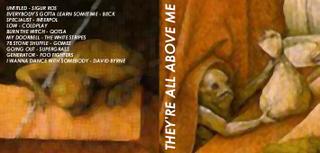
"They're All Above Me" & "CD2004"
Two cds from David. The first is a mix cd proper; the second is a copy of David's annual compilation of music he got into over the preceding year (presumably made for his own purposes some time ago).
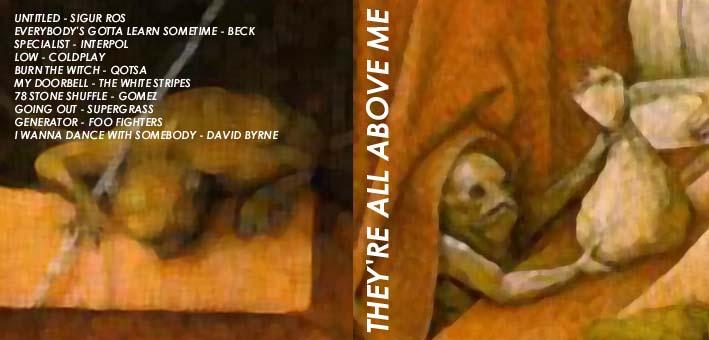
"They're All Above Me" is ten songs by 'David' bands and artists of various stripes...I don't think I know anyone else who's really into any one of Queens of the Stone Age, Gomez or Supergrass (though common sense and record sales tell me there must be thousands in Melbourne alone). It's neat, anyway. The common theme seems to be a kind of 'alternative mainstream' mindset and a certain jitteriness or nervous energy; how that fits with the Bosch cover is anyone's guess. I like the Sigur Ros and Beck songs ("Untitled" and "Everybody's Gotta Learn Sometime" respectively); Supergrass's "Going Out" also good; "My Doorbell"'s not all that I recalled, but still pretty good (likewise "Generator" - but then I always preferred the Color and the Shape singles more anyway); "Low" and "Burn The Witch" are, well, a Coldplay song and a QOTSA one; I already knew "Specialist" and "78 Stone Shuffle"; and David Byrne's "I Wanna Dance With Somebody" is suitably Byrne-esque and so both straight and ironic, but more 'straight', I think.
I already knew most of the songs on "CD2004", many through the good offices of David himself. It's a good listen, though - mostly modern rock, all catchy. Multiple songs from Low, Antics, the Walkmen, Phantom Planet, theredsunband and Kings of Leon. My five favourite songs on the cd, in order:
1. "The Rat" - The Walkmen (I'm not entirely sold on the Walkmen, but this song is flat out great)
2. "Sound and Vision" - David Bowie (the best 'pop' song on Low)
3. "Knowitall" - Phantom Planet (a real beast of an anthem)
4. "Revolution Blues" - Neil Young (probably the best song on On The Beach)
5. "Misery Is A Butterfly" - Blonde Redhead (shimmery chilly art-pop)
"They're All Above Me" is ten songs by 'David' bands and artists of various stripes...I don't think I know anyone else who's really into any one of Queens of the Stone Age, Gomez or Supergrass (though common sense and record sales tell me there must be thousands in Melbourne alone). It's neat, anyway. The common theme seems to be a kind of 'alternative mainstream' mindset and a certain jitteriness or nervous energy; how that fits with the Bosch cover is anyone's guess. I like the Sigur Ros and Beck songs ("Untitled" and "Everybody's Gotta Learn Sometime" respectively); Supergrass's "Going Out" also good; "My Doorbell"'s not all that I recalled, but still pretty good (likewise "Generator" - but then I always preferred the Color and the Shape singles more anyway); "Low" and "Burn The Witch" are, well, a Coldplay song and a QOTSA one; I already knew "Specialist" and "78 Stone Shuffle"; and David Byrne's "I Wanna Dance With Somebody" is suitably Byrne-esque and so both straight and ironic, but more 'straight', I think.
I already knew most of the songs on "CD2004", many through the good offices of David himself. It's a good listen, though - mostly modern rock, all catchy. Multiple songs from Low, Antics, the Walkmen, Phantom Planet, theredsunband and Kings of Leon. My five favourite songs on the cd, in order:
1. "The Rat" - The Walkmen (I'm not entirely sold on the Walkmen, but this song is flat out great)
2. "Sound and Vision" - David Bowie (the best 'pop' song on Low)
3. "Knowitall" - Phantom Planet (a real beast of an anthem)
4. "Revolution Blues" - Neil Young (probably the best song on On The Beach)
5. "Misery Is A Butterfly" - Blonde Redhead (shimmery chilly art-pop)
Neil Young - Greatest Hits
Neil Young is one of those artists who, when I'm not actually listening to his stuff, I tend to think is fairly boring and uninspiring, but whenever I do put one of his records on (I only have Harvest and On The Beach), I really, really enjoy it. (I'm particularly thinking of an end of summer melancholy evening walking down St Kilda Road, feeling really broken down and tired, listening to On The Beach and completely digging it.) And the same thing has come into play in listening to this greatest hits, much of which is new to me; the disc really hammers home how frickin great the man is. It's fiery and ragged and delicate and real - really quite incandescent.
The extended jams are great - I especially like "Cowgirl in the Sand" and "Like A Hurricane" - but the more tender moments are also wonderful (I'm gradually coming round to believing that Young's original version of "Only Love Can Break Your Heart" may be better than the Saint Etienne cover, which is iconic in its own right as far as I'm concerned...well, they're très different, obviously)...not that extendedness and tenderness are necessarily mutually exclusive, in principle or here in fact. Also, hearing the Harvest cuts in this context has made me reevaluate them a bit, and positively at that, realising that they're not quite so blandly middle of the road after all (finding myself singing along to "Old Man" and then - the kicker - "Heart of Gold" - was a bit of a giveaway...I already knew that "The Needle and the Damage Done" was something else).
I don't know if all great music necessarily ages well; for mine, greatness doesn't have to be 'for the ages', and greatness in the moment is greatness nonetheless. But, in any case, the music on this disc speaks pretty clearly to me.
The extended jams are great - I especially like "Cowgirl in the Sand" and "Like A Hurricane" - but the more tender moments are also wonderful (I'm gradually coming round to believing that Young's original version of "Only Love Can Break Your Heart" may be better than the Saint Etienne cover, which is iconic in its own right as far as I'm concerned...well, they're très different, obviously)...not that extendedness and tenderness are necessarily mutually exclusive, in principle or here in fact. Also, hearing the Harvest cuts in this context has made me reevaluate them a bit, and positively at that, realising that they're not quite so blandly middle of the road after all (finding myself singing along to "Old Man" and then - the kicker - "Heart of Gold" - was a bit of a giveaway...I already knew that "The Needle and the Damage Done" was something else).
I don't know if all great music necessarily ages well; for mine, greatness doesn't have to be 'for the ages', and greatness in the moment is greatness nonetheless. But, in any case, the music on this disc speaks pretty clearly to me.
Monday, August 08, 2005
Nelly Furtado - Folklore
From time to time, I take a mainstream pop single to heart, and "I'm Like A Bird" was one such when it hit the charts a while back; having dug out the cd single, I see that it was back in 2000...hard to believe that it was so long ago. Anyhow, Folklore was her follow up album - I haven't listened to the first - and veers quite strongly towards the 'global pop' side of things (in that respect, it recalls Arular), but isn't all that interesting. It starts off quite brightly, with banjo and mandolin tinkling away in the first couple of songs and some pleasant sung-chanted tunes, but the album doesn't really take off at any point, and the production is maybe a bit too 'top 40', giving it a glossy, homogeneous feel that doesn't do justice to Furtado's attempts to genre-hop and synthesise.
Profile II: The Best of Emmylou Harris
Another compilation, gathering recordings from 1979 to 1984. I don't know how this works, but somehow it always takes a couple of listens for me to get past Harris's voice and/or singing style in order to enjoy her music, after which that same voice and singing becomes the best part of the record (on this cd, the effect is particularly pronounced with the traditional number "Wayfaring Stranger", which has, of course, been recorded by countless others, each providing a comparison point for this version). Anyhow, I haven't really taken any of the songs on this cd to heart, but it's all eminently listenable with that voice pealing away.
Marianne Faithfull - This Little Bird
A collection of songs released by Faithfull in the sixties. Used as I am to her gravel-voiced, lower octave latter-day work, this is something of a eye-opener, recalling no one so much as Francoise Hardy, though perhaps slightly less twee and sentimental, and sometimes a bit of early Joni. While I'm not tremendously impressed, these songs do have a certain simple, twinkling charm, just touched by a little shadow - corresponding nicely with my picture of those times.
Lisa Miller - Pushover EP
Both less and more than a standard ep - less in the sense that it comes across as something like an extended single, including an album cut, an alternate take, a few live tracks and only one wholly new song, but more in the sense that it runs for some 40 minutes, and so outdistancing plenty of alleged long players. What material there is, though, falls into that vast category of 'pleasant but not exceptional'. The title track's alright, but not one of Miller's stronger singles, while the alternate version is overlong and sub-Beth Orton in style; the live cuts are uniformly solid; the cover of Gram Parson's "Hickory Wind" works, preserving the wispy melancholy of the original.
Thursday, August 04, 2005
Neil Gaiman - Sandman: Brief Lives
Volume 7, in which Delirium and Dream go in search of Destruction, who is revealed to be an all-round nice guy (the nicest of the seven, it seems - there's such warmth in his interactions with others, especially Barnabas). It's quite a straightforward, linear story, but the devil - and much of the joy - is in the details.
Here is a list of the reasons why I like Dream:
* He's rake-thin
* And tormented
* And self-absorbed
* And rapier-sharp
* And mysterious
* And aloof
* And somewhat frightening
* And very, very powerful
* And only vaguely accountable to others
* But, underneath it, he's really rather nice
* And when he falls in love, he falls hard
* And he has a very strong sense of responsibility
* And is driven by inner compulsions and principles
* All of which eventually dooms him.
Ah, so that's why...
Here is a list of the reasons why I like Dream:
* He's rake-thin
* And tormented
* And self-absorbed
* And rapier-sharp
* And mysterious
* And aloof
* And somewhat frightening
* And very, very powerful
* And only vaguely accountable to others
* But, underneath it, he's really rather nice
* And when he falls in love, he falls hard
* And he has a very strong sense of responsibility
* And is driven by inner compulsions and principles
* All of which eventually dooms him.
Ah, so that's why...
Kings of Leon - Youth & Young Manhood
There's always a pretty strong predisposition towards liking cds which have been gifts - the principle also operates with books, though to a lesser extent, maybe (perhaps it's just that people are more likely to give books on the basis that they've heard that it's good rather than because they've read and enjoyed it themselves) - so I approached Kings of Leon with an open mind after being given the album by Penny (in part because she's been enjoying it lately, and in part because she thought the album's title appropriate to its occasion, that being my lately passed birthday), despite not having been grabbed by the bits and pieces of their stuff that I'd heard before.
That notwithstanding, though, I still think that this is a band which is entirely solid without ever threatening to be particularly good, and all the southernisms can be a bit irritating over the course of a whole album. They're probably actually better than I think, for I've never been particularly into bluesy, four to the floor rock and roll (a brief dalliance with Led Zep in late high school excepted) - it's just not my style, and especially not now, with sweet sad tuneful stuff continuing to be what it's all about). But still, the only song on Youth & Young Manhood which particularly does it for me is "Joe's Head", which is, admittedly, pretty darn good.
That notwithstanding, though, I still think that this is a band which is entirely solid without ever threatening to be particularly good, and all the southernisms can be a bit irritating over the course of a whole album. They're probably actually better than I think, for I've never been particularly into bluesy, four to the floor rock and roll (a brief dalliance with Led Zep in late high school excepted) - it's just not my style, and especially not now, with sweet sad tuneful stuff continuing to be what it's all about). But still, the only song on Youth & Young Manhood which particularly does it for me is "Joe's Head", which is, admittedly, pretty darn good.
Wednesday, August 03, 2005
"My Room Is White"
A rather mournful, distinctly after-dark mix cd from trang. Old, sad-eyed favourites from the Dirty Three ("I Really Should've Gone Out Last Night"), Bic Runga ("Without You"), Coldplay ("The Scientist"), and others; the late-night crooning of Nina Simone, Marianne Faithfull, Madeleine Peyroux and Nick Cave (PJ Harvey's "Horses in my Head" also fits well with these); a scattering of melancholy songs by girls with sweet voices; and others in a similar vein. Definitely a cd only for particular moods, but very much right for those moods.
Neil Gaiman - Death: The High Cost of Living
On the subject of likability and characters who could've been written specifically to appeal, I was thinking that one of the things about Morpheus is that everyone reading these comics is (I reckon) going to see at least a bit of themselves in him (or, possibly, vice versa). And Death, then, is like the older sister or best girl friend that everyone wants - cool, quirky, cute, a bit...well...dreamy, but with her feet firmly on the ground.
This one's sort of sweet.
This one's sort of sweet.
Bill Willingham - The Sandman Presents: Taller Tales
These ones weren't written by Gaiman himself, but I picked up the book anyway because it features, Thessaly, who's one of my favourite characters at this point (because she's a cutie, and bookish, and also because she's an incredibly powerful, thousands-of-years-old witch who kills everything that gets in her way - and, in this story, she carries a teddy bear around with her everywhere...honestly, some of these characters could have been written specifically to appeal to me...). As Willingham promises, each of the three stories (the Mervyn as secret agent one, the 'Danny Nod, heroic library assistant' one and the 'Thessaliad') is itself about stories, and they're all three of them good (the throwaway sequences at the end - 'Everything you always wanted to know about dreams...but were afraid to ask' - are also fun).
Neil Gaiman - Sandman: A Game of You & Fables and Reflections
Two more from the Sandman series proper (these are volumes 5 and 6; I've resigned myself to reading them all out of sequence). I really like A Game of You - am surprised again by how immediately likable these characters are. All of the figures in A Game of You are new to me except Thessaly (who becomes Larissa by the time of The Kindly Ones) and the Sandman himself (plus brief appearances by Nuala, Matthew and Lucien), but it takes no time at all for Gaiman to get us rooting for them, and feeling that there's an interesting back story behind the words and images actually on the page. The 'dream' characters are endearing, naturally, while also having a sort of gravitas, and the ones from the 'real' world are eminently sympathetic (and believable). And the whole 'Barbie' concept is great - y'know, like I said last time, clever.
I'd actually read Fables & Reflections before, in a library somewhere, some time. It didn't particularly impress me then, but now, having been introduced to the figures who fleetingly pass through the major storylines of these nine self-contained shorts, I appreciated the book much more, whereas large chunks of it made no sense when I didn't have the necessary context. That said, I still didn't enjoy it as much as the other Sandman I've read lately.
I'd actually read Fables & Reflections before, in a library somewhere, some time. It didn't particularly impress me then, but now, having been introduced to the figures who fleetingly pass through the major storylines of these nine self-contained shorts, I appreciated the book much more, whereas large chunks of it made no sense when I didn't have the necessary context. That said, I still didn't enjoy it as much as the other Sandman I've read lately.
Monday, August 01, 2005
Kate Grenville - The Secret River
While I quite enjoyed this book, reading it has reminded me of why I've never particularly been into historical fiction as a genre (which does, now that I come to think about it, render my choice of the subject "Contemporary Historical Fictions" slightly odd, at least when looked at from that angle). I mean, it was easy to read, there was a suitable sense of place and time, etc, etc, but still it didn't engage me on any deep level - there was no sense of 'ah' to it. I should say, though, that I didn't predict the direction that it took in the closing stanzas, and that the choices made by Genville seemed, in retrospect, to be the right ones, giving the story a sense of honesty and imbuing it with more of an allegorical character (which is, in this case, a good thing in that it's not distracting). So yeah, this is good, but I suppose I'm just a philistine, or looking for different things in literature, or both, because it doesn't excite me.
Friday, July 29, 2005
Gabriel García Márquez - One Hundred Years of Solitude
So this is 'magic realism'. I'd always recoiled from the phrase, not expecting to find much to enjoy within the genre (though I've enjoyed what Borges I've read, if he counts), but my expectations were, to some extent, upended by One Hundred Years of Solitude. To begin with, I didn't expect it to be so strongly grounded in social reality, and in political concerns. And for seconds, I didn't anticipate that the 'magic' or fantastic elements would so effectively serve literary purposes - the way in which the returns of dead people, instantiated through their ghosts, serves as a literalisation of the underlying theme of the ongoing dialogue between past and present, for example.
The sense of the endless repetition (which I'm not entirely sure is repetition with difference) and circularity of history is what I most clearly took away from the novel. The theme is made explicit at several points, as Úrsula in particular remarks on it, crossing over and mixing with the sense that history, literature and reality are separated by boundaries that are inherently permeable, which complicates the historically deterministic flavour of that emphasis. I wasn't sure what to make of the ending - will need to think more on it, but initial impression is that the idea of deciphering the image that one is living is at least potentially a transformative rather than conservative one.
A less critical response: I liked the book without loving it - and you have to admire its verve and what seems to be a real accomplishment.
The sense of the endless repetition (which I'm not entirely sure is repetition with difference) and circularity of history is what I most clearly took away from the novel. The theme is made explicit at several points, as Úrsula in particular remarks on it, crossing over and mixing with the sense that history, literature and reality are separated by boundaries that are inherently permeable, which complicates the historically deterministic flavour of that emphasis. I wasn't sure what to make of the ending - will need to think more on it, but initial impression is that the idea of deciphering the image that one is living is at least potentially a transformative rather than conservative one.
A less critical response: I liked the book without loving it - and you have to admire its verve and what seems to be a real accomplishment.
The Velvet Underground - Loaded
While having intended to do so for ages, I'd never got around to listening to this record properly, but my interest was recently piqued anew when Swee Leng declared it her favourite Velvet Underground album. Anyhow, I like it, but it doesn't speak to me in the way that The Velvet Underground & Nico does, and it doesn't compel in the way that White Light/White Heat does (not that I'm particularly a booster of that latter); it's probably about on a par with The Velvet Underground, for mine, or maybe slightly below...turns out that I don't have much to say about Loaded, which sort of says it all, really.
"Hope Is Important"
A new mix cd from David, its title picking up on an old - but perhaps still apposite - symbolic phrase. It's made up mostly of acoustic-y stuff sung by boys (a style of music traditionally liked much more by David than by me), which gives rise to some nice transitions (Simon and Garfunkel to the Shins is a good one, as I've thought of the Shins as a modern day Simon and Garfunkel crossed with Big Star before). Actually, my favourite is Beck's newie, "Girl"; least favourite is definitely either the Gorillaz song featuring Shaun bloody Ryder (I really don't like the man), or the unnecessary disco-rock (a tautology, ha ha) song "If I Ever Feel Better" by Phoenix. Iron and Wine's cover of "Such Great Heights" also falls into the unnecessary category, but I'm glad that I've heard it. Quite like the Surfjan Stevens cut, "The Lord God Bird", too, which pretty much sums up my feelings about Stevens so far.
Kilowatthours - The Bright Side
Not bad, this. Hard to describe, though - guitar and keyboard-based, vocals low down in the mix (when there at all), downbeat, slight shoegazery pop music. It's a quality album, and has some pretty fine moments ("Almost Airtight" is especially good), but lacks the spark that would allow it captivate.
"Welcome to Orlando.mp3"
"Welcome to Orlando.mp3"
Some loose ends
It's relatively unusual for me to start a book and not finish it, but it does happen, especially with non-fiction. Given the volume of reading that I'm going to be doing this semester, though, a few that I'm currently various amounts of the way through look likely to be left hanging. I've already returned Don Quixote to the library, having thoroughly enjoyed its first few chapters but sadly decided that now might not be the best time to read it in its entirety. I'm unsure whether I'll return to Love in the Time of Cholera - seems more likely that I'll leave it for another time. And, for the second time, I'm going to return The Collected Dorothy Parker to the library only partially read.
While I like Dorothy Parker very much, if I'm honest, it's more the idea of her than the woman or her writing themselves which appeals. Her best known verse is deliciously cynical and clever but doesn't touch me deeply, and many of her short stories don't resonate (although the acute observation of "The Standard of Living" and the sustained bile of "The Waltz" are both just grand). The reviews and miscellaneous critical essays are something, though - wonderfully, terribly acerbic and knowing, even when she praises something.
Anyhow, usually books/films which I start without finishing don't rate a mention on this blog, but absolute consistency isn't, after all, a virtue.
While I like Dorothy Parker very much, if I'm honest, it's more the idea of her than the woman or her writing themselves which appeals. Her best known verse is deliciously cynical and clever but doesn't touch me deeply, and many of her short stories don't resonate (although the acute observation of "The Standard of Living" and the sustained bile of "The Waltz" are both just grand). The reviews and miscellaneous critical essays are something, though - wonderfully, terribly acerbic and knowing, even when she praises something.
Anyhow, usually books/films which I start without finishing don't rate a mention on this blog, but absolute consistency isn't, after all, a virtue.
New Buffalo - New Buffalo EP
A little musicbox of a record. Alternate versions of three songs from The Last Beautiful Day ("I've Got You And You've Got Me", "Recovery" and "Inside"), none of them improvements on the originals (though the distorted-guitar version of that first has a certain je ne sais quoi, tweaking the fuzzy dreaminess of the album version in a different way) plus two pleasant but not really memorable new cuts, and yet I can't honestly say that I'm disappointed by this ep, much as I would've preferred it had it been comprised of entirely new material, for it has that shimmery New Buffalo-ness to it...
Tony Takitani
Based on a Murakami story, which I haven't read - in fact, I don't know if it's available in English. I liked it, which obviously wasn't true of everyone in the audience - I noticed about half a dozen people leave at various points, and there were probably more - and suspect that coming at it as 'a film based on a Murakami story' helps, for it allows one to fill in a lot of the gaps as well as to be a lot more forgiving of how slowly it moves.
One key aspect of Murakami's work which the film conveyed really well was the all-pervasive loneliness and the sense of the gaps and missed connections between people - the theme was pretty explicit from the get-go, and the way it was rendered 'felt' right, down to the way that contingent and partial happiness is nonetheless possible in places. I thought that the characters really looked and behaved like Murakami characters (the way that their motivations are sort of opaque and yet their actions and interactions somehow familiar), and the way the film was shot, like a series of chapters, was also effective. Overall, it was kind of faintly dreamy while at the same time being very much grounded in real life (or at least the approximation of it that most, if not all, of us are living) - again, very Murakami.
Missing were the madcap elements and any outright fantasy, and had they been present, Tony Takitani would've been a rather different film. Something of that effect was obtained by the way in which some of the lines of the voiceover were delivered by the characters, in character rather than overtly metafictionally but nonetheless in a sort of space where it seemed that any other characters who were around the speaker at the time didn't hear their words, which struck me as both profound and, on occasion, funny.
See, it's not a depressing film as such - or, at least, it didn't seem so to me, though I can see how some might respond to it in that way - but its worldview isn't overwhelmingly positive either. I suppose that it corresponds pretty well to my own perspective, and so it seems truthful to me, which is why I like it.
One key aspect of Murakami's work which the film conveyed really well was the all-pervasive loneliness and the sense of the gaps and missed connections between people - the theme was pretty explicit from the get-go, and the way it was rendered 'felt' right, down to the way that contingent and partial happiness is nonetheless possible in places. I thought that the characters really looked and behaved like Murakami characters (the way that their motivations are sort of opaque and yet their actions and interactions somehow familiar), and the way the film was shot, like a series of chapters, was also effective. Overall, it was kind of faintly dreamy while at the same time being very much grounded in real life (or at least the approximation of it that most, if not all, of us are living) - again, very Murakami.
Missing were the madcap elements and any outright fantasy, and had they been present, Tony Takitani would've been a rather different film. Something of that effect was obtained by the way in which some of the lines of the voiceover were delivered by the characters, in character rather than overtly metafictionally but nonetheless in a sort of space where it seemed that any other characters who were around the speaker at the time didn't hear their words, which struck me as both profound and, on occasion, funny.
See, it's not a depressing film as such - or, at least, it didn't seem so to me, though I can see how some might respond to it in that way - but its worldview isn't overwhelmingly positive either. I suppose that it corresponds pretty well to my own perspective, and so it seems truthful to me, which is why I like it.
J M Coetzee - Waiting for the Barbarians
Certainly has an impact - this is a powerful novel - but not very much fun to read. It's perhaps too obviously an allegory, and some of its symbolism rather too obvious (the scars on the girl's body, for example) - but I do tend to be a hard marker about these kinds of things, and perhaps I spend too much time reading stuff on the boundaries of 'literature' to really enjoy a Novel like Waiting for the Barbarians. As with all these books that I'm reading for my course, will look forward to the new perspective brought by studying it formally later on.
Wednesday, July 27, 2005
Subjectivity
Having settled (I think) on my English subjects for this semester, I've been interested to note the books that I'll be reading for them (although naturally the books themselves played a part in my choices of subjects). For "Reading the Subject: Freud, Fiction, Lacan", which is the only one I was always committed to, the major fiction texts are The White Hotel, Coetzee's Waiting for the Barbarians and Mrs Dalloway (plus a D H Lawrence short story and Hitchcock's Vertigo); for "Contemporary Historical Fictions", it's One Hundred Years of Solitude, V, Toni Morrison's Beloved, Sexing The Cherry, Sontag's The Volcano Lover: A Romance, Iain Sinclair's White Chappell, Scarlet Tracings, True History of the Kelly Gang and Kate Grenville's The Secret River. Taking them in turn...
The White Hotel I read earlier this year, following the recommendation of a lass I met on a clerkship in '04; I admired it but didn't really like it, and I'll be interested to see how it reads in light of what I'm presumably going to learn about psychoanalytic theory etc over the coming semester. In keeping with the theme of law firms and literature, Coetzee was recommended to me by the human resources manager of a firm during my articles interview (a bad sign as far as my chances of being offered the position went, I thought, but I filed the recommendation away nonetheless); I hadn't got round to reading any of his stuff, though, before Waiting for the Barbarians over the last few days. Thoughts on that to follow...and Mrs Dalloway shall be my second confrontation with Virginia Woolf after the failed tilt at To The Lighthouse of a couple of years ago - may this encounter prove more fruitful! I started it last night and found it making more sense to me than that other did at the time.
As to the Historical Fictions books, well, Sexing The Cherry is one of my favourite books by an author who used to be my favourite author, while V is one of my favourite books by an author who may well be my favourite author right now. One Hundred Years of Solitude, which I started on the bus on the way home from uni today, makes the second Márquez book I've commenced in the last month, after basically 23 years of him slipping under my radar (Steph C had recommended Love in the Time of Cholera to me a while back, and I read a few pages of it before being distracted by other things; it's still somewhere in my room). I don't know much about Morrison, Sontag or Grenville (though have been hearing each of their names forever), and am looking forward to reading them; also, never having read any Peter Carey novels despite enjoying his short stories, I'm keen to get my teeth into True History and expect the Sinclair to be good (I haven't heard of him before, but the blurb is promising).
As it happens, it's just as well that I'm reasonably enthused about that reading list because, given that there's quite a lot of other material associated with both subjects, and that the philosophy subject upon which I've settled, "Recent European Philosophy" (Heidegger's critique of metaphysics) looks as if it might understatedly be termed challenging, and that I've also a thesis to write, and that I intend to take my studies a bit more seriously this semester, I don't imagine I'll be reading much else in the way of literature over the next few months.
The White Hotel I read earlier this year, following the recommendation of a lass I met on a clerkship in '04; I admired it but didn't really like it, and I'll be interested to see how it reads in light of what I'm presumably going to learn about psychoanalytic theory etc over the coming semester. In keeping with the theme of law firms and literature, Coetzee was recommended to me by the human resources manager of a firm during my articles interview (a bad sign as far as my chances of being offered the position went, I thought, but I filed the recommendation away nonetheless); I hadn't got round to reading any of his stuff, though, before Waiting for the Barbarians over the last few days. Thoughts on that to follow...and Mrs Dalloway shall be my second confrontation with Virginia Woolf after the failed tilt at To The Lighthouse of a couple of years ago - may this encounter prove more fruitful! I started it last night and found it making more sense to me than that other did at the time.
As to the Historical Fictions books, well, Sexing The Cherry is one of my favourite books by an author who used to be my favourite author, while V is one of my favourite books by an author who may well be my favourite author right now. One Hundred Years of Solitude, which I started on the bus on the way home from uni today, makes the second Márquez book I've commenced in the last month, after basically 23 years of him slipping under my radar (Steph C had recommended Love in the Time of Cholera to me a while back, and I read a few pages of it before being distracted by other things; it's still somewhere in my room). I don't know much about Morrison, Sontag or Grenville (though have been hearing each of their names forever), and am looking forward to reading them; also, never having read any Peter Carey novels despite enjoying his short stories, I'm keen to get my teeth into True History and expect the Sinclair to be good (I haven't heard of him before, but the blurb is promising).
As it happens, it's just as well that I'm reasonably enthused about that reading list because, given that there's quite a lot of other material associated with both subjects, and that the philosophy subject upon which I've settled, "Recent European Philosophy" (Heidegger's critique of metaphysics) looks as if it might understatedly be termed challenging, and that I've also a thesis to write, and that I intend to take my studies a bit more seriously this semester, I don't imagine I'll be reading much else in the way of literature over the next few months.
O Brother, Where Art Thou? soundtrack
Took me a while to get round to this, and in the end did so as a fairly natural outgrowth of current listening habits (though Aimee Mann and Mazzy Star are currently predominating over the more overtly country/folk, nevermind bluegrassy, stuff). Anyhow, it's a good listen, especially in view of the film, which I like.
Talking Heads - Talking Heads '77
The debut - pretty good (like all of their albums that I've heard). To be honest, most Talking Heads albums tend to blur into each other for me except Fear of Music and Remain in Light, but I did have the sense that, "Psycho Killer" aside, this one lacks the pop highlights which make Little Creatures, Speaking in Tongues, etc so much fun.
Neil Gaiman - The Sandman: Season of Mists & The Kindly Ones
I've been aware of Sandman for a while now, but found the proliferation of Sandman-related books rather bewildering, and wasn't excited enough to dig around and work out how they all fit together. Anyway, the subject came up with Yee Fui and she lent me a couple of volumes, which I've since gratefully devoured (Season of Mists twice over; I'm halfway through a second reading of The Kindly Ones). I was initially something of a sceptic - I've always found Gaiman's purely prose work to be a little unsubtle and overblown (Coraline excepted, and the childrens' picture books fall in a different category) - but was quickly won over.
I think that the graphic novel format brings Gaiman's strengths - fervid imagination, interesting use of symbols and mythic tropes, the ability to paint on a large scale, and a talent for the grotesque - to the fore, and the Sandman narrative-set is a suitable subject for their showcasing. I was surprised by how dense its stories are, and how likable its characters (it's hard to pick favourite characters based on just these two, but Dream appealed, needless to say, and likewise Death (and, in a different way, Delirium); also liked Matthew the raven). The comics are really inventive, particularly in the writing (which is also rather clever in places), and yet have a flowing, easy-to-follow style which may owe something to the fashion in which they tap into so many cultural archetypes; while reading the two volumes, I frequently got the sense that Gaiman was involved in a kind of metaphorical mapping of our collective (un)consciousness, a suspicion borne out by the introduction to The Kindly Ones.
One thing that I found interesting was the way that figures like the Endless, Cain and Abel, Lucifer, the Furies, and so on coexist alongside both totemic figures like the raven, the mythological beast gatekeepers and the librarian, and other characters who aren't obviously drawn from any particular source while seeming to resonate with several (Hob Gadling interested me, and likewise Larissa; Mervyn is another example) - which seems true to the way that our unconscious would function, 'peopled' by this kind of diaspora of types, not all of which are readily accessible or recognisable for us. Reading Season of Mists and The Kindly Ones (volumes 4 and 9 respectively) left me with the sense that there are a lot of gaps for me to fill - I guess I have a new series to track down through Rowden White.
I think that the graphic novel format brings Gaiman's strengths - fervid imagination, interesting use of symbols and mythic tropes, the ability to paint on a large scale, and a talent for the grotesque - to the fore, and the Sandman narrative-set is a suitable subject for their showcasing. I was surprised by how dense its stories are, and how likable its characters (it's hard to pick favourite characters based on just these two, but Dream appealed, needless to say, and likewise Death (and, in a different way, Delirium); also liked Matthew the raven). The comics are really inventive, particularly in the writing (which is also rather clever in places), and yet have a flowing, easy-to-follow style which may owe something to the fashion in which they tap into so many cultural archetypes; while reading the two volumes, I frequently got the sense that Gaiman was involved in a kind of metaphorical mapping of our collective (un)consciousness, a suspicion borne out by the introduction to The Kindly Ones.
One thing that I found interesting was the way that figures like the Endless, Cain and Abel, Lucifer, the Furies, and so on coexist alongside both totemic figures like the raven, the mythological beast gatekeepers and the librarian, and other characters who aren't obviously drawn from any particular source while seeming to resonate with several (Hob Gadling interested me, and likewise Larissa; Mervyn is another example) - which seems true to the way that our unconscious would function, 'peopled' by this kind of diaspora of types, not all of which are readily accessible or recognisable for us. Reading Season of Mists and The Kindly Ones (volumes 4 and 9 respectively) left me with the sense that there are a lot of gaps for me to fill - I guess I have a new series to track down through Rowden White.
Monday, July 25, 2005
The Langley Schools Music Project - Innocence & Despair
This is one that I owe to pitchfork (damnit, I'm not going to hate them just because their coverage is so comprehensive!) and, indirectly, to David who, having read the same review (I think) put one of the songs from these sessions on a mix cd for me a while ago. The music, recorded in the 70s, is basically vocal, with a bit of fairly primitive instrumentation (mostly clangorous percussion, with a bit of piano and the occasional acoustic guitar) - and all made up of popular songs done by pretty much untrained kids ranging in age from 9 to 12.
It's largely choral, though two of the highlights are solo renditions of "The Long and Winding Road" and, especially, "Desperado", and great to listen to; the numbers include "God Only Knows" (my favourite Beach Boys song), "Good Vibrations", "Sweet Caroline" (my favourite - ahem - Neil Diamond song), "Space Oddity", "To Know Him Is To Love Him", and so on...it's hard to listen to the recordings independent of the story - these songs recorded in two sessions as part of student 'musical education', in a school gym, with the most basic of production tools and with numerous flaws and imperfections and yet arguably grasping something transcendent in their simplicity.
The liner notes suggest that the project "echoes Brian Wilson, Carl Orff, Eno, and Phil Spector, with traces of Philip Glass, Moondog and Gregorian chant", and while I'm not familiar with all of those artists and styles, I don't think the comparison to those which I do have a handle on is too great a claim. Writing that really makes one think about music, though, and what it is about music that we find valuable and worthwhile. More than most forms of art, perhaps, there's a necessary tension between design and chance in the creation of music, and the precise relationship between the two is, it seems, rather fluid. And it does seem to call into question the standards by which we evaluate music - and, more fundamentally, the validity of holding to any such standards in the first place...
It's largely choral, though two of the highlights are solo renditions of "The Long and Winding Road" and, especially, "Desperado", and great to listen to; the numbers include "God Only Knows" (my favourite Beach Boys song), "Good Vibrations", "Sweet Caroline" (my favourite - ahem - Neil Diamond song), "Space Oddity", "To Know Him Is To Love Him", and so on...it's hard to listen to the recordings independent of the story - these songs recorded in two sessions as part of student 'musical education', in a school gym, with the most basic of production tools and with numerous flaws and imperfections and yet arguably grasping something transcendent in their simplicity.
The liner notes suggest that the project "echoes Brian Wilson, Carl Orff, Eno, and Phil Spector, with traces of Philip Glass, Moondog and Gregorian chant", and while I'm not familiar with all of those artists and styles, I don't think the comparison to those which I do have a handle on is too great a claim. Writing that really makes one think about music, though, and what it is about music that we find valuable and worthwhile. More than most forms of art, perhaps, there's a necessary tension between design and chance in the creation of music, and the precise relationship between the two is, it seems, rather fluid. And it does seem to call into question the standards by which we evaluate music - and, more fundamentally, the validity of holding to any such standards in the first place...
Thursday, July 21, 2005
Mikhail Bulgakov - The Master and Margarita
Yee Fui recommended this to me, and had she not done so, I think it's eminently possible that I'd never have read it. I'm very glad that I did, though; herewith an (edited) extract from an email I've just written to her, since it pretty much captures my initial response to the novel:
... "The Master and Margarita", which I finished yesterday and really loved. At first, while reading it, my predominant response was one of simple pleasure at the gleeful anarchy wrought by Woland and co (of which co Behemoth is, as I mentioned to you the other night, definitely my favourite - I was always going to like The Cat, but what a cat Behemoth is!) - it's such a joy to read, and all the better that the targets of this havoc should predominantly be the literary and artistic set and its numerous functionaries and hangers-on (at first, the proliferation of characters - all with Russian names, natch - bewildered me a bit, but I'd more or less found my feet by the end). As it went on, though, the metafictional aspects became more apparent ('the master', hah!), and of course I enjoyed them, too.
... [Woland] strikes me more as a Stalin figure; even so, given that a key aspect of both regimes was, I'm pretty sure, the suppression of religion (qua opium of the masses a la Marx, I presume), it seems odd that the Stalin-figure should be incarnate as the (Christian) devil (not to mention one who eventually seems to serve the ends of good by both reuniting the master and Margarita, and liberating Pilate). Still, a certain ambiguity seems central to the book - which probably allows it to skewer as many targets as it does, and in such wickedly sharp fashion, too. Of course the best thing about "The Master and Margarita" is how crazy and skewed and sometimes laugh-out-loud funny it is ...
This is one book that I definitely want to re-read in the nearish future (though I don't know if the pressures of coursework/thesis-writing and the constant thrill of the new will actually allow me to do so); a second reading would allow me to pay more attention to the nuances and perhaps read it more critically (maybe with some kind of commentary to help me work out the particular social context in which it was written). In particular, I'd want to think about it more in political terms, which would in turn necessitate knowing a bit more about 20th century Russian politics...
... "The Master and Margarita", which I finished yesterday and really loved. At first, while reading it, my predominant response was one of simple pleasure at the gleeful anarchy wrought by Woland and co (of which co Behemoth is, as I mentioned to you the other night, definitely my favourite - I was always going to like The Cat, but what a cat Behemoth is!) - it's such a joy to read, and all the better that the targets of this havoc should predominantly be the literary and artistic set and its numerous functionaries and hangers-on (at first, the proliferation of characters - all with Russian names, natch - bewildered me a bit, but I'd more or less found my feet by the end). As it went on, though, the metafictional aspects became more apparent ('the master', hah!), and of course I enjoyed them, too.
... [Woland] strikes me more as a Stalin figure; even so, given that a key aspect of both regimes was, I'm pretty sure, the suppression of religion (qua opium of the masses a la Marx, I presume), it seems odd that the Stalin-figure should be incarnate as the (Christian) devil (not to mention one who eventually seems to serve the ends of good by both reuniting the master and Margarita, and liberating Pilate). Still, a certain ambiguity seems central to the book - which probably allows it to skewer as many targets as it does, and in such wickedly sharp fashion, too. Of course the best thing about "The Master and Margarita" is how crazy and skewed and sometimes laugh-out-loud funny it is ...
This is one book that I definitely want to re-read in the nearish future (though I don't know if the pressures of coursework/thesis-writing and the constant thrill of the new will actually allow me to do so); a second reading would allow me to pay more attention to the nuances and perhaps read it more critically (maybe with some kind of commentary to help me work out the particular social context in which it was written). In particular, I'd want to think about it more in political terms, which would in turn necessitate knowing a bit more about 20th century Russian politics...
Wednesday, July 20, 2005
Mazzy Star - Among My Swan
Well, another Mazzy Star album. Woozy and splendid, of course, if perhaps slightly less intoxicating than She Hangs Brightly and So Tonight That I Might See.
The Hudsucker Proxy
First viewing since learning that this is a Coen brothers film (second or third viewing all up), and it's still enjoyable. This time picked up that it's as much a satire of a certain type of old-fashioned film genre as it is one of big business; Jennifer Jason Leigh steals the show, of course, but there's plenty of delight to be had in Robbins' performance and the scenery-chewing of Paul Newman.
Sunday, July 17, 2005
Cowboys, Indians and Commuters: The Penguin Book of New American Voices edited by Jay McInerney
This collection has been several weeks in the reading, at scattered intervals (the number of books I have on the go is becoming unmanageable again), but tonight I read the last of the stories within it that I intend to. I'd picked it up in the first place because Donna Tartt was one of the contributors - the story, "Sleepytown", is a sombre, haunted meditation which has more in common with The Little Friend (at the time still unwritten) than The Secret History and is very good. As to the others, only Charles D'Ambrosio's "Her Real Name" and William T Vollmann's "The Blue Wallet" particularly appealed to me; I admired Eugenides' "Capricious Gardens" but, as usual with his writing, didn't particularly enjoy it, and the DFW story included, "Forever Overhead", is the only piece of his that I've read in the past and actually liked somewhat (though it still left - and leaves - me a bit cold).
McInerney (whose fiction I've never read) selected the stories with the usual composite of aims in mind - a sort of 'state of the nation' sampling with appropriate nods to diversity which also included the 'best' recent short fiction (though he doesn't put it quite like that in his rather good introduction and editor's note to the collection). I found a lot of the selections to be simply boring - unpleasant and/or unengaging, and dealing with various strata of society which the authors obviously knew well but which hold no interest for me. I'm not sure if perhaps I'm growing more narrow-minded (or, to put a better construction on it, specialised) in my literary tastes...but then again, when did I ever enjoy this kind of gritty, true-to-life type fiction? More of a dreamer, I.
McInerney (whose fiction I've never read) selected the stories with the usual composite of aims in mind - a sort of 'state of the nation' sampling with appropriate nods to diversity which also included the 'best' recent short fiction (though he doesn't put it quite like that in his rather good introduction and editor's note to the collection). I found a lot of the selections to be simply boring - unpleasant and/or unengaging, and dealing with various strata of society which the authors obviously knew well but which hold no interest for me. I'm not sure if perhaps I'm growing more narrow-minded (or, to put a better construction on it, specialised) in my literary tastes...but then again, when did I ever enjoy this kind of gritty, true-to-life type fiction? More of a dreamer, I.
The Concretes - Boyoubetterunow
Since discovering the joys of the Concretes' self-titled lp last year, I've had Boyoubetterunow on the 'to buy' list without holding out much hope of ever getting my hands on it, but, much to my surprise, Collector's Corner came through with the goods (as it so often does) yesterday. I'd actually been looking for a Ronettes best-of, which is kind of appropriate - the latter-day Swedish outfit are steeped in that kind of delicious girl group pop ("Other Ones" even starts with the "Be My Baby" drum fill, though of course without coming anywhere near the Jesus and Mary Chain's appropriation of it on "Just Like Honey").
Boyoubetterunow is a repackaging of the Concretes' first two eps, and while it doesn't have the swagger and glitter of The Concretes, a lot of the elements are there (the quirky tunefulness, the voice, the punctuating horns, the keyboards that sound like organs, and so on), and these early songs possess a pleasing modesty in their own right. They're devoted to melody, which always helps, but the band's sunnier impulses are intersheaved with darker, more downbeat elements - a neat concoction.
Boyoubetterunow is a repackaging of the Concretes' first two eps, and while it doesn't have the swagger and glitter of The Concretes, a lot of the elements are there (the quirky tunefulness, the voice, the punctuating horns, the keyboards that sound like organs, and so on), and these early songs possess a pleasing modesty in their own right. They're devoted to melody, which always helps, but the band's sunnier impulses are intersheaved with darker, more downbeat elements - a neat concoction.
Sin City
In many ways, there's very little to Sin City, but that doesn't stop it from being stunning. The film is all spectacle; it doesn't flag for a second, and packs a mighty punch - the action is comic-booky and so both spectacular and visceral. Its universe is a harsh, individualistic one, but there's a morality of sorts of play, and indeed it's the implicit moral choices made by the characters which drive much of the action forward. I don't know much about the noir genre, but doing a whole film in black + white, with only the occasional splashes of red and yellow and blue-grey-green eyes, and setting it seemingly exclusively at night, must be a good start, particularly when taken with the hard-boiled dialogue (and voiceovers) and frequent outbreaks of violence. The film is pulpy in feel - there are basically three completely separate narratives, more or less related one after the other - but it's all part of the effect...
I also thought that all of the lead actors (primarily Willis, Rourke, Owen, Alba and Del Toro) were very good - striking the right notes and sustaining them from the get-go. The support cast was uniformly good, too (Elijah Wood stood out as the absolutely terrifying, spidery 'eater of souls'). And the city looked just right - not ostentatiously gothic or baroque in its layout and architecture, but all shadows and alleys, urban dystopia writ large precisely because done in such muted, accretion-of-everydayness style.
On a different note, I was bemused by the way in which Sid completely ruled over me in the medium-famous celebrity identification stakes - variously, he was excited about Jessica Alba, recognised Josh Hartnett, and actually knew who Alexis Bledel was - although, thanks to David's repeated mentioning of the 'lesbian Charlie's Angels film' and my consequent googling of that very phrase to learn that the film in question is called 'D.E.B.S.', I was at least able to pick the sword-wielding Japanese prostitute as Devon Aoki...
I also thought that all of the lead actors (primarily Willis, Rourke, Owen, Alba and Del Toro) were very good - striking the right notes and sustaining them from the get-go. The support cast was uniformly good, too (Elijah Wood stood out as the absolutely terrifying, spidery 'eater of souls'). And the city looked just right - not ostentatiously gothic or baroque in its layout and architecture, but all shadows and alleys, urban dystopia writ large precisely because done in such muted, accretion-of-everydayness style.
On a different note, I was bemused by the way in which Sid completely ruled over me in the medium-famous celebrity identification stakes - variously, he was excited about Jessica Alba, recognised Josh Hartnett, and actually knew who Alexis Bledel was - although, thanks to David's repeated mentioning of the 'lesbian Charlie's Angels film' and my consequent googling of that very phrase to learn that the film in question is called 'D.E.B.S.', I was at least able to pick the sword-wielding Japanese prostitute as Devon Aoki...
Saturday, July 16, 2005
Audition
This is another of those entries which shouldn't be read by anyone who might ever consider watching the film in question themselves...
.
.
.
Not sure how I heard of Audition, but if someone recommended it to me, I'd sorely like to know who it was. For much of its duration, the film is an almost aggressively everyday narrative, touched by genuine warmth (especially between Aoyama and his son) and humour (I'm thinking of the parade of unsuitable candidates who present themselves at the audition) and broken up only by a couple of rather Lynchian touches (the intercut scene where Asami, kneeling alone in her apartment, slowly raises her head, which has taken on the aspect of a death's head, followed by the violent jumping, gobbling movement of the mysterious canvas bag, definitely made me nervous). But the last third! The insertion of the needles was bad enough, but I was nauseated enough to have to look away while Asami was sawing off Aoyama's foot with the piano wire. I must admit that, despite initial impressions, the film as a whole seems to fit together cogently enough, both plot-wise and thematically, and in fact is a rather interesting meditation on any number of subjects (guilt, abuse, female objectification...), but the climax was so sickening that I'm almost reluctant to say so. Ugh.
.
.
.
Not sure how I heard of Audition, but if someone recommended it to me, I'd sorely like to know who it was. For much of its duration, the film is an almost aggressively everyday narrative, touched by genuine warmth (especially between Aoyama and his son) and humour (I'm thinking of the parade of unsuitable candidates who present themselves at the audition) and broken up only by a couple of rather Lynchian touches (the intercut scene where Asami, kneeling alone in her apartment, slowly raises her head, which has taken on the aspect of a death's head, followed by the violent jumping, gobbling movement of the mysterious canvas bag, definitely made me nervous). But the last third! The insertion of the needles was bad enough, but I was nauseated enough to have to look away while Asami was sawing off Aoyama's foot with the piano wire. I must admit that, despite initial impressions, the film as a whole seems to fit together cogently enough, both plot-wise and thematically, and in fact is a rather interesting meditation on any number of subjects (guilt, abuse, female objectification...), but the climax was so sickening that I'm almost reluctant to say so. Ugh.
Haruki Murakami - South of the Border, West of the Sun
I was touched by this one, and really cared about its characters - found myself almost holding my breath while reading the chapter in which Shimamoto first reappears at the bar but also felt the force of the novel's ending. Having lately been a bit enthused about getting back to writing myself (so to speak), I've been amazed anew by the way in which Murakami's fiction just makes sense.
Magnétophone - I Guess Sometimes I Need To Be Reminded Of How Much You Love Me
I've resigned myself to the reality that I'm unlikely to make it all the way through this album, at least not now, when the bulk of my playlist is basically sweet sad songs - Aimee, Lucinda, Kathleen Edwards, and so on. Indeed, enjoying this kind of fractured ambient/idm stuff would probably be a stretch for me at the best of times, but I can sort of see why 4ad put it out - there are some broody-pretty washes of synthy melodies happening, and I can actually imagine myself liking this quite a lot if I were to listen to it in a more receptive mood. For the time being, though, am putting it to one side.
Emmylou Harris - Pieces of the Sky
From 1975 - her solo debut, I think, and almost exclusively made up of interpretations of others' songs. Gentle, tasteful, melodic - really nice, though I prefer Wrecking Ball. My favourite's "Sleepless Nights" (Boudeleaux and Felice Bryant), which is just the right kind of plaintive.
Friday, July 15, 2005
Emmylou Harris - Wrecking Ball
Relatively recent Emmylou - 1995 - and my first of hers (though I borrowed Pieces of the Sky at the same time), and, it has to be said, the music sounds the way I'd imagine 'cosmic American music' would sound (thank you, Gram). A key thing about this recording seems to be that it was produced by Daniel Lanois, who also wrote two of the songs (and co-wrote a third) - which may go some way to explaining why the Lanois-penned opener "Where Will I Be" is so reminiscent of U2 circa Achtung Baby - and he brings a clean, subdued air to proceedings, over which Harris's voice drifts and glitters.
When I got this cd, the first cuts I wanted to hear were the Lucinda and Gillian songs ("Sweet Old World" and "Orphan Girl" respectively), and after initial consternation I've grown to like Harris's interpretations (particularly of "Orphan Girl"). She also does songs by Dylan and Young which I didn't know (the Young composition, "Wrecking Ball", giving this album its title), plus Steve Earle ("Goodbye" - one of the album's best moments), Julie Miller, Hendrix, Anna McGarrigle ("Goin' Back To Harlan", another highlight) and two which she had co-written with others.
Listening to this record and Pieces of the Sky, I was initially a sceptic, but both have won me over in the last week or so. Harris can certainly sing, and judging by the ones whose originals I'm familiar with, she has a knack for bringing her own voice (literally and otherwise) to the songs she chooses. I said earlier that I thought this recording could well qualify as cosmic American music, and by that I meant that it has the sort of wispy widescreen country flavour, tinged with a discrete rock bent, that I've always associated with the phrase...I like it.
When I got this cd, the first cuts I wanted to hear were the Lucinda and Gillian songs ("Sweet Old World" and "Orphan Girl" respectively), and after initial consternation I've grown to like Harris's interpretations (particularly of "Orphan Girl"). She also does songs by Dylan and Young which I didn't know (the Young composition, "Wrecking Ball", giving this album its title), plus Steve Earle ("Goodbye" - one of the album's best moments), Julie Miller, Hendrix, Anna McGarrigle ("Goin' Back To Harlan", another highlight) and two which she had co-written with others.
Listening to this record and Pieces of the Sky, I was initially a sceptic, but both have won me over in the last week or so. Harris can certainly sing, and judging by the ones whose originals I'm familiar with, she has a knack for bringing her own voice (literally and otherwise) to the songs she chooses. I said earlier that I thought this recording could well qualify as cosmic American music, and by that I meant that it has the sort of wispy widescreen country flavour, tinged with a discrete rock bent, that I've always associated with the phrase...I like it.
Wednesday, July 13, 2005
JJL and other celebrity crushes
Having managed to watch three Leigh films in the last two nights, I've been thinking about celebrity crushes (I've done my little disquisition on this general subject, or at least on a particular sub-species thereof, the indie-rock crush, elsewhere) - it's always nice to have at least a couple of these. But the list is pretty short, really - Leigh's the main one, and I'm finding it hard to think of any others. Audrey Tautou, maybe, but that's more an Amelie thing than anything else. Zadie Smith, but only while I'm reading White Teeth and for a few days after I finish the book. Dorothy Parker, perhaps, if it's possible to crush on someone who was dead before one was born (and in any case that probably owes much to Mrs Parker and the Vicious Circle). Aimee Mann? Juliette Binoche? Well, not really...and I think that's it.
Kansas City
Strikes me as something of a cinéaste's film - directed by Robert Altman, it's a film about setting and period and, to be honest, not much else. Kansas City, 1934 - petty thieves and organised crime, deal-making politicians and violent enforcers, laudanum-addicted socialite wives and tough-talking dames, cacophonous jazz bars and neon-lit nights. But the jazz scenes are great and Leigh completely carries the film - as far as I'm concerned, there's no one more watchable in cinema today - ably supported by Miranda Richardson and the rest. So, all in all, I wasn't disappointed.
In The Cut
Really only rented this because Jennifer Jason Leigh had a supporting role in it - the prospect of watching Meg Ryan in a psychosexual thriller didn't particularly do it for me. And unfortunately In The Cut is, in a word, dull (though all of the actors are very good in it) - I was tempted to give up on the film at several points. As a thriller, it's frankly uninteresting, and while Campion seems to be trying to make some points about the psychology of desire, it's all too murky to unravel (if there was a point to the ice-skating flashbacks, I didn't pick it up). A while ago, Penny gave me a copy of To The Lighthouse, and possibly having made it more than about a third of the way through before giving up might have augmented my appreciation of this film (I do intend to have another go at that book one of these days)...
eXistenZ
Second time round, this one (if I've remembered correctly) having been another that I originally caught on the big screen in the months between high school and university. I'm pretty sure that it was my first Cronenberg (not that there've been all that many since), but I have a feeling that I was already enthused about JJL at the time, at least if the magazine cover dated July 1999 and still on my wall today is anything to go by. I remember quite enjoying it that first time without loving it, appreciating the reality/virtuality thing, and on principle liking the existentialist ponderings (though even at the time they struck me as worn a bit on the film's figurative sleeve) but feeling somewhat let down by the ending (and being terrified by Willem Dafoe's Gas). On this viewing, the film stands up as a neat package, the flatness of the visual style struck me more clearly (a flatness which is entirely apt to the settings), and the ending seems less like a cheat (after all, it had to end in something like the vein that it does, one way or another), but eXistenZ is still somehow on the insubstantial side and not as satisfying as it might have been.
Monday, July 11, 2005
"Better than wrestling": Ed Wood
This was one of those films which kept me in a state of wry amusement for its entire running time, occasionally prompting smiles and even laughter (particularly in the scene where Wood's motley assortment of associates sneak into the warehouse in order to steal the suspended mechanical octopus). The aesthetic is very Tim Burton, and it works well; it would've been easy to slide into outright ridicule of Wood and his ilk, and there are plenty of other obvious targets woven into the fabric of the film, but instead Ed Wood chooses the more difficult route of presenting its subjects as both ridiculous and sympathetic. We're meant to feel both exasperation and a sort of admiration in relation to Depp's Wood, and likewise towards the whole industry, its hucksters, conmen and icons alike, and that's exactly how I felt.
There's pathos in the figure of Martin Landau's Bela Lugosi, abandoned by the industry that made him great and reduced to a tattered morphine addict, and, less obviously, in Bill Murray's melancholically ageing queen, and Sarah Jessica Parker as Wood's long-suffering girlfriend is spot-on in her scathing assessment of Wood's crew as a bunch of no-hopers and never-weres, but it's all balanced by the sheer enthusiasm of Ed Wood for the films he makes and for cinema itself, constantly talking himself out on the fine edge of nothing, filled with joie de vivre and chutzpah but also faintly aware of the tenuousness of it all, and the appearance of Orson Welles (Vincent D'Onofrio) near the end is just what was needed to tip things in the right direction, both for Wood and for us as viewers, so that Ed Wood ultimately appears as a celebration of all things cinematic, remaining true to its fond, if unsparing, tone throughout.
There's pathos in the figure of Martin Landau's Bela Lugosi, abandoned by the industry that made him great and reduced to a tattered morphine addict, and, less obviously, in Bill Murray's melancholically ageing queen, and Sarah Jessica Parker as Wood's long-suffering girlfriend is spot-on in her scathing assessment of Wood's crew as a bunch of no-hopers and never-weres, but it's all balanced by the sheer enthusiasm of Ed Wood for the films he makes and for cinema itself, constantly talking himself out on the fine edge of nothing, filled with joie de vivre and chutzpah but also faintly aware of the tenuousness of it all, and the appearance of Orson Welles (Vincent D'Onofrio) near the end is just what was needed to tip things in the right direction, both for Wood and for us as viewers, so that Ed Wood ultimately appears as a celebration of all things cinematic, remaining true to its fond, if unsparing, tone throughout.
M.I.A. & Diplo - Piracy Funds Terrorism, Vol. 1 and Diplo - Favela on Blast
The Piracy Funds Terrorism mix preceded the release of Arular but contains remixed versions of cuts from that album along with other sampled material; because I was never excited enough to track it down before I heard the album proper, I'm actually in the position of hearing the two recordings in the order in which they would, had the natural course of events obtained, have been made available to the masses. Perhaps that explains why I'm comparatively unexcited about Piracy Funds Terrorism - I've largely heard these rhymes and beats already, and in a more familiar (to me) and concentrated, if less fluent, setting (ie, the lp itself). The "Baile Funk" tracks backloading the mix are something a bit different, though.
Diplo's 30-minute Favela on Blast mix is, for me, far more interesting to listen to. Apparently 'favela' is the Brazilian term for shanty-towns, and the music here is based on a genre called 'baile funk' which emanates from Rio, and listening to it (Diplo is, from what I gather, a sort of cultural reappropriator, equipped with sample machine and usual tools of the trade), I can see that the influence is pretty strong on Arular, from the outright copping of the trumpets for use on "Bucky Done Gun" to the haranguing vocal style and heavy, straight-up beats. My favourite parts are the vocal which carries the first five minutes or so and the call-and-response at around the 15-minute mark, but it stays at a pretty high level all the way through.
Both of these are legitimately available here.
Diplo's 30-minute Favela on Blast mix is, for me, far more interesting to listen to. Apparently 'favela' is the Brazilian term for shanty-towns, and the music here is based on a genre called 'baile funk' which emanates from Rio, and listening to it (Diplo is, from what I gather, a sort of cultural reappropriator, equipped with sample machine and usual tools of the trade), I can see that the influence is pretty strong on Arular, from the outright copping of the trumpets for use on "Bucky Done Gun" to the haranguing vocal style and heavy, straight-up beats. My favourite parts are the vocal which carries the first five minutes or so and the call-and-response at around the 15-minute mark, but it stays at a pretty high level all the way through.
Both of these are legitimately available here.
Paul Auster - The New York Trilogy: City of Glass, Ghosts, The Locked Room
I first came across the name of Paul Auster earlier this year, while doing reading for Genre, and have just now followed it up (reading it in the gaps between doing other things over the last fortnight or so). The trilogy is made up of three inter-connected novellas, each bringing a slightly different perspective to bear on the theme of writing and the world. These tales of detectives and writers, constructions and disappearances, signs and meanings, are impeccably postmodern in their particulars, right down to the references to key texts from Hawthorne's "Twice-Told Tales" to Don Quixote to Walden.
While doing research for my Genre paper, I came across Brian McHale's characterisation of the shift from modernism to postmodernism as a change in dominant from the epistemological to the ontological. He comments that this was particularly evident in detective fiction, and while I can't remember whether McHale discusses Auster in this connexion, it's an apt way of approaching the New York Trilogy - the nature of the detectives' investigations is continually shifting, as is the figurative ground under their feet, and these shifts occasion striking alterations in the realities of the world as they experience it.
This time round, I read these for pleasure (these themes fascinate me, after all), and I feel as if I've only scraped the surface of Auster's reflectively multi-faceted text-structures. The closing section of The Locked Room made my head spin with its bewildering juggling of signifiers and images from City of Glass and Ghosts, and especially with its sudden reorientation of the position of the reader and writer of all three books, and I suspect that it all fits together on a deeper level than I've yet properly thought through...needless to say, I enjoyed these very much.
While doing research for my Genre paper, I came across Brian McHale's characterisation of the shift from modernism to postmodernism as a change in dominant from the epistemological to the ontological. He comments that this was particularly evident in detective fiction, and while I can't remember whether McHale discusses Auster in this connexion, it's an apt way of approaching the New York Trilogy - the nature of the detectives' investigations is continually shifting, as is the figurative ground under their feet, and these shifts occasion striking alterations in the realities of the world as they experience it.
This time round, I read these for pleasure (these themes fascinate me, after all), and I feel as if I've only scraped the surface of Auster's reflectively multi-faceted text-structures. The closing section of The Locked Room made my head spin with its bewildering juggling of signifiers and images from City of Glass and Ghosts, and especially with its sudden reorientation of the position of the reader and writer of all three books, and I suspect that it all fits together on a deeper level than I've yet properly thought through...needless to say, I enjoyed these very much.
Friday, July 08, 2005
K J Bishop - The Etched City
Not bad, but not great, either. Aspires to be a dark fantasy somewhat in the mold of Miéville, and has its moments, but doesn't quite have the sense of pacing and scope which would have allowed it to work. In her city descriptions, Bishop's obviously going for a sort of 'teeming metropolis' vibe, but it doesn't come through properly, and neither the city nor its characters really come to life (even the central protagonists, Raule and Gwynn, didn't strike me as being especially clearly drawn - moral ambiguity is all very well, and in fact is something that Bishop does well, but lack of vividness of characterisation is something else altogether). Also, the way in which the philosophical ruminations are handled is rather tedious - it isn't so much their content as the way in which they are expressed, in long monologues on the parts of the characters (occasional stiltedness of dialogue and descriptive writing also dog The Etched City). So, a litany of criticisms - but all of that said, I'd probably be willing to give Bishop another go if she puts more books out in the future, because there are hints of something pretty good in here.
Daria: "Disenfranchised" & "School Dysfunctions"
Just renewing my acquaintance with the delightful Daria through this pair of video collections, the forming including "Cafe Disaffecto", "Malled", "This Year's Model" and "Lab Brat", and the latter being made up of "Arts 'N' Crass", "Fair Enough" and "Through A Lens, Darkly". I came across the show on tv back in high school and (television never having been a big part of my life) probably only watched about a dozen or so episodes, maybe twenty at tops, but the impression it left was deep nonetheless.
Returning now (a couple of these episodes seem familiar, but I think most are wholly new to me), I'm surprised by how gentle the humour is, but therein, I suppose, lies much of the show's charm - Daria and Jane may be teenage desaffectées par excellence, but for all their sarcasm and negativity neither is truly sad or angry, and both remain wired into the rest of the world to a very large extent. On the flip side, many characters who could've been unremittingly obnoxious (Kevin and Brittany, say, or Quinn and the rest of Daria's family) instead come across as basically sympathetic albeit on a different planet from Daria herself...it's not as dark as Ghost World, say, or, for that matter, real life - despite their differences, everyone more or less gets along in Daria's world (well, for a given value of 'more or less', anyway). But it's that sugarcoating which makes the show go down so sweetly.
Returning now (a couple of these episodes seem familiar, but I think most are wholly new to me), I'm surprised by how gentle the humour is, but therein, I suppose, lies much of the show's charm - Daria and Jane may be teenage desaffectées par excellence, but for all their sarcasm and negativity neither is truly sad or angry, and both remain wired into the rest of the world to a very large extent. On the flip side, many characters who could've been unremittingly obnoxious (Kevin and Brittany, say, or Quinn and the rest of Daria's family) instead come across as basically sympathetic albeit on a different planet from Daria herself...it's not as dark as Ghost World, say, or, for that matter, real life - despite their differences, everyone more or less gets along in Daria's world (well, for a given value of 'more or less', anyway). But it's that sugarcoating which makes the show go down so sweetly.
"Life just kind of empties out": Aimee Mann - The Forgotten Arm
At first, this album seemed all a bit samey, I definitely felt the absence of more (or any) soaring moments - there's no "Pavlov's Bell" or "Today's The Day" to immediate grab one's attention - which added up to a fairly lukewarm initial listening experience. But I expected that it would get better with time, and on about the third or fourth listen, The Forgotten Arm just opened up for me; "Goodbye Caroline" was the first song to really hit home (what is it with songs referencing girls called Caroline?) but I'd felt the sense creeping up on me before, and from there it was all magic.
Have since listened to the album over and over (in the process, incidentally, also remembering how great Bachelor No 2 is) and it continues to grow (most recently while doing the long train ride and walk home today after a day which should have been fun but somehow just wasn't, mainly because I was so incapacitatingly tired, I think - an appropriate mood in which to be listening to Aimee Mann). The 'concept album' conceit works, I reckon - there does seem to be a suitable flow to its narrative from beginning to end, both lyrically and musically, and I doubt that closer "Beautiful", for example, would've had the impact that it does without the story structuring the album as a whole.
At the moment, the high point for me is the stunningly sad double punch of "Little Bombs" and "That's How I Knew This Story Would Break My Heart" (that latter, tremulous yet direct, is something of a cousin to the wonderful "Wise Up"), but "King of the Jailhouse" is brill (working particularly well in the context of the album's conceptual scheme), too, and I also like "She Really Wants You", even though it's probably the most obvious song on the album, rather a lot.
Have since listened to the album over and over (in the process, incidentally, also remembering how great Bachelor No 2 is) and it continues to grow (most recently while doing the long train ride and walk home today after a day which should have been fun but somehow just wasn't, mainly because I was so incapacitatingly tired, I think - an appropriate mood in which to be listening to Aimee Mann). The 'concept album' conceit works, I reckon - there does seem to be a suitable flow to its narrative from beginning to end, both lyrically and musically, and I doubt that closer "Beautiful", for example, would've had the impact that it does without the story structuring the album as a whole.
At the moment, the high point for me is the stunningly sad double punch of "Little Bombs" and "That's How I Knew This Story Would Break My Heart" (that latter, tremulous yet direct, is something of a cousin to the wonderful "Wise Up"), but "King of the Jailhouse" is brill (working particularly well in the context of the album's conceptual scheme), too, and I also like "She Really Wants You", even though it's probably the most obvious song on the album, rather a lot.
Donna Tartt - The Little Friend
While not as perfectly pitched to appeal to me as The Secret History, I very much like The Little Friend, Tartt's second novel. The first time I read it, a couple of years ago or so, a lot of its charm lay in the central character, Harriet Dufresnes - a precocious, bookish, prickly, and distinctly unlovable little girl preoccupied with solving the mystery of her brother Robin's death (which occurred too early for Harriet to remember, when she was a baby)...given those character traits, it's not hard to see why I like the character so much, I guess.
Anyway, this time round, for one reason and another I happened to be feeling quite sad over the period in which I was reading The Little Friend, and, perhaps for that reason, the sadness which permeates the whole book was at the forefront of my mind throughout. Not only is the entire family haunted by Robin's spectre, but there are other sadnesses too - the old, quiet tragedies of Edie and the aunts, Libby's untimely death, the departure of Ida Rhew, the only sketched-out plight of Lasharon Odum and all the others like her in the background, Danny Ratliff's inability to escape his family and circumstances, the growing away of Hely from Harriet, and, hanging over everything, the oppressive weight of the Mississippi atmosphere and the grim history of that part of America.
There are some loose ends, and things which feel unresolved (most notably, the central mystery regarding how Robin came to be hanged from the old black tupelo tree in the yard on that fateful day), but I don't feel that they particularly detract from the novel, for The Little Friend functions primarily as a treatment of the ramifications and reverberations of loss, secondarily as an imagining of a particular childhood and the passing of much of its innocence, and 'tertiarily' as a study of a certain slice of small-town America of the past - not, in any meaningful sense, as a murder mystery...in its rendition of the latter two, the book has definite shades of To Kill A Mockingbird, and indeed, Tartt seems to nod to Lee's book by including a passing reference to a girl who is a champion baton-twirler (though possibly I'm reading more into that than was intended). In some ways, it's quite a distanced, reserved book, but it speaks to me anyway.
Anyway, this time round, for one reason and another I happened to be feeling quite sad over the period in which I was reading The Little Friend, and, perhaps for that reason, the sadness which permeates the whole book was at the forefront of my mind throughout. Not only is the entire family haunted by Robin's spectre, but there are other sadnesses too - the old, quiet tragedies of Edie and the aunts, Libby's untimely death, the departure of Ida Rhew, the only sketched-out plight of Lasharon Odum and all the others like her in the background, Danny Ratliff's inability to escape his family and circumstances, the growing away of Hely from Harriet, and, hanging over everything, the oppressive weight of the Mississippi atmosphere and the grim history of that part of America.
There are some loose ends, and things which feel unresolved (most notably, the central mystery regarding how Robin came to be hanged from the old black tupelo tree in the yard on that fateful day), but I don't feel that they particularly detract from the novel, for The Little Friend functions primarily as a treatment of the ramifications and reverberations of loss, secondarily as an imagining of a particular childhood and the passing of much of its innocence, and 'tertiarily' as a study of a certain slice of small-town America of the past - not, in any meaningful sense, as a murder mystery...in its rendition of the latter two, the book has definite shades of To Kill A Mockingbird, and indeed, Tartt seems to nod to Lee's book by including a passing reference to a girl who is a champion baton-twirler (though possibly I'm reading more into that than was intended). In some ways, it's quite a distanced, reserved book, but it speaks to me anyway.
Tuesday, July 05, 2005
Gemma Hayes - Night On My Side
On my first couple of listens through this album, I was distracted by Hayes' odd, subdued ululations, but they soon receded into the background; what I couldn't shake, however, on repeated spins, was the feeling that these songs just aren't very good. There are hints of something better - "Hanging Around", "Let A Good Thing Go", "Ran For Miles", "Lucky One (Bird of Cassandra)" - but even those ones only half work for me, and most of the album blurs into a gently indistinct wallpaper.
Monday, July 04, 2005
'Til Tuesday - Coming Up Close: A Retrospective
Aimee Mann's old band - I'd heard and liked "Coming Up Close" (the song) before, but didn't really have a sense for what the rest of their stuff was like. From that starting point, this collection was initially a little disorienting - the selections from the band's first two albums, Voices Carry and Welcome Home, in particular are very 'eighties' in sound, dominated on first listen by that decade's characteristic, dreaded drum machine/synth sound (my thoughts turn unavoidably to "Take My Breath Away" and its ilk). In fact, though, rather incongruously, I prefer the cuts from those two to those from the band's third lp, Everything's Different Now, even though the latter are, unsurprisingly, closer in style to Mann's solo work.
The charm of those earlier songs - of which "On Sunday" is, apart from "Coming Up Close" (which is in an entirely different league), my favourite - lies in their straight-ahead, swooping melodies and dramatic choruses. By contrast, the picks from Everything's Different Now are, if somewhat more sophisticated, rather on the anemic side - for mine, Mann's songwriting wasn't quite strong enough at this point for these more elliptical, delicately-fashioned songs to fully work. With the benefit of hindsight, I think that Whatever and I'm With Stupid saw her striking out in a slightly different (and successful) direction, before really bringing all the various 'Til Tuesday and solo-to-date threads together in Bachelor No 2 (then more or less treading water with the very good but somehow undistinguished Lost In Space) - songs like "How Am I Different", "Red Vines", "Deathly", "Calling It Quits" and so forth are wonderful because they have those sweeping irresistible melodies and the stately Bacharach-esque elegance (plus, by then, the synth was long gone and to the forefront come a clean, biting electric guitar which perfectly set off Mann's voice and songs...).
Anyhow, glad to own this cd, but I think that it has pretty much sated my curiosity as far as 'Til Tuesday goes.
The charm of those earlier songs - of which "On Sunday" is, apart from "Coming Up Close" (which is in an entirely different league), my favourite - lies in their straight-ahead, swooping melodies and dramatic choruses. By contrast, the picks from Everything's Different Now are, if somewhat more sophisticated, rather on the anemic side - for mine, Mann's songwriting wasn't quite strong enough at this point for these more elliptical, delicately-fashioned songs to fully work. With the benefit of hindsight, I think that Whatever and I'm With Stupid saw her striking out in a slightly different (and successful) direction, before really bringing all the various 'Til Tuesday and solo-to-date threads together in Bachelor No 2 (then more or less treading water with the very good but somehow undistinguished Lost In Space) - songs like "How Am I Different", "Red Vines", "Deathly", "Calling It Quits" and so forth are wonderful because they have those sweeping irresistible melodies and the stately Bacharach-esque elegance (plus, by then, the synth was long gone and to the forefront come a clean, biting electric guitar which perfectly set off Mann's voice and songs...).
Anyhow, glad to own this cd, but I think that it has pretty much sated my curiosity as far as 'Til Tuesday goes.
China Miéville - The Scar
Another treat from Miéville's chest of dark wonders - weird and fantastic in every sense. Even more shades of grey than Perdido Street Station or Iron Council and just as gripping - which really is saying an awful lot.
Sophie B Hawkins (and a long-standing mystery solved)
From Ms Hawkins' official website:
* * *
Q
Hi Sophie,
I like your song "As I lay me down." I work in a bank and we listen to the radio all day long and hear your song alot. Me and the girls at work were listening one day, and this new girl started singing your song. And in the background music on one part the new girl thinks it says "I like tacos", but I think it is just music or humming. This has been a big controversies between us and I was wanted you to answer my question. So does it really say "I like tacos" in the background?? Sorry for the silly question.
Thank you,
Alicia
Tulsa, OK
A
--Dear Alicia, this is a sweet question. I love tacos, but that's not what I'm singing in the backround, it's "ooh la kah koh", which is an indigenous language of the Ballantine tribe. It means, "wash your feet before you sleep", which is good advice on any account. I hope you all keep enjoying the song, and check out my new album, "Wilderness", there are some cool backrounds on that album, too. Take Care, come see a show and you and your friends can sing the backrounds on stage! Bye, sophie.
* * *
Have idly been reading a bit about Hawkins, who I know solely through "As I Lay Me Down" and, before that, "Damn I Wish I Was Your Lover", both of which I remember from years back and have always rather liked in that ubiquitous radio song kind of way. Seems that there's rather more to her than just those two songs, though - have been halfway inspired to try to listen to a full album somewhere along the line.
* * *
Q
Hi Sophie,
I like your song "As I lay me down." I work in a bank and we listen to the radio all day long and hear your song alot. Me and the girls at work were listening one day, and this new girl started singing your song. And in the background music on one part the new girl thinks it says "I like tacos", but I think it is just music or humming. This has been a big controversies between us and I was wanted you to answer my question. So does it really say "I like tacos" in the background?? Sorry for the silly question.
Thank you,
Alicia
Tulsa, OK
A
--Dear Alicia, this is a sweet question. I love tacos, but that's not what I'm singing in the backround, it's "ooh la kah koh", which is an indigenous language of the Ballantine tribe. It means, "wash your feet before you sleep", which is good advice on any account. I hope you all keep enjoying the song, and check out my new album, "Wilderness", there are some cool backrounds on that album, too. Take Care, come see a show and you and your friends can sing the backrounds on stage! Bye, sophie.
* * *
Have idly been reading a bit about Hawkins, who I know solely through "As I Lay Me Down" and, before that, "Damn I Wish I Was Your Lover", both of which I remember from years back and have always rather liked in that ubiquitous radio song kind of way. Seems that there's rather more to her than just those two songs, though - have been halfway inspired to try to listen to a full album somewhere along the line.
Friday, July 01, 2005
Haruki Murakami - Sputnik Sweetheart
This is a nice book, preoccupied with the gaps between people, and the divisions within them - with how people can almost but never quite feel or perhaps be complete, either in themselves or when paired with another. And it's about writing, and language, and, in some enfolding-yet-within kind of way, how they relate to all of the above. It's briefer than most if not all of his other novels, and perhaps for that reason it produced a couple of almost paradoxical responses in me. On the one hand, I found it quite tricky to get a handle on - while I 'felt' the overall sense of what was being written, I didn't really see the point of some of it. But on the other, Murakami seems a lot more obvious in places than he normally allows himself to be. In a way, they're both criticisms, I suppose, but they didn't really detract from my enjoyment, because being able to grasp the shape of a Murakami book is enough, at least initially.
Anyhow, saw a bit of myself in K but, to be honest, more, in some indefinable way, in Sumire (I'm still too young, undamaged, unpoised to identify with Miu); also, Sputnik Sweetheart seemed, if not sadder, then at least less optimistic than anything else Murakami has written, though I haven't really systematically thought about this...
Anyhow, saw a bit of myself in K but, to be honest, more, in some indefinable way, in Sumire (I'm still too young, undamaged, unpoised to identify with Miu); also, Sputnik Sweetheart seemed, if not sadder, then at least less optimistic than anything else Murakami has written, though I haven't really systematically thought about this...
The Replacement Killers
A splashy bit of fun. Wastes not a single minute of screen-time and always looks (and sounds) the part - the unusual camera angles are a particular highlight, though the taut gunplay shouldn't be underestimated either. Chow Yun Fat and Mira Sorvino are excellent with what are basically cartoon cut-out roles, and likewise the supporting cast of villains, police officers and associates. There's nothing to this film, but it's an entertaining ride.
Built To Spill - Keep It Like A Secret
I'd been aware of Keep It Like A Secret for a while, partly because it was well received critically, and partly because of its extremely cool cover artwork; having taken the plunge, it took me a couple of listens to get my ear in for it (as it always does with this kind of rock) but, having done so, the album is growing on me pretty strongly.
Even though some of the songs are pretty long, the band doesn't muck around with these songs, throwing in plenty of melodies (half-melodies) and hooks (half-hooks) and doing a really good job with that indie-rock thing of taking a song in a number of different directions over its running time while always bringing together the various aspects in some kind of intricate mesh ("The Plan" and "Carry The Zero", two of my favourites, do this particularly effectively). There are guitar heroics a-plenty, and also some nicely spacey cuts ("Else" being the obvious one in that latter regard); drawing on my own musical vocabulary, I'd say they're sort of like Buffalo Tom meets latter-day Dismemberment Plan (though obviously there are antecedents for both of them which may have more directly influenced Built To Spill, and Keep It Like A Secret actually came out in the same year as Emergency & I and before Change).
Even though some of the songs are pretty long, the band doesn't muck around with these songs, throwing in plenty of melodies (half-melodies) and hooks (half-hooks) and doing a really good job with that indie-rock thing of taking a song in a number of different directions over its running time while always bringing together the various aspects in some kind of intricate mesh ("The Plan" and "Carry The Zero", two of my favourites, do this particularly effectively). There are guitar heroics a-plenty, and also some nicely spacey cuts ("Else" being the obvious one in that latter regard); drawing on my own musical vocabulary, I'd say they're sort of like Buffalo Tom meets latter-day Dismemberment Plan (though obviously there are antecedents for both of them which may have more directly influenced Built To Spill, and Keep It Like A Secret actually came out in the same year as Emergency & I and before Change).
Subscribe to:
Posts (Atom)